In a last-ditch effort to avert a war, the United States and Iran have begun Oman-mediated talks in Geneva. US President Donald Trump has continued to ramp up military and economic pressure on Iran to force Supreme Leader Ayatollah Khamenei into accept his terms on the nuclear and ballistic missile programme.
In a last-ditch effort to avert a war, the United States and Iran on Thursday began talks in Geneva with Oman’s mediation.
Even as American and Iranian negotiators are holding talks, US President Donald Trump has continued to ramp up military and economic pressure on Iran to force Supreme Leader Ayatollah Khamenei into accept his terms on the nuclear and ballistic missile programme.
While Iran has shown willingness to make concessions on the nuclear programme, it has maintained that the missile programme is beyond the scope of talks.
Ahead of the meeting, US Secretary of State Marco Rubio said that Iran’s insistence on excluding the missile programme from talks was a “big, big problem”.
In recent months, Trump has moved hundreds of fighter planes and dozens of warships —including two aircraft carriers— to West Asia for a potential offensive against Iran that could range from limited targeted strikes to a full-scale invasion.
Since the last round of US-Iran talks on February 17, Trump has moved an additional 150 aircraft to West Asia, according to Washington Post.
The Foreign Ministry of Oman confirmed that Foreign Minister Badr al-Busaidi has met US and Iranian officials. It is not known if talks have concluded for the day.
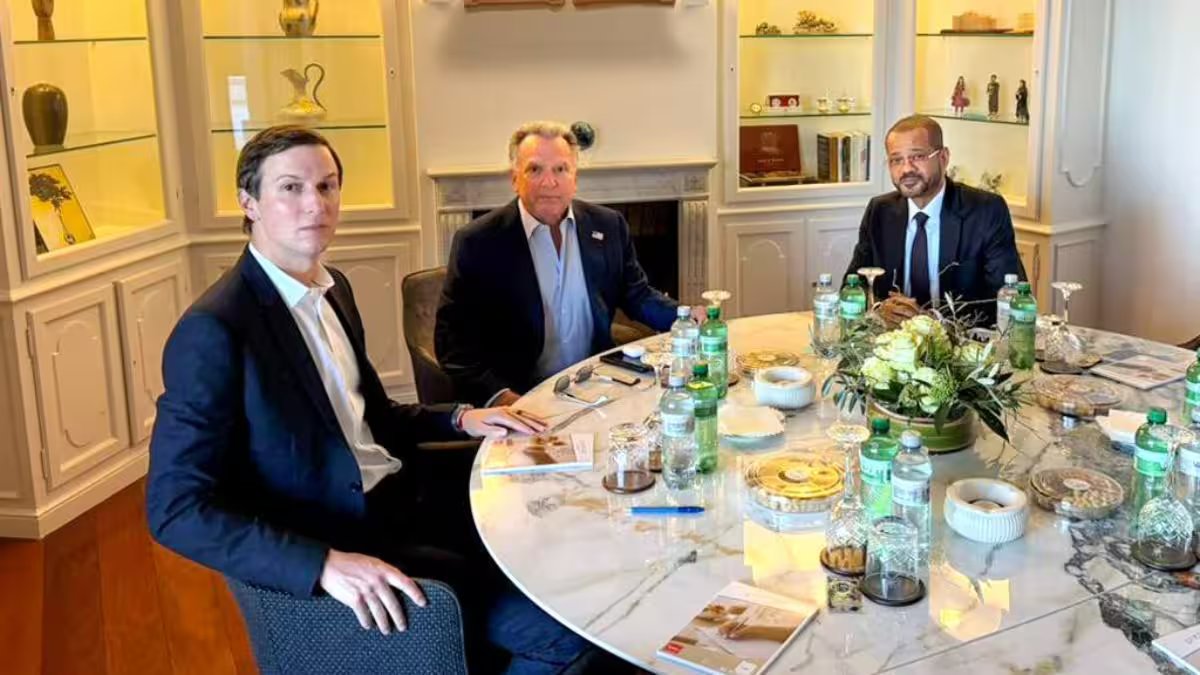
The US delegation will be led by US Special Envoy Steve Witkoff and Jared Kushner, Trump’s son-in-law, and Iran’s delegation will be led by Foreign Minister Abbas Araghchi. Al-Busaidi will mediate talks between them in the ‘Oman format’.
Al-Busaidi will hold separate back-and-forth talks with both the delegations to convey their positions to each other and try to bridge the gaps. The Foreign Ministry of Oman shared photos of al-Busaidi’s meetings separately with US and Iranian officials.
“The meeting addressed a review of the Iranian side’s perspectives and proposals along with the responses and inquiries from the American negotiating team regarding the handling of the key elements of Iran’s nuclear program and the necessary guarantees to achieve the desired agreement for this important dossier from all its technical and oversight aspects,” the foreign ministry said in a statement about the meeting with Kushner and Witkoff.
Al-Busaidi clarified that the efforts are continuing intensively and in a constructive spirit, under the negotiators’ unprecedented openness to new and creative ideas and solutions, while preparing the supportive conditions for progress and reaching a fair agreement with sustainable guarantees, the statement further read.
📸 | عقد معالي السيد بدر بن حمد بن حمود البوسعيدي @badralbusaidi وزير الخارجية مساء أمس الأربعاء لقاءً ثنائياً في مدينة جنيف بسويسرا مع معالي الدكتور سيد عباس عراقجي وزير خارجية الجمهورية الإسلامية الإيرانية، وذلك في إطار المحادثات الإيرانية الأمريكية الجارية وغير المباشرة… pic.twitter.com/Vbqok9x2ct
— وزارة الخارجية (@FMofOman) February 26, 2026
Following the meeting with Aragchi earlier in the day, the Omani foreign ministry said he and al-Busaidi discussed the latest developments and reviewed the visions and proposals that the Iranian side will present in order to reach an agreement on the Iranian nuclear programme based on the guiding principles agreed upon in the previous round of negotiations.
The war of words continue
Even as American and Iranian officials are holding talks, the war of words has continued.
Trump has warned Iran that he would go for an offensive if talks fail and Iran has warned it would not hold back.
“My preference is to solve this problem through diplomacy. But one thing is certain. I will never allow the world’s number one sponsor of terror, which they are by far, to have a nuclear weapon. Can’t let that happen. We are in negotiations with them. They want to make a deal, but we haven’t heard those secret words: ‘We will never have a nuclear weapon,’” Trump said on Tuesday.
In an interview with India Today ahead of talks, Aragchi warned that there would be no winners in any conflict and “it would be a devastating war” for everyone.
“Since the Americans’ bases are scattered through different places in the region, then unfortunately perhaps the whole region would be engaged and be involved, so it is a very terrible scenario,” said Aragchi.
Analysts have noted lately that Trump has deployed up to 40-50 per cent of American air power in West Asia for a potential offensive against Iran — the largest since the Gulf War of 1991 and the invasion of Iraq in 2003. The airpower has joined tens of thousands of ground troops in several bases in the region.
End of Article