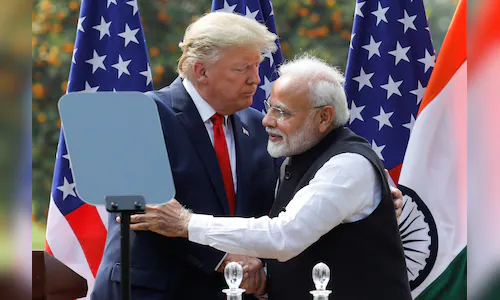
What India will get in return is a reciprocal tariff rate of 18% on goods originating in India including textile & apparel, leather & footwear, plastic & rubber, organic chemical, home décor, artisanal products and certain machinery. Similarly, tariffs are to be ‘removed’ on certain aircraft and aircraft parts of India, imports of aluminum, steel, automotive parts —what the consequent tariff will be is unclear.
There is a commitment to remove reciprocal tariff on a ‘wide range of goods’ on the successful completion of the Interim Agreement and again conditionally, on generic pharmaceuticals and ingredients also. There is also a commitment to take into consideration ‘India’s request that the US continue to lower tariff on Indian goods.’
What both countries have jointly committed to do is provide each other preferential market access in sectors of ‘respective interests’, establish rules of origin, address non-tariff barriers, discuss their respective standards and conformity procedures, strengthen economic security alignment to enhance supply chain resilience.
This was followed by an executive order from the US President that he had ‘received‘ an information/recommendation from senior officials that India has committed to stop directly or indirectly import Russian Federation oil and hence additional duty of 25% will no longer be imposed on products of India imported into US from 12.01 AM on February 7, 2026. However, the order has a dire warning too — the officials have been tasked to monitor whether India has resumed to import directly or otherwise oil which would result in additional action being commenced including imposition of the ad valorem rate of 25% on imports from India.
On first glance this would appear to be an unequal arrangement, lacking symmetry. India reducing to nil or eliminate tariffs on a whole range industrial goods, electronic components, smart phones, while US would impose an 18% tariff. Yes, this is lesser than the 50% imposed prior to February 07 but much higher than what was the tariff as it existed pre-Liberation Day and not in any way reciprocal. Further US goods will get unprecedented market access. India has also committed in very many other areas. The $500 billion commitment to purchase US goods undoubtedly spread over five years will still be challenging. All this is conditional —that the US will determine from whom India will purchase, what. India has responded to say that national interest will determine our decisions.
The dairy sector, staple crops and core food items and fruits and processed food industry are protected- this obviously forms India’s absolute red lines and on this we have not budged. However, India’s farm unions have called for a nation-wide protest against the US-India framework. The Government will need to assure them that their interests have indeed been protected. India’s manufacturing sector, be it machinery, chemicals, electrical, vehicles and components will have to brace up for severe competition. All the industry associations have welcomed the framework — but they would need to sensitise their constituents as to what lies ahead. The FTAs with UK, EU, EFTA, and now the framework with US will usher in an environment which will be very different from the domestic environment as it existed under the earlier FTAs.
US is India’s biggest export market. The 18% tariff which Indian exports will face is much better than the other BRIC nations, better than all other countries in South and Southeast Asia. In fact, only the EU, UK, Japan, and Switzerland have lesser rates than India. Indian exports in these key sectors will have a competitive edge. There is a lot to cheer about.
The prime minister has hailed the framework as ‘a reflection of the ‘growing depth, trust and dynamism of our partnership.’ The commerce minister has tweeted that the interim agreement ‘will open a $30 trillion market for Indian exporters, especially MSME, farmers and fishermen’. The labour-intensive sectors like textiles & apparels, leather & footwear, artisanal products will be major beneficiaries of this framework. They would have to take the lead and demonstrate the benefits which can accrue to the nation. Some have hailed the framework as India’s 1991 moment when external pressures have forced domestic reforms. Time will tell whether it is indeed so.
The framework appears very ambiguous to put it mildly. For instance, it is not clear which are the ‘additional products’ which is mentioned along with the ‘wide range of food and agricultural products.’ It is not clear if the tariff reductions on automobiles have quota limits. The pink papers already carry full page advertisements of Harley Davidson motorcycles now being available in India at cheaper prices. It is not clear what aligning the security and economic policies with the US means. These are early days — and greater clarity on the contours of the framework will emerge once it gets operationalised fully. And in the meantime, let us hope that the mercurial US trade policy does not change.
—The author, Najib Shah is former chairman, Central Board of Indirect taxes & Customs (CBIC). The views are personal.