“Speech has power. Words do not fade. What starts out as a sound, ends in a deed.”
This famous adage highlights the importance that word wordplay in our daily life. In fact, we are often told that words have the power to leave a huge impact and create a lasting memory — either good or bad.
Realising this, we, at Firstpost Explainers, have begun a new series titled ‘Word of the Week’. Every Sunday, as you sit back and unwind, we shall come up with a word choice that has dominated the week’s headlines, and explain everything you want to know about it.
For this week, we choose the Iranian rial — Iran’s currency — which is in doldrums as our Word of the Week. Here’s why.
Origins of rial
Before we deep dive into why we picked the Iranian rial as our word of the week, here’s a bit of background.
The history of the Iranian rial dates back to 1798 when it was first introduced as a silver coin during the reign of the Qajar dynasty. At the time, the rial was part of a system that included other coins like the toman, which was worth 10 rials.
It was in 1932 that the rial became Iran’s main currency, and today, it is an essential aspect of the lives of over 85 million citizens.
Notably, the rial is also the currency unit of Oman and Yemen. The Omani rial, issued by the Central Bank of Oman, was adopted as the country’s monetary unit in 1972. Meanwhile, the Yemeni rial became the official currency of the Yemen Arab Republic (North Yemen) when it gained its independence in the 1960s, and has served as the currency of united Yemen since 1990.
Protests over a diminishing rial
Last Sunday (December 28),
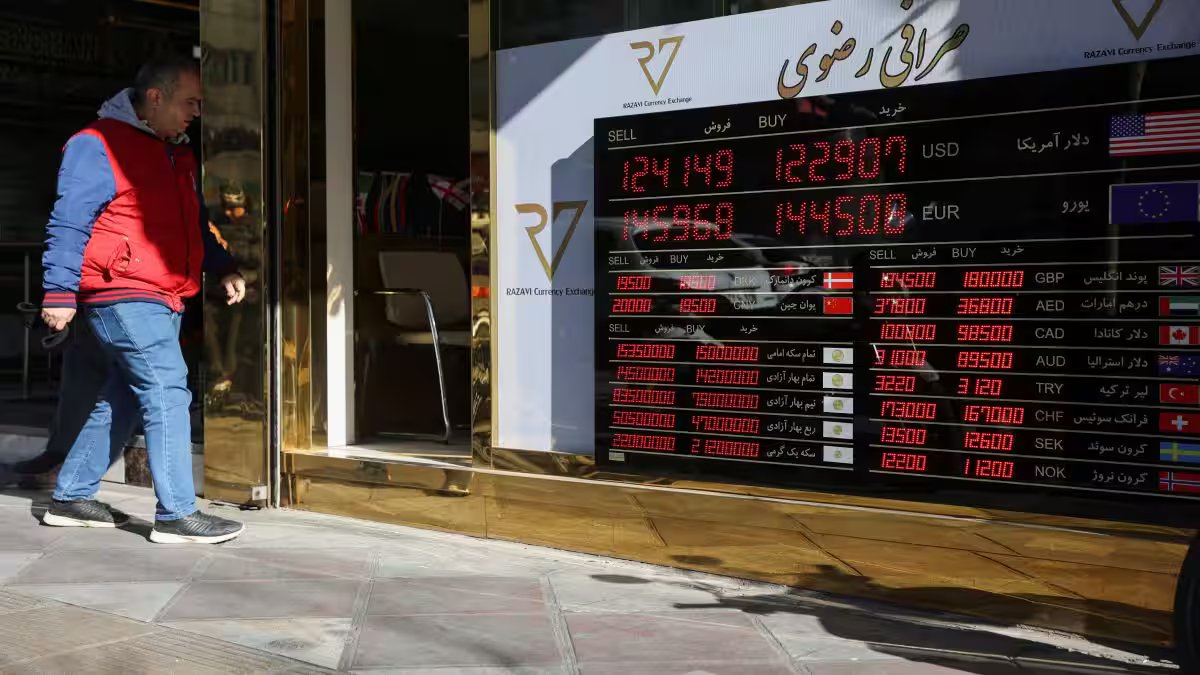
protests erupted in Iran when shopkeepers took to the streets to protest the government’s handling of a sharp fall in the Iranian rial and rapidly rising prices.
Iran’s rial has fallen to its lowest level in history; the US dollar is trading at nearly 1.45 million rials, down roughly 20 per cent in December alone. This has led to a rise in inflation — it has surged past 42 per cent nationwide, with Food prices increasing 72 per cent and health and medical items are up 50 per cent from December last year.
Speaking to The New York Times, Mariam, a 41-year-old bank employee in Tehran whose salary now only covers two-thirds of her monthly expenses, said she hardly dined out and tried not to buy meat or invite guests over for meals. “Things have gotten so expensive that over the past few days, when I had guests, I was constantly crunching numbers to ensure I wouldn’t run out of money before the end of the month,” she said.
Saghar, a 55-year-old housewife, told the Financial Times, “You go to the grocery store and see people checking prices and not buying products as basic as milk or yoghurt, let alone meat.”
As the week progressed, so did the anger over the economic crisis. In fact, by Thursday (January 1), the protests spread from Tehran’s Grand Bazaar to major cities including Isfahan, Shiraz, Mashhad, Hamadan and Qeshm.
Moreover, demonstrators no longer simply voiced their grievances about the economic hardships they were facing. Now, they are demanding
regime change, with some demonstrators even chanting slogans such as “Death to the dictator”.
The most intense violence appeared to strike Azna, a city in Iran’s Lorestan province, some 300 kilometres (185 miles) southwest of the capital, Tehran. There, online videos purported to show objects in the street ablaze and gunfire echoing as people shouted: “Shameless! Shameless!”
In Lordegan, a city in Iran’s Chaharmahal and Bakhtiari province, online videos showed demonstrators gathering on a street, with the sound of gunfire in the background. In fact, authorities note that a total of seven people have died in the rial protests until Thursday.
Notably, the protests in Iran have also reverberated in the United States with US President Donald Trump and Iranian officials exchanging duelling threats on Friday (January 2). It began when the American leader wrote on his Truth Social platform, warning Iran that if it “violently kills peaceful protesters,” the United States “will come to their rescue.”
“We are locked and loaded and ready to go,” Trump wrote, without elaborating.
Shortly after, Ali Larijani, a former parliament speaker who serves as the secretary of Iran’s Supreme National Security Council, alleged on X that Israel and the US were stoking the demonstrations. “Trump should know that intervention by the US in the domestic problem corresponds to chaos in the entire region and the destruction of the US interests,” Larijani wrote on X. “The people of the US should know that Trump began the adventurism. They should take care of their own soldiers.”
Ali Shamkhani, an adviser to Supreme Leader Ayatollah Ali Khamenei who previously was the council’s secretary for years, further warned that “any interventionist hand that gets too close to the security of Iran will be cut.”
“The people of Iran properly know the experience of ‘being rescued’ by Americans: from Iraq and Afghanistan to Gaza,” he added on X.
What happens next is unknown. But for now, the rial protests continue to roil Iran.
End of Article