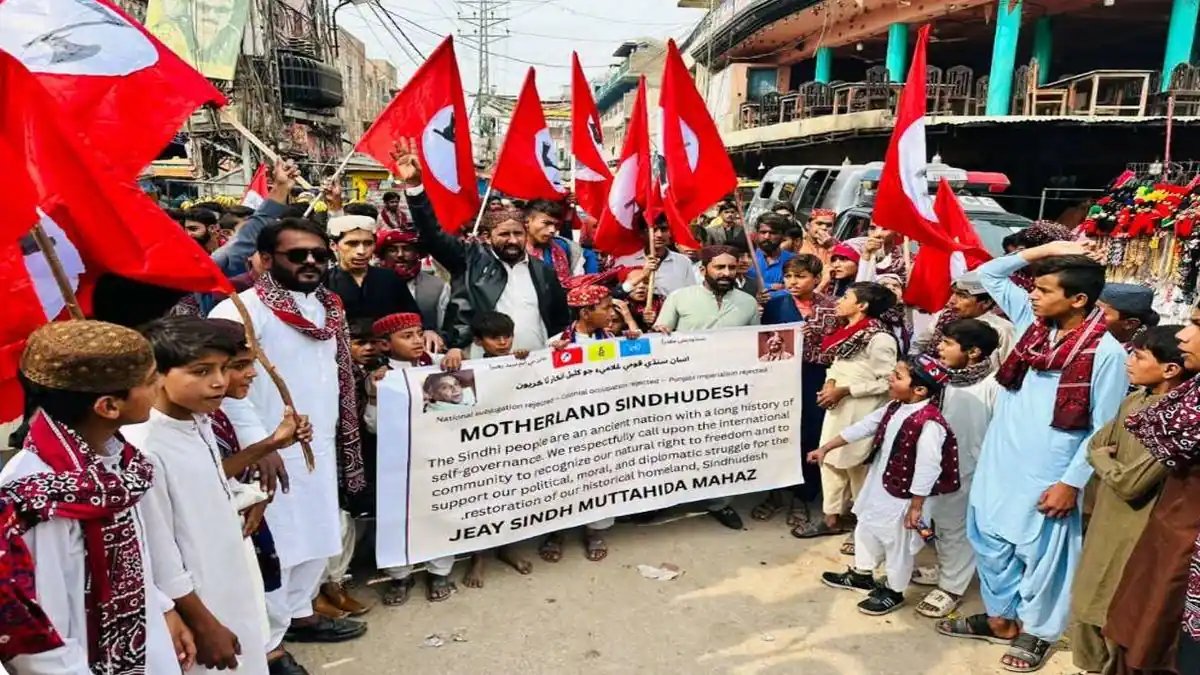
There’s a growing anger in Pakistan. And some of this anger erupted in violent protests in Karachi as supporters of a separate “Sindhudesh” clashed with the police.
The violence erupted on Sunday (December 7) when Sindhudesh supporters came out on the streets of the Pakistani city, chanting slogans of ‘Azadi’ (freedom) and ‘Pakistan Murdabad. However, Karachi police diverted the rally, prompting anger from the supporters, which ended up with violence.
But what exactly happened? And more importantly, what is this demand for Sindhudesh, which is at the centre of these protests?
Sindhudesh rally turns violent; 45 arrested
On the occasion of Sindh Culture Day (December 7), hundreds of people had come out on the streets for a rally, demanding for a separate Sindhudesh.
According to South Deputy Inspector General of Police Syed Asad Raza, the problem began when authorities asked the rally participants to use the Lines Area route towards Saddar and subsequently the venue of the rally at Karachi Press Club (KPC), but “they were bent upon using the main Sharea Faisal from Jinnah Bridge”.
Soon after, the
situation deteriorated with the police claiming that the protesters began pelting stones at the security personnel and engaged in vandalism. This, in turn, prompted law enforcement authorities to tear gas them.
Yesterday,Sindhi People protested in Karachi, demanding a new country Sindhudesh. pic.twitter.com/3lDuLpDuBk
— War & Gore (@Goreunit) December 8, 2025
Following the clashes, 45 demonstrators were arrested, said the South DIG, adding that 12 of the 45 arrested were released on the surety of the Karachi Bar Association president.
Reacting to the incident, Sindh Home Minister Ziaul Hassan Lanjar ordered immediate action against those involved, with his office saying that he had ordered “those damaging police vehicles and citizens’ property should be arrested immediately”.
For the past few years, Sindh Culture Day rallies in Pakistan have devolved into violence, noted the senior police official. According to Raza, in 2023, during Sindh Cultural Day celebrations, there were violent confrontations between law enforcers and protesters. And similar scenes took place in 2024 — a police van was damaged, and police personnel were manhandled.
A call for Sindhudesh
But what exactly is Sindhudesh that led to this flare-up?
Plainly put, it’s a demand for a separate country — Sindhudesh — for the Sindhi population in Pakistan. Many Sindhis, who live in Pakistan and collected under the banner of Jeay Sindh Muttahida Mahaz (JSMM), have been demanding for a different country for themselves, claiming they are sidelined and marginalised in Pakistan. Some even state that they have been political repressed and their human rights are violated time and again.
Earlier in May, the president of JSMM issued a plea to the United Nations and other international communities, urging recognition of Sindhudesh as an independent nation. In a political manifesto, titled The Sindhudesh Global Freedom Charter, the JSMM argued that the Sindhi people are subject to a form of internal colonialism under Pakistan’s military and political establishment.
In April too, the JSMM appealed to Prime Minister Modi for moral, political, and practical backing, stressing the historical and cultural connections between Sindh and India. The chairman of the JSMM, Shafi Burfat, also declared that “Sindh is not Pakistan”, alleging that the region was annexed without the consent of its people and has faced systemic cultural and political suppression by what he described as a “Punjabi military establishment.”
The demand for Sindhudesh isn’t new. Many Sindh nationalists argue that their land was illegitimately occupied by the British Empire and then delivered to the Islamic nation of Pakistan in 1947 against the wishes of its population.
According to the memoirs of the 19th-century British traveller Richard Burton, Sindh province was one of the calmest regions of British India, with its own unique blends of faith. He described the province as a land characterised by many shrines of Sufi saints; which were attended in large numbers by both Muslim as well as Hindu natives of the region.
Sindh lived in inherent peace and when Partition arrived, it was decided that
Sindh would go to Pakistan. It was after the creation of Pakistan that the Sindhi people experienced an onslaught on their way of life — their culture, language, and pluralistic values, were all threatened by the Pakistan establishment.
Moreover, many Sindhis argue that there’s widespread discrimination in the allocation of resources. Zafar Sahito, founder of the JSMM, told Eurasian Times, “Sindh generates 63 per cent of the revenue, while all the power rests in a province of Punjab, which has a 65 per cent population in the army. Also, the language imposition of Urdu has happened, although we only speak Sindhi, which has resulted in our own languages fading out of our society.”
Sahito has also claimed that the girls of Sindh are in danger with many of them being abducted, raped and converted to Islam. Moreover, the demography of the region is being changed by forcing original inhabitants to flee their motherland.
Sindh in the news again
While the struggle for a separate Sindhudesh has been ongoing in Pakistan since the 1970s, it has gained attention internationally too recently, thanks to Defence Minister Rajnath Singh’s recent comments.
Speaking at the Sindhi Samaj Sammelan event in New Delhi in November, Rajnath said many Sindhi Hindus of his generation “never fully accepted” the 1947 decision that led to Sindh becoming part of Pakistan. Singh said that Sindhi Hindus, especially from the generation of leaders like LK Advani, have never accepted the separation of the Sindh region from India.
“Today, Sindh may not be a part of India, but civilisationally, Sindh will always be a part of India. As far as land is concerned, borders can change. Who knows, tomorrow Sindh may return to India again,” Rajnath said then.
Soon after, the JSMM welcomed Rajnath Singh’s statement, saying it reflected rare wisdom, political maturity, and moral clarity, reaffirming a truth rooted in more than 5,000 years of shared cultural and spiritual heritage.
Press Statement
Jeay Sindh Muttahida Mahaz (JSMM) In Response to the Statement of Indian Defence Minister Shri Rajnath Singh
The Jeay Sindh Muttahida Mahaz (JSMM) warmly welcomes the recent remarks by the Defence Minister of India, Shri Rajnath Singh, who reaffirmed the deep…
— Shafi Burfat (@shafiburfat) November 30, 2025
Will Sindhudesh become a reality? It remains unknown but it seems that the Sindh nationalists won’t take no for an answer.
With inputs from agencies
End of Article