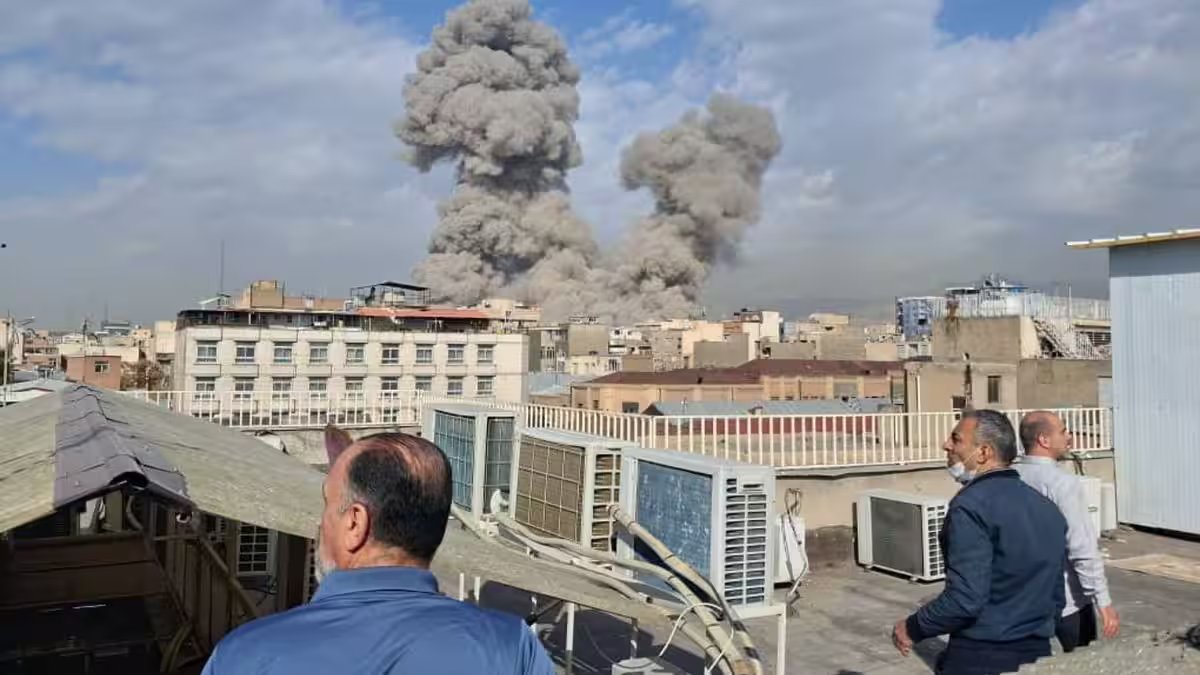
For China, the US‑Israeli war on Iran has underscored the limits of its power and influence in West Asia. The latest instance of China’s refusal to come to a partner’s aid shows that its support remains largely economic and rhetorical — and that partners cannot rely on it militarily.
For China, the US‑Israeli war on Iran has underscored the limits of its power and influence in West Asia. The latest instance of China’s refusal to come to a partner’s aid shows that its support remains largely economic and rhetorical — and that partners cannot rely on it militarily.
China has spoken in support of Iran, but those statements have not been as sharp as one might expect considering the extent to which the United States and Israel have gone against Iran.
For one,
unlike Venezuela where they just whisked away President Nicolas Maduro, they have killed the Supreme Leader Ayatollah Ali Khamenei of Iran and vowed to kill anyone who replace him. And they have indicated theirs is a war without a deadline, not a limited special operation.
China’s muted reaction as US & Israel hammered main ally in West Asia
In the first day, it became clear that
US President Donald Trump and Israeli Prime Minister Benjamin Netanyahu were seeking a regime change in Iran, but China was just “highly concerned” and called for “immediate cessation of military operations”.
As Iran had emerged central to China’s goals in West Asia in recent years, the reaction was quite subdued and showed China did not have any appetite to go against the United States in a theatre beyond the bare minimum rhetoric.
Follow our live coverage of the US-Israeli war on Iran
here
Even as it became clear that Khamenei was dead and the American-Israeli war would continue for the foreseeable future, China’s rhetoric did not jump to the ‘wolf warrior’ level it is infamous for. Instead, it echoed statements that developing nations of Global South issue.
Chinese Foreign Ministry Spokesperson Mao Ning declared the offensive as “a grave violation of Iran’s sovereignty and security” that “tramples on the purposes and principles of the UN Charter”. There was no warning to cease their offensive. The only call to action was to “urge an immediate stop to military operations”.
Then, in a call with Israeli Foreign Minister Gideon Sa’ar, Chinese Foreign Minister Wang Yi conveyed the same in even more diplomatic language.
“Force cannot solve problems; it generates new challenges and long-term repercussions,” said Wang.
The US-Israeli war show China’s limitations & nature of partnerships
China’s response to Trump and Netanyahu’s war on Iran has shown two things.
One, China cannot yet overcome or even challenge American military power. For all the talk of China displacing the United States as the sole superpower, the United States continues to be central to West Asia and has no match militarily.
Two, countries now know that China’s partnership has economic and trade benefits but no assurance of security. China failed to safeguard Maduro and later refused to do anything —or could not do anything— as Trump and Netanyahu hunted Khamenei.
In an article for NDTV, international relations scholar Harsh V Pant noted that China’s silence on Iran “is a reminder of the structural limits of Beijing’s ambitions in a region still profoundly shaped by American hard power”.
“More importantly, China’s inability —or unwillingness— to deter decisive Western military action underlines a credibility gap. For all its talk of a Global Security Initiative and a multipolar order, Beijing remains reluctant to project force in defence of its partners when confronted by US resolve,” noted Pant, Vice President, Observer Research Foundation (ORF).
The US-Israeli offensive is a setback to China in many ways. In the near-term, it has lost access to highly discounted crude oil and a connectivity partner.
At a moment of domestic economic sensitivity, such volatility would be hardly welcome, Pant noted.
Moreover, China had been
increasing its foothold in the region in recent years. In 2023, China mediated between the normalisation of ties between Iran and Saudi Arabia. That normalisation is now dead and efforts to increase the footprints are also stalled at least for now.
But Pant has suggested that China could also be playing the long game with its cautious silence.
For one, a weakened or economically desperate Iran may become more reliant on Chinese capital for reconstruction, according to Pant.
As for the wider region, Gulf powers may deepen their economic engagement with China as part of their hedging strategies as an insurance against American unpredictability under Trump, noted Pant.
In such a case, China will try to convert short-term turbulence into long-term leverage through reconstruction contracts, oil diplomacy, and calibrated mediation, according to Pant.
End of Article