While Reliance Industries, Adani Group and Tata Group have collectively pledged $28 billion in investments over the next few years, US Big Tech firms—Google, Microsoft and Amazon—have committed slightly less, at under $25 billion.
The difference might not seem much, but the nuance here is that while the American firms are digital natives, India’s investments are led by traditional conglomerates diversifying into the factories of the artificial intelligence (AI) age.
To be sure, another $6.5 billion is in the pipeline from other Indian players such as Hiranandani Group-owned Yotta Data Services, Bharti Airtel’s Nxtra, and Hyderabad-based CtrlS—taking the India tally well beyond Big Tech’s planned spend.
Breaking up the numbers, Reliance Industries Ltd (RIL) is expected to spend up to $15 billion for every 1GW of data centre capacity.
While the company did not announce any specific investment, its chairman and managing director Mukesh Ambani had said at the company’s 48th annual general meeting on 29 August that RIL will build gigawatt-scale, AI-ready data centres powered by green energy, and that work had begun on its first data centre in its Jamnagar, Gujarat hub.
RIL’s spending was estimated by analysts at Morgan Stanley after the company announced on Thursday that its youngest artificial intelligence-focused subsidiary—Reliance Intelligence—will allow Jio users to use Google Gemini AI Pro free for 18 months.
“We estimate RIL will invest US $12-15 bn to build 1GW AI datacenter, underwriting about 25% for internal use and leasing the rest as “Datacenter-as-a-Service” to hyperscalers and LLM providers (RIL Intelligence),” Morgan Stanley analysts Mayank Maheshwari, Pranitha Shetty and Hinal Choudhary wrote in a note dated 31 October.
Then, on 9 October, Tata Consultancy Services (TCS) announced an investment of $6.5-7 billion to establish a 1 GW data centre capacity over seven years. Prior to this, in August, Adani Enterprises Ltd, the flagship firm of the Ahmedabad-based Adani Group, outlined plans to spend $6.5 billion over 10 years to achieve 1 GW of data centre capacity, which will be completely powered by renewable energy.
For the US firms, Google’s parent, Alphabet, announced last month that it would invest $15 billion for its 1GW data centre facility in Andhra Pradesh. On 7 January, Microsoft announced a $3 billion investment, followed by Amazon’s $6.8 billion, bringing the total to $ 24.8 billion.
Emails sent to RIL and Adani Group seeking comment remained unanswered till press time.
“India’s data centre landscape is entering a phase where domestic conglomerates will lead the charge, not because of sentiment, but because of structure,” said Sanchir Vir Gogia, chief executive of tech consultancy firm, Greyhound Research. “These enterprises possess the one capability global providers cannot replicate at scale in India: integrated control over power, land, and capital.”
Gogia said Reliance, Adani, and TCS are approaching data infrastructure not as a technology play but as a national utilities business that underpins India’s digital sovereignty. “Their gigawatt-class plans show an understanding that in the AI era, compute is constrained less by chip availability and more by electricity, cooling, and interconnects,” he added.
The new-age factory
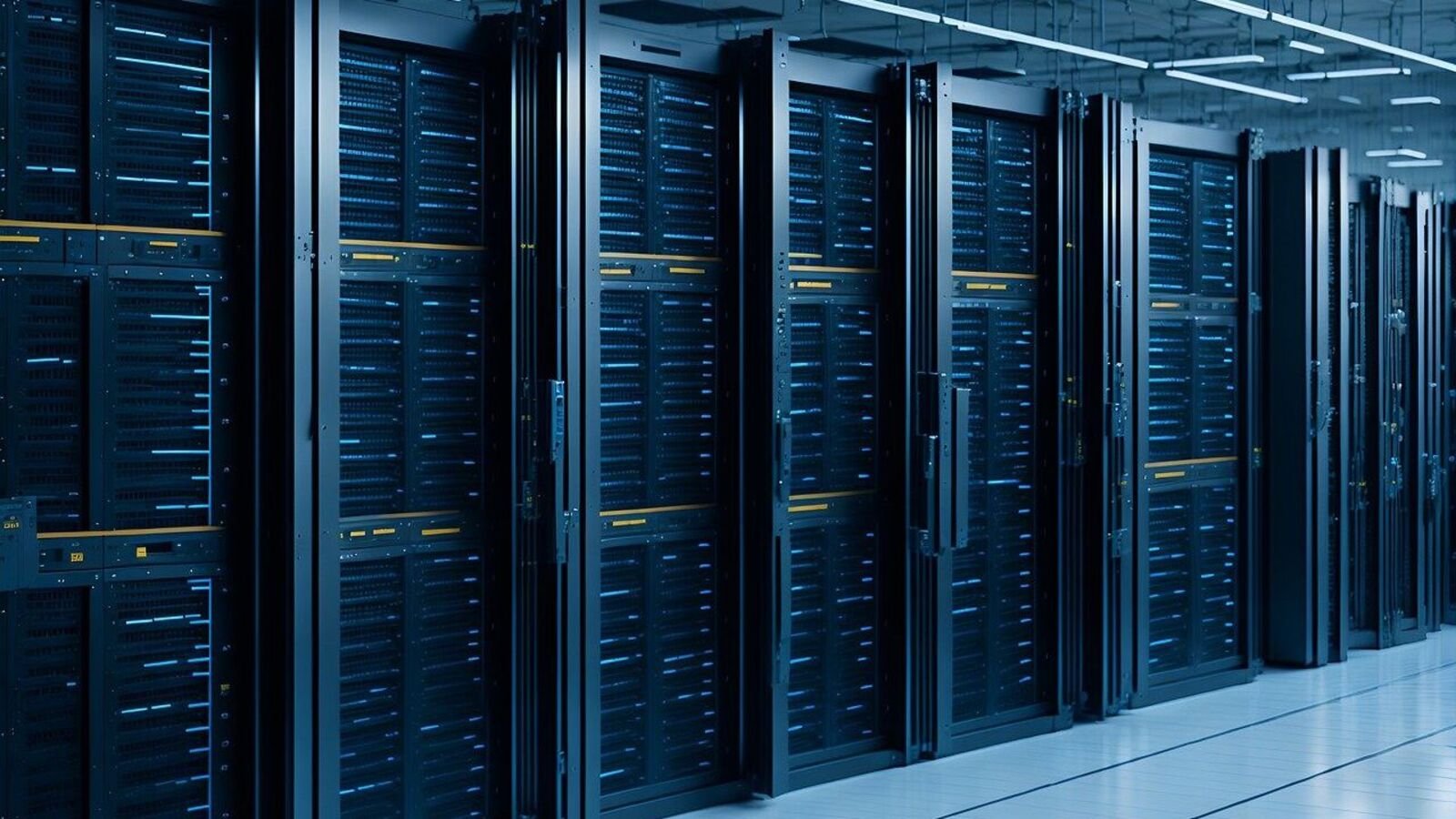
Data centres are the factories of the AI age—vast, secure facilities that house the servers, networking equipment and cooling systems needed to process and store petabytes of data generated every day. As 5G networks roll out and connected devices multiply, the volume of data produced by consumers, vehicles, and industrial systems is surging. Add the rise of generative AI, and the need for high-speed computing infrastructure becomes existential.
Meanwhile, India’s regulatory mandates and digital explosion have created a perfect storm of demand. Banking regulator Reserve Bank of India (RBI) now requires payment data to be stored domestically. Markets regulator Securities and Exchange Board of India (Sebi) has similar stipulations for market participants.
The cost of setting up a data centre in India is 30% lesser than the US, and almost half that of Japan, according to a note by public policy body Takshashila Institution earlier this month.
According to brokerage firm JM Financial’s 27 March report, India’s data centre capacity is set to rise to almost four times in the next five years.
“India’s colocation data centre capacity as of 2024 stood at 1.35GW, up 38% YoY. Despite this, India’s data centre density is 14 petabyte/megawatt (MW), one of the lowest in the world. We estimate that India needs a total capacity of 5GW by 2030, just to reach 50% of China’s data centre density,” JM Financial analysts Abhishek Kumar and Nandan Arekal wrote in the note.
“This aligns with the current announced under-construction and planned capacity of 3.3GW by 2028. At an average capex per MW of ₹46.5 crore, this will translate into an incremental capital outlay of $20 billion over the next five years. Investments in cloud infrastructure (servers, etc.) could be an additional $60 billion,” they added.
An investor presentation by Kotak Securities, published last month, stated that India’s public cloud services are expected to scale up to $22 billion by 2030, representing a 20% compounded annual growth rate (CAGR). The country’s AI market, meanwhile, is projected to also grow to $22 billion, but by 2027, expanding at a 35% CAGR.
