Tarique Rahman, who spent 17 years in self-exile in London, has made a striking political comeback, leading the Bangladesh Nationalist Party (BNP) to a decisive victory after two decades.
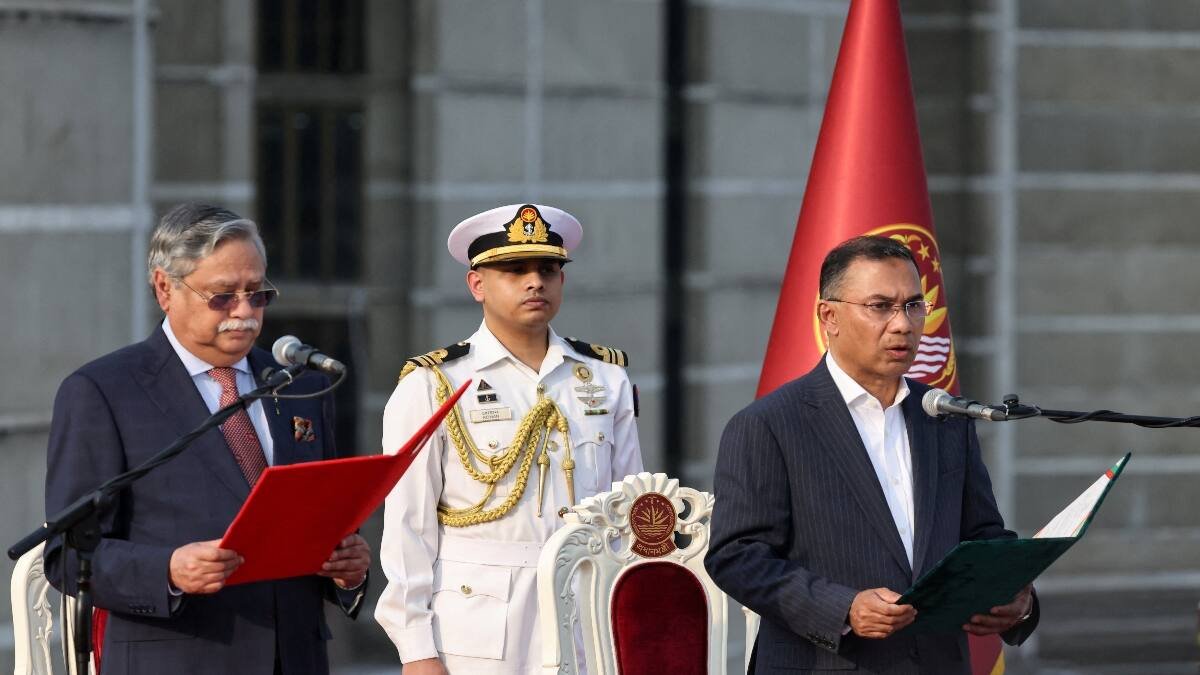
The 60-year-old BNP chairman was sworn in as Bangladesh’s Prime Minister for the first time on Tuesday after his party won 209 out of 297 seats in the 13th Parliamentary polls held on February 12.
Right-wing Jamaat-e-Islami, long seen as aligned with Pakistan, secured 68 seats. Meanwhile, the Awami League of ousted premier Sheikh Hasina was barred from contesting the election.
The outcome marks a major turnaround for the BNP, which had faced two decades of political marginalisation under Hasina’s 15-year rule, ending with her government’s collapse following nationwide student-led protests in August 2024.
Founded by Rahman’s father, former military ruler turned politician Ziaur Rahman, the BNP was led by his mother, Khaleda Zia, for nearly four decades after Ziaur Rahman’s assassination in 1981.
Rahman returned to Bangladesh in December last year to a massive public welcome. However, his homecoming was soon overshadowed by personal tragedy, as Khaleda Zia passed away after a prolonged illness just five days later.
Rahman takes BNP helm amid personal loss
Assuming the chairmanship of the BNP amid this personal loss, Rahman faced a party navigating a politically uncertain landscape ahead of the elections. Despite these challenges, he is widely credited with steering the BNP to secure a dominant position in Bangladesh’s political arena.
Though often seen as a product of dynastic politics, Rahman’s family background has endowed him with significant political acumen, enabling him to manoeuvre his party successfully through a complex and rapidly evolving scenario.
A soft-spoken Tarique Rahman drew massive crowds as he spearheaded the Bangladesh Nationalist Party’s campaign, ultimately leading the party to a landslide win and becoming the country’s new prime minister.
Since his return to Bangladesh, Rahman has adopted a markedly restrained approach, avoiding inflammatory rhetoric and instead calling for reconciliation, despite his and his family’s long-standing strained relations with the deposed Awami League government.
Born on November 20, 1965, in Dhaka, Rahman witnessed Bangladesh’s liberation struggle in 1971 as a young boy. He, along with his mother and brother, was arrested during the conflict but released on December 16, 1971, following the country’s independence from Pakistan.
Rahman pursued studies in international relations at the University of Dhaka but later dropped out to start businesses in textiles and agro-products. He was elected Senior Vice-Chairman of the BNP in 2009 and gradually took on a leading role in reorganising the party.
Rahman married cardiologist Dr Zubaida Rahman, the daughter of a former navy chief, in 1994. They have a daughter named Zaima Zarnaz Rahman.
During the Awami League’s rule, Rahman became a central target of several corruption and criminal cases, and he was convicted in absentia in some. He was sentenced to life in connection with a 2004 grenade attack on a rally led by Sheikh Hasina that killed 24 people and injured dozens. Rahman has consistently denied all allegations, describing them as politically motivated, and was acquitted in all cases during Muhammad Yunus’ interim government following Hasina’s ouster.
In 2018, when Khaleda Zia was jailed on graft charges, Rahman was appointed Acting Chairman of the BNP. Following her death, he officially became the party’s chairman, guiding the BNP to its historic electoral comeback.
According to a PTI report, citing analysts, the election results marked a remarkable reversal of fortune for Rahman, who left the country in 2008, saying he needed medical treatment after his release from detention under a military-backed caretaker administration.
Yet, they said uneasy doubts and speculations accompanied the enthusiasm.
Rahman unveils vision for Bangladesh’s future
“I have a plan for the people of my country and for my country,” Rahman said hours after his return to Bangladesh in December, echoing US civil rights activist Martin Luther King’s iconic remark, “I have a dream.”
He has since gradually unfolded his vision, pledging to recalibrate Bangladesh’s international partnerships to attract investment without binding the country too closely to any single power.
Key elements of Rahman’s plan include expanding financial aid for poor families through “family cards,” reducing reliance on garment exports by promoting industries such as toys and leather goods, and introducing a two-term, 10-year limit for prime ministers to curb autocratic tendencies.
Acknowledging the challenges ahead in a nation of 170 million people, Rahman noted that his government faces two major tasks: reviving the economy and ensuring good governance.
Analysts have highlighted internal discipline within the BNP as a significant hurdle. Over the past 18 months, some party activists earned a reputation for extortion and targeting political rivals, prompting the BNP to expel roughly 10,000 members. They were also accused of lodging false criminal cases against opponents.
In earlier decades, critics described Rahman as a brash operator during the BNP’s 2001–2006 rule under his mother, Khaleda Zia, with accusations that he ran a parallel power centre—charges he denies.
Observers now note that his 17-year exile in a country with advanced democratic governance appears to have reshaped him, presenting a markedly changed figure as he reenters Bangladesh’s political arena.
“This is not that Tarique we heard of or seen before,” PTI quoted a minority Hindu community leader, preferring anonymity as he talked to him for over an hour two weeks ago, when he cracked sophisticated jokes and explained his vision for the country, as saying.
In a post-election press conference, Rahman called for “national unity” and “peace” in the national interest, warning that divisiveness would undermine democracy. He said the country faces a fragile economy, weakened institutions, and a deteriorating law and order situation.
When a journalist asked how he would reconcile with the millions of Awami League supporters, Rahman answered, “rule of law”.
With input from agencies
End of Article