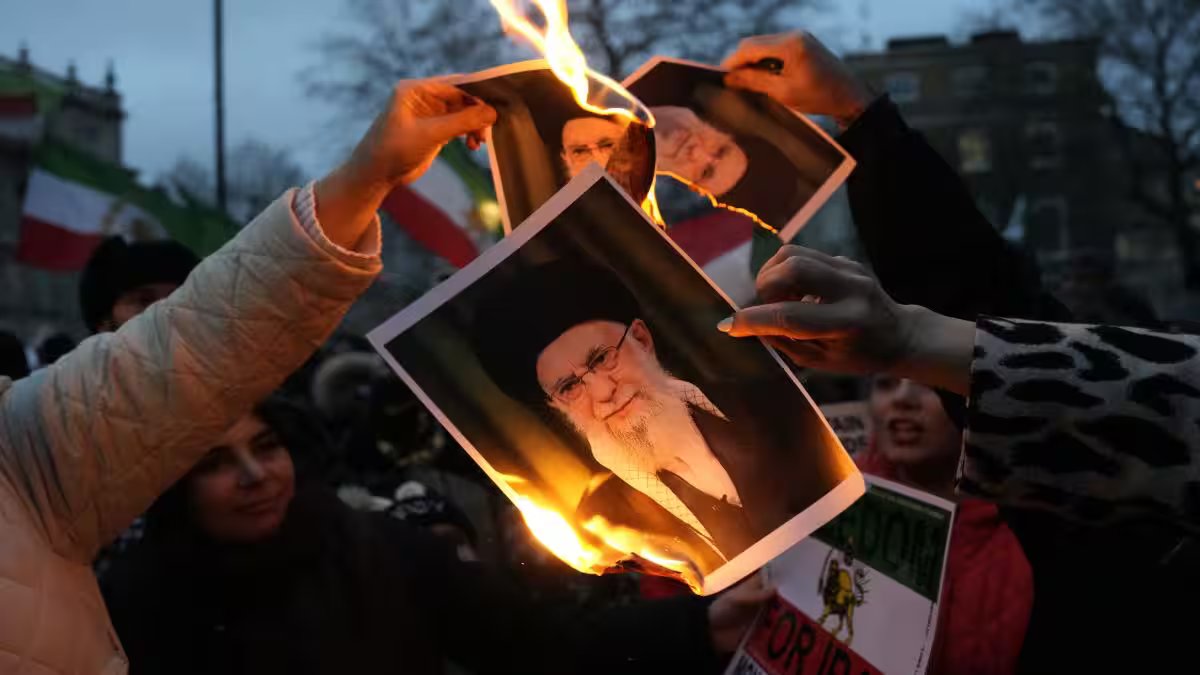
Two thousand five hundred and seventy one and counting. That’s the death toll from the nationwide protests in Iran that continue unabated despite the regime trying to use force and intimidation to quell the anger. This figure dwarfs the death toll from any other round of protest or unrest in Iran in decades and recalls the chaos surrounding the country’s 1979 Islamic Revolution.
The
demonstrations, which began late last December, over Iran’s ailing economy, soon devolved into anger over the regime led by 86-year-old Supreme Leader
Ayatollah Ali Khamenei.
As Iran unleashes its violence against the demonstrators, US President
Donald Trump wrote on his social media platform, “Iranian patriots, keep protesting — take over your institutions.” He further added, “I have cancelled all meetings with Iranian officials until the senseless killing of protesters stop. Help is on its way.”
As the demonstrations continue, we take a closer look at just some of the lives that have been lost so far.
Robina Aminian, a fashion student
Twenty-three-year-old
Aminian was a budding designer, studying at the University of Tehran, with dreams of moving to Milan to pursue a career in fashion.
On the evening of January 8, when thousands of Iranians flooded into the streets, she left her college and joined the demonstrations, according to the Norway-based IHR, which analysed and verified her case.
She was shot at close range from behind, with a bullet striking her head, said one of her family members. After facing many objections from officials, Aminian’s family was able to retrieve her body, but, were not allowed to hold any mourning ceremony for her. Additionally, they were forced to bury her by the side of a road.
“She was a strong girl, a courageous girl, and she was not someone you could control and make decisions for. She fought for things she knew were right and fought hard,” her uncle Nezar Minouei said.
“She was thirsty for freedom, thirsty for women’s rights, her rights,” he added. “Overall, she was a girl who was alive, who lived.”
Amir Mohammad Koohkan, futsal coach
Koohkan’s life was cut short on January 3 when he was hit by live ammunition during a protest in the town of Neyriz. An indoor futsal coach and referee, he was described by his friends as someone, “who didn’t like to see people in this state… misery”.
“Everyone knew him for his kindness and good nature. The whole town loved him,” said a friend to the BBC.
“The family are both grieving and angry. Grieving because they lost their son, angry because he was killed by the regime,” said the friend, adding, “It was far too soon for him, really far too soon. He was so young.”
And while his family grieved his loss, security forces threatened his relatives and intimated they would never hand over his body. They tried to force his parents to appear on camera for the state-run broadcaster IRIB in Fars Province. During the recording, they were coerced into repeating a scripted narrative claiming their son was not a protester, that he had left home on Saturday to “help the poor,” and that he was allegedly killed by demonstrators.
However, his parents refused to yield to their demands.
Shayan Asadollahi, a hairdresser
As the world celebrated the start of a new year, for 28-year-old Asadollahi, January 1 marked the end of his life. The hairdresser and modelling enthusiast — he had over 50,000 followers on Instagram — was killed by security forces on January 1.
Asadollahi was the sole breadwinner for his mother and sister after his father died in an accident last year. Friends described him as an avid supporter of the Persepolis football club.
Like in many other cases, authorities withheld his body for five days, pressuring his family to say he had been a Basij member or that he had died in a traffic accident. He was eventually buried quietly in the remote village of Deh Haji.
Ahmadreza Amani, trainee lawyer
Amani, 28, was studying to become a lawyer when he was gunned down by government forces on New Year’s Day. He was an intern with the Yazd Bar Association at the time, IranWire said.
The Iranian government buried Amani’s body four days after the January 1 protests, disclosing the location to his family much later.
Mehdi Zatparvar, bodybuilder
A former champion bodybuilder and coach, 39-year-old Zatparvar was killed on January 9 during protests in the city of Rasht in Gilan province in northwestern Iran.
A two-time World Classic Bodybuilding champion, Zatparvar had a master’s degree in sports physiology. He began weightlifting at the age of 13 and went on to earn national and international titles in powerlifting and weightlifting between 2011 and 2014.
“We only want our rights, the voice that has been stifled for 40 years must be shouted out,” he wrote on Instagram shortly before his demise.
At the age of 17, Moradi was a promising young footballer who was a member of the Tehran Youth Premier Football League and played with the Saipa Club. According to the Hengaw human rights organisation, the teen was also a swimmer and wrestler.
Originally from Salas-e Babajani, Moradi was targeted by security forces in Azna.
After his death, a post on his Instagram asked: “Who had the heart to kill you?”
A source familiar with the case told Hengaw that Moradi’s family received confirmation of his death but that they had not yet been allowed to take possession of his body.
Mehdi Salahshur, father of two
In the city of Mashhad, 50-year-old Mehdi Salahshur — a father of two children — was gunned down by security forces on January 8. A sculptor by profession, Salahsur was active in Iran’s arts and culture scene and served as an honorary member of the Visual Arts Development Institute.
His social media profiles reveal that he had taken part in nearly 20 exhibitions showcasing his work and had held workshops at the University of Tehran.
Javad Ganji, filmmaker
Thirty-nine year-old director and filmmaker, Javad Ganji was shot dead during protests on January 9 in Tehran. He had worked as an assistant director and production planner on several projects in cinema and TV for several years.
Following Ganji’s death, the Iranian Independent Filmmakers Association said it is “deeply concerned regarding the ongoing humanitarian crisis in Iran”, adding that “the brutal actions of the Islamic regime have escalated to alarming levels”.
“Another Tiananmen tragedy is forming before our eyes, with a magnitude ten times greater. It is imperative to respond to the Iranian people’s call for help and prevent further bloodshed. The time for action is now.”
These are just some of the victims of Iran’s brutal crackdown on dissenters. Like these, there are many more stories and heartbreak to share. In fact, doctors and hospital staff say that they are overwhelmed by the scenes unfolding in front of them.
Doctors also note that most of the victims coming their way were wounded with gunshots concentrated on protesters’ eyes and heads – a tactic that rights groups said authorities used against demonstrators in the country’s 2022 Woman, Life, Freedom protests.
One medical professional was quoted as telling The Guardian, “[Security forces] are deliberately shooting at the head and the eyes. They want to damage the head and the eyes so they can no longer see, the same thing they did in 2022,” adding that many of the patients had to have their eyes removed and were blinded.
With inputs from agencies
End of Article