“The SCOTUS decision to strike down President Trump’s IEEPA-based reciprocal tariffs has already been followed by a headline global tariff of 15% under Section 122, while levies under other measures such as Sections 232 and 201 remain intact. This implies the US has lost immediate tariff leverage to secure favourable trade deals, with the focus now shifting to sectoral duties and alternative routes. Even so, we believe the fallout will be narrower and less damaging than in 2025,” Emkay’s Madhavi Arora and Harshal Patel wrote.
“Most nations are likely to renegotiate their trade arrangements with the US, and political considerations — including low approval ratings and the November 2026 midterms — could restrain further aggressive tariff action. For India, effective tariffs of 11–13% and the absence of Russia oil-linked penalties should enable more favourable negotiations.”
The Supreme Court ruling is also expected to prompt New Delhi to reassess the contours of its trade engagement with Washington, with the immediate threat of punitive duties tied to Russian oil purchases receding. While India may continue to calibrate crude imports to avoid friction with the Trump administration, lower tariff pressure strengthens its hand in any renegotiation of the bilateral trade deal.
In a major setback to a key economic pillar of Trump’s second term, the US Supreme Court, in a 6–3 verdict authored by Chief Justice John Roberts, held that the sweeping tariffs were unlawful and that the president had exceeded his authority in imposing them.
Earlier this month, after the US and India announced a framework for an interim trade agreement, Trump signed an executive order removing the 25% punitive tariff imposed on India over its Russian oil purchases, citing New Delhi’s commitment to halt direct and indirect energy imports from Moscow and to step up purchases of American energy. Under that arrangement, Washington had reduced the reciprocal tariff on India from 25% to 18%.
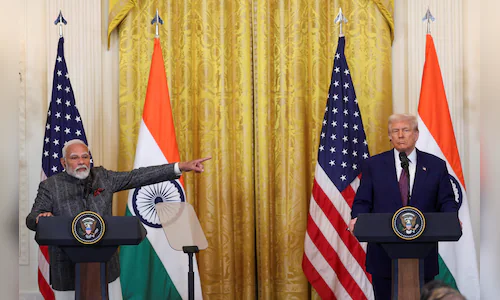
Following the court’s verdict, Trump said there would be “no change” to the trade deal with India. “My relationship with India is fantastic and we’re doing trade with India,” he said at a White House press conference, adding that New Delhi had scaled back Russian oil imports at his request. He reiterated that India would pay tariffs while the US would not, calling the revised pact a “fair deal” and describing his equation with Prime Minister Narendra Modi as “great.”