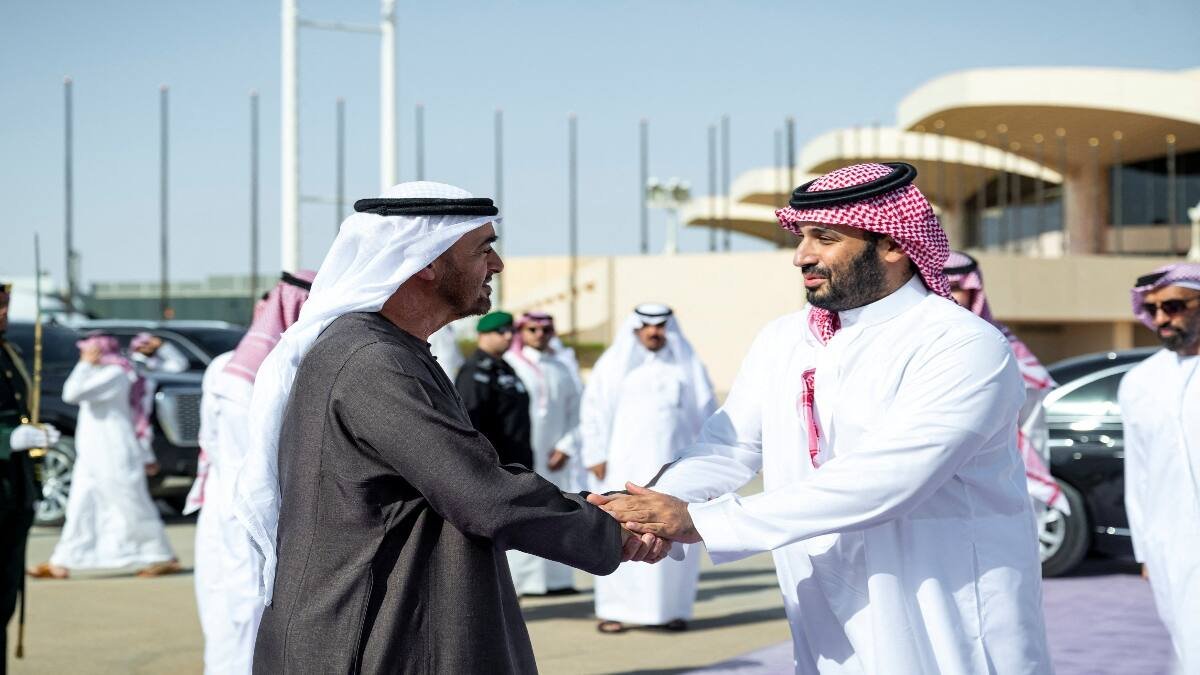
At the World Economic Forum, discussions meant to focus on finance, technology, and development are increasingly dominated by the widening Saudi-UAE rivalry and its impact on regional crises across West Asia
Finance, economic development and technology dominate the official agenda at the World Economic Forum, but discussions in the Swiss Alps are repeatedly circling back to geopolitics as crises across West Asia deepen and overlap.
From Gaza and Iran to Sudan, Syria and Yemen, the region’s conflicts remain unresolved and increasingly interconnected. Underpinning many of these flashpoints is a widening rift between Saudi Arabia and the United Arab Emirates, now difficult to ignore and increasingly on public display.
The Gulf’s two largest economies are openly at odds following the collapse of their coalition in Yemen, with public sparring between Riyadh and Abu Dhabi reaching its sharpest point since the Qatar embargo ended in 2021.
According to Semafor, Saudi officials and commentators argue the kingdom is defending state sovereignty and regional order, accusing the UAE of empowering secessionist movements to preserve influence in fragile states.
Emirati sympathisers counter that Saudi Arabia has drifted toward an Islamist axis linked to Ankara, Doha and Islamabad, casting the UAE — alongside Israel — as a frontline bulwark against political Islam and the Muslim Brotherhood.
Despite the tensions, both countries remain close US allies. US President Donald Trump has not intervened to mediate, and Davos is widely seen as unlikely to deliver any breakthrough, even as global attention is pulled toward other disputes, from Greenland to NATO tensions.
One thing is certain, participants say: the dialogue will be intense, and the stakes unmistakable.
Allies to rivals
The dispute is striking given how much Saudi Arabia and the UAE share.
According to Center for Strategic and International Studies (CSIS) report, both seek to transform their economies beyond oil, position themselves as global hubs for technology, finance, aviation and tourism, and reduce the region’s long association with extremism and instability. Both view Iran and jihadi groups such as al Qaeda and ISIS as existential threats, and both ultimately see Israel as a regional partner, albeit on different timelines and conditions, added the report.
Those shared ambitions, however, have also fueled rivalry. The fallout became public when the Emirati-backed Southern Transitional Council seized territory in Yemen near Saudi Arabia’s southern border, prompting sharp exchanges and Saudi airstrikes before the group withdrew. While the immediate crisis has eased — with the UAE reportedly pulling its forces out of Yemen — the underlying antagonism remains.
Beyond Yemen, economic competition is a major driver. The UAE has long been the Gulf’s commercial powerhouse, but Saudi Arabia is racing to catch up, competing aggressively for investment, corporate headquarters, airlines and tourism.
Personal dynamics also play a role. The relationship between Emirati President Mohammed bin Zayed and Saudi Crown Prince Mohammed bin Salman, once close, has evolved into rivalry, reflecting clashing visions of leadership and regional order.
Policy differences
Policy differences further widen the gap. Saudi Arabia has prioritised de-escalation and containment of regional conflicts, while the UAE has sought to project influence through local allies and proxies. Riyadh has occasionally worked with Islamist actors where alternatives are limited; Abu Dhabi has pursued their elimination, even at the cost of aligning with controversial partners.
According to CSIS, citing analysts, the depth of the Saudi-UAE split now rivals — and may exceed — the 2017 rupture with Qatar, which took years to resolve. If the current divide proves bridgeable, it is unlikely to close quickly. Western officials argue that prolonged Gulf divisions risk becoming strategic own-goals, creating openings for Iran and other adversaries.
For now, as Davos discussions continue, the Saudi-UAE rivalry looms large over a region already stretched by overlapping crises.
With inputs from agencies
End of Article