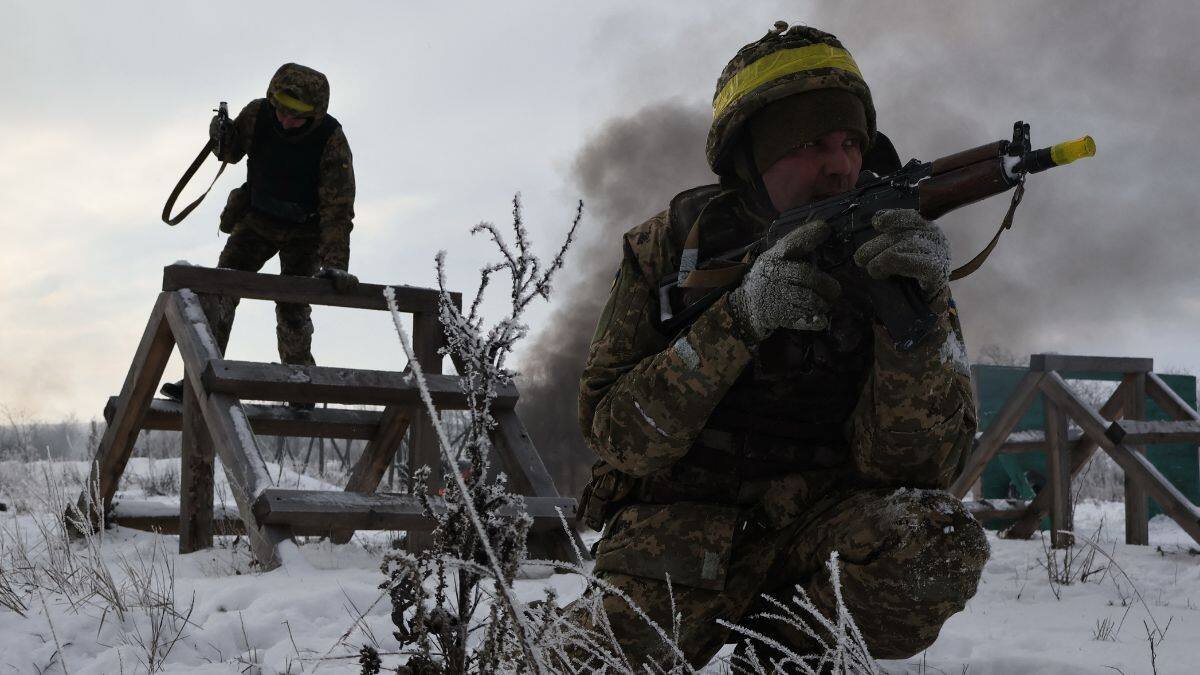
Russia’s war in Ukraine has shifted into a grinding battle of attrition with Moscow making its largest territorial gains since 2022 as diplomacy lags and Ukrainian forces face mounting pressure on multiple fronts.
Russia’s slow gains across Ukrainian territory in 2025 mark its biggest territorial advance since the war erupted in 2022 as the conflict settles into a prolonged battle of attrition.
According to an AFP analysis of battlefield data, Russian forces captured more land last year than in the previous two years combined, pressing their advantage against Ukrainian troops stretched thin by manpower shortages and equipment gaps.
Based on data from the Institute for the Study of War (ISW) and the Critical Threats Project, Russia seized more than 5,600 square kilometres of Ukrainian territory in 2025 — about 0.94% of the country’s landmass.
While far below the dramatic territorial grab of over 60,000 square kilometres in 2022, the advances highlight Moscow’s ability to turn sustained pressure into incremental gains as the war enters its fourth year.
These gains include areas independently assessed as being under Russian control, as well as territory claimed by Moscow, a distinction that highlights how battlefield momentum, rather than dramatic breakthroughs has become the primary measure of progress.
A war of attrition replaces early-war shock tactics
Unlike the early stages of the invasion, when Russia sought rapid territorial expansion through overwhelming force, 2025 saw Moscow lean heavily on attritional tactics. Russian forces combined heavy artillery bombardment, drone warfare, and relentless infantry assaults to wear down Ukrainian defences across multiple sectors.
The data shows that Russia’s biggest territorial advance came in November, when it captured 701 square kilometres, pointing to intensified offensive operations late in the year. By contrast, December recorded just 244 square kilometres of gains, the smallest monthly increase since March, suggesting both battlefield fatigue and operational limits.
Throughout the year, Ukraine faced sustained pressure not just from the front lines but also from deep-strike bombardment targeting infrastructure and supply lines. Western analysts have noted that while Russia’s advances were often marginal in tactical terms, they proved cumulatively significant over time, allowing Moscow to nibble away at Ukrainian-held territory without committing to large-scale manoeuvre warfare.
This grinding approach aligns with assessments that Russia has restructured its war effort to prioritise endurance both militarily and politically betting that Ukraine’s resources and Western support would be harder to sustain over a prolonged conflict.
Ukraine squeezed by manpower gaps and firepower imbalance
For Kyiv, 2025 proved to be one of its most difficult years since the invasion began. Ukrainian forces, widely described as outmanned and outgunned, struggled to hold defensive lines as Russia exploited numerical superiority and a steady flow of munitions.
Military analysts say Ukraine’s losses of territory were often the result of prolonged pressure rather than sudden defeats. Russian troops advanced metre by metre in contested zones, forcing Ukrainian units to withdraw to preserve manpower. In several areas, Ukrainian commanders opted for tactical retreats rather than risk encirclement, a sign of how battlefield calculations have shifted in favour of damage limitation.
At the same time, Kyiv has accused Moscow of deliberately escalating military operations to undermine diplomatic initiatives, arguing that Russia sees battlefield gains as leverage rather than a path to compromise. Ukrainian officials insist the Kremlin is not seriously interested in peace and is instead using negotiations as cover to consolidate territorial control.
Diplomacy lags behind battlefield momentum
Russia’s advances have unfolded against a backdrop of renewed diplomatic manoeuvring, including attempts by US President Donald Trump to position himself as a peacemaker. Trump has engaged both Moscow and Kyiv in talks aimed at ending the war, but has so far failed to extract meaningful concessions from the Kremlin.
Russia continues to occupy just under a fifth of Ukraine, and has demanded that Kyiv withdraw from parts of the eastern Donbas region as a condition for peace, a position Ukraine has repeatedly rejected. The gap between diplomatic efforts and battlefield realities has only widened as Russia’s slow territorial gains reinforce its negotiating posture.
Analysts note that while Russia is no longer capable of rapid, large-scale advances, its ability to sustain pressure gives it a strategic edge in a long war. For Ukraine, the challenge lies not only in halting further losses, but in convincing Western allies that sustained support remains crucial despite the absence of dramatic battlefield shifts.
As the conflict moves deeper into attrition, Russia’s gains in 2025 suggest that control of time rather than territory alone may now be the decisive factor shaping the war’s next phase.
End of Article