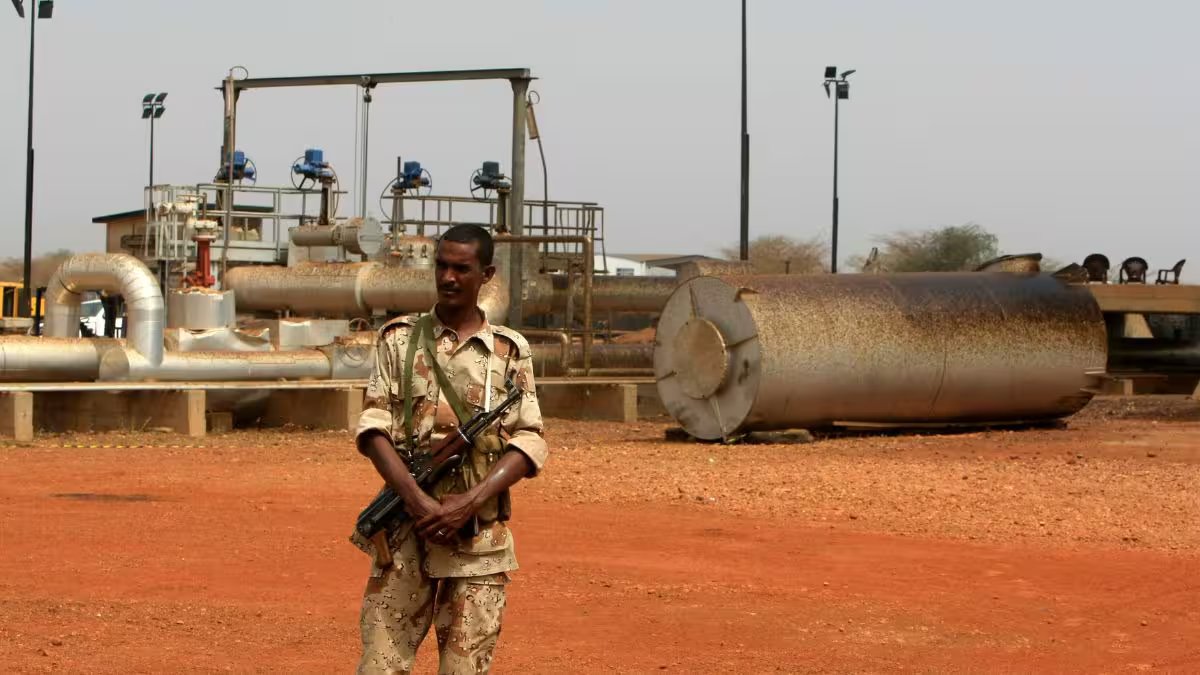
In the ongoing Sudanese civil war, paramilitary group Rapid Support Forces (RSF) has captured the strategic Heglig oilfield in the South Kordofan province. Sources have said that Sudanese military withdrew into South Sudan amid RSF’s advance in the region.
Sudan’s RSF paramilitary forces have captured the country’s largest oilfield at Heglig in the South Kordofan province along the border with South Sudan.
The Rapid Support Forces (RSF) and an engineer at the oilfield separately confirmed the development on Monday.
An engineer at Heglig oilfield told AFP on Monday that the RSF had seized the facility and Sudanese staff along with the military had withdrawn into neighbouring South Sudan.
“This morning the RSF took control of the field. Our technical teams shut it down and halted production, and the workers were evacuated to South Sudan,” the engineer said on the condition of anonymity.
The engineer further said, “The processing plant near the field through which South Sudanese oil passes was also shut down.”
Since 2023,
the Sudanese military and RSF have been locked in a civil war after the collapse of the uneasy power-sharing arrangement between the country’s military, led by General Abdel Fattah al-Burhan, and the RSF, led by Mohamed Hamdan Dagalo, better known as Hemedti. The
RSF is widely believed to have the support of United Arab Emirates (UAE) in the conflict whereas the Sudanese military is believed to be supported by Saudi Arabia and Egypt.
In October, the RSF captured the military’s last holdout in the country’s western Darfur region, essentially splitting the country into two halves where the RSF paramilitary and its allies control the west and large swathes of south and the military controls the north, east, and centre of the country.
Sudanese military withdraws into South Sudan
Government sources told Reuters that the military and oilfield’s staff withdrew from the area to avoid clashes that could have damaged the oil facilities.
Another source said staffers and military withdrew into South Sudan.
Heglig lies along Sudan’s southern border and houses the main processing facility for South Sudanese oil, which makes up much of the revenue for landlocked South Sudan’s government.
From Heglig, oil is transported through the Greater Nile pipeline system to Port Sudan on the Red Sea for export, making the Heglig site vital both for Sudan’s hard-currency earnings and for South Sudan, according to Reuters.
ALSO READ —
Sudan massacres: Satellite images show pools of blood & piles of bodies in city captured by RSF
At various point, the United Nations (UN) has described the Sudanese civil war as the world’s worst humanitarian crisis. According to estimates, up to 150,000 people have been killed, hundreds of thousands injured, and 14 million displaced.
As a result of the war, around 24 million are considered to be in acute hunger and 600,000 are facing famine.
In the ongoing civil war, the RSF and its allies have been widely accused of sexual violence against women, including rape, gang rape, forced marriages, and sexual slavery. Following the capture of the last holdout, El-Fashir, in Darfur, the RSF has been accused of massacres of thousands of non-Arab communities like Fur, Masalit, and Zaghawa.
End of Article