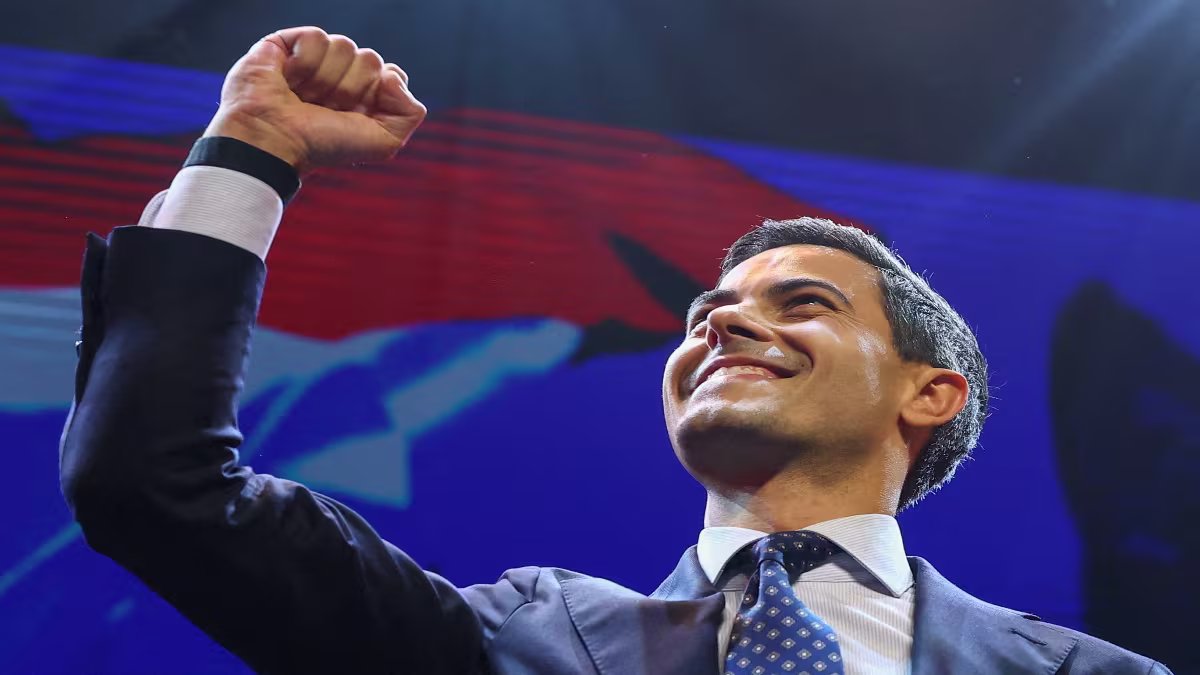
Jetten pulled off a stunning election win in October, coming from behind to dethrone the far-right Freedom Party (PVV) led by firebrand politician Geert Wilders by a razor-thin margin
Thirty-eight-year-old centrist Rob Jetten took oath on Monday as the Netherlands’ youngest-ever prime minister, also making history as the country’s first openly gay premier as the new Dutch government assumed office
Jetten secured a surprise victory in October’s snap election, overturning a projected loss to defeat the far-right Party for Freedom (PVV) led by Geert Wilders by a razor-thin margin, reported AFP.
The election was triggered after the PVV withdrew from the previous coalition — widely regarded as the Netherlands’ most right-wing government in recent history — which collapsed after just 11 months in power.
Jetten’s Democrats 66 (D66) has formed a coalition government with the centre-right Christian Democratic Appeal (CDA) and the liberal People’s Party for Freedom and Democracy (VVD). The three parties hold a combined 66 seats, falling nine short of an outright majority in parliament.
Coalition negotiations lasted 117 days — significantly shorter than the 223 days required to form the previous government.
Following his election win, Jetten said populist movements could be defeated “if you campaign with a positive message for your country.”
During the campaign, he pledged to “bring the Netherlands back to the heart of Europe,” stressing that “without European cooperation, we are nowhere.”
In a joint manifesto released in January, the coalition partners committed to full support for Ukraine and vowed to meet the country’s Nato defence spending obligations.
Although the new government is not as far to the right as the previous one, it still has a “right-wing signature”, AFP quoted Sarah de Lange, a professor of politics at Leiden University, as saying.
“The coalition has opted for budget cuts rather than running a deficit to finance any investments it wants to make” and there is “substantial continuity between the immigration plans of the new government and the previous one”, De Lange added.
The parties have pledged to press ahead with a crackdown on migration, including measures such as tougher rules on family reunification.
Wilders out
They also want to cut social benefits, including unemployment benefits, to help finance proposed investments in the military and defence.
But since the coalition will rely on support from opposition parties to pass legislation, “getting larger reforms passed by parliament might take longer than usual”, De Lange said.
Jetten and his cabinet were sworn in on Monday by King Willem-Alexander at the Huis Ten Bosch in The Hague.
The prime minister was initially more keen on a broad coalition including the left-leaning Groenlinks/PvdA, but this was firmly opposed by VVD leader Dilan Yesilgoz.
Wilders, who shook Europe’s political scene to the core with a shock election win in November 2023, saw his fortunes plummet in last year’s election.
His PVV party plunged from 37 seats in 2023 to 26 seats after what was widely seen as a lacklustre campaign.
The PVV still finished in second place, but all parties in the coalition had ruled out working with Wilders, leaving him sitting on the sidelines.
Other far-right parties have made inroads in Europe’s fifth-largest economy, however.
The Forum for Democracy, led by 28-year-old Lidewij de Vos, gained four seats in the 2025 election with a message against “uncontrolled immigration” and “the hopeless EU”.
Hard-right party JA21 also shot up the rankings, gaining eight seats and nearly securing a place at the cabinet table before being blocked by Jetten.
With inputs from agencies
End of Article