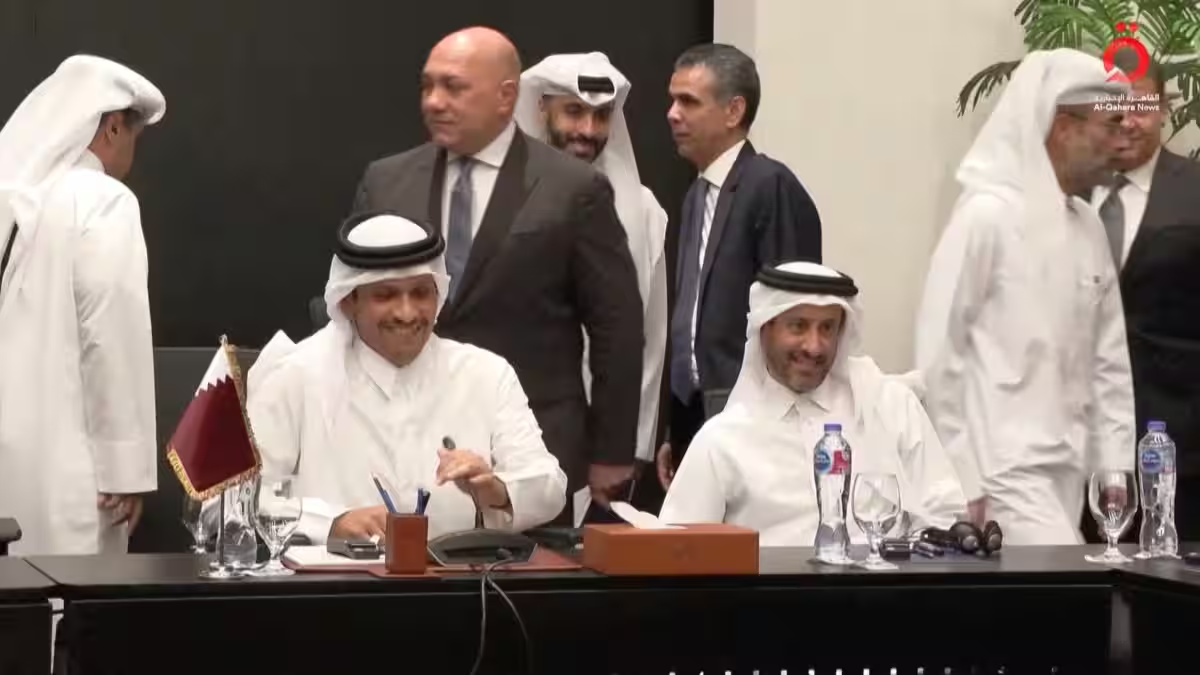
Qatar and Egypt on Sunday called on Israel to withdraw its troops from Gaza as the next step to implement the second phase of the fragile ceasefire with Hamas.
Qatar and Egypt on Sunday called on Israel to withdraw its troops from
Gaza as the next step to implement the
fragile ceasefire with Hamas. The two guarantors of the truce, brokered by US President Donald Trump, also demanded the swift formation of an international stabilisation force to take control of the Palestinian coastal enclave.
The measures were spelt out in the US- and UN-backed peace plan that has largely halted fighting. However, the deal is in a stalemate as the warring parties have yet to agree to move forward to the second phase of the
20-point plan. It is pertient to note that the first phase of the ceasefire required the Israeli troops to pull back behind a “yellow line” within Gaza’s borders, while the Palestinian militant group Hamas released the
living hostages it still held and handed over the remains of all but one of the deceased.
“Now we are at the critical moment … A ceasefire cannot be completed unless there is a full withdrawal of the Israeli forces (and) there is stability back in Gaza,” the Qatari premier, Sheikh Mohammed bin Abdulrahman Al Thani, told the Doha Forum, an annual diplomatic conference.
Qatar, alongside Egypt and the US, helped in securing the long-elusive truce, which remains delicate as Israel and Hamas accuse each other of breaching its terms. The major point of contention has been the implementation of the second phase, which has yet to begin, including the question of Hamas’s disarmament.
Why are both sides not moving forward with the second phase?
As per the 20-point peace plan, Hamas is supposed to disarm, with members who decommission their weapons allowed to leave Gaza. However, the Palestinian group has repeatedly rejected the proposition. On Saturday, Hamas said that it was ready to hand over its weapons in the Gaza Strip to a Palestinian authority on the condition that the Israeli army’s occupation ends.
“Our weapons are linked to the existence of the occupation and the aggression,” Hamas’s chief negotiator, Khalil al-Hayya, said in a statement. “If the occupation ends, these weapons will be placed under the authority of the state,” he added.
Under the order, which was endorsed by the United Nations in November, Israel is obligated to withdraw from its positions, Gaza is to be administered by a transitional governing body known as the “
Board of Peace”, and an international stabilisation force is to be deployed.
“We need to deploy this force as soon as possible on the ground because one party, which is Israel, is violating the ceasefire every day,” Egypt’s foreign minister,
Badr Abdelatty, said at the Doha Forum. The Egyptian foreign ministry noted that Abdelatty and Sheikh Mohammed met on Saturday, with both stressing “the importance of continuing efforts to implement” the peace agreement.
However, Arab and Muslim nations in the region have been hesitant to participate in the new force, since they believe that they could end up fighting with Palestinian militants. Trump would theoretically chair the “Board of Peace”, while the identities of the other members have yet to be announced.
End of Article