
The report states that a joint physical inspection across 19 sampled districts revealed that out of 2,079 sampled houses reported by the state government as completed, 77 houses were actually incomplete. In several cases, construction quality was found to be substandard. Roofs of 42 houses were made of tin or asbestos sheets despite the scheme allowing only pucca roofs. Walls of 1,548 houses, or 74 per cent of the sampled units, were found without plaster even though these houses were officially shown as completed.
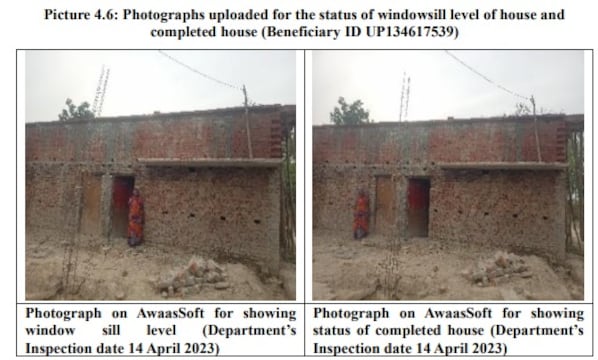
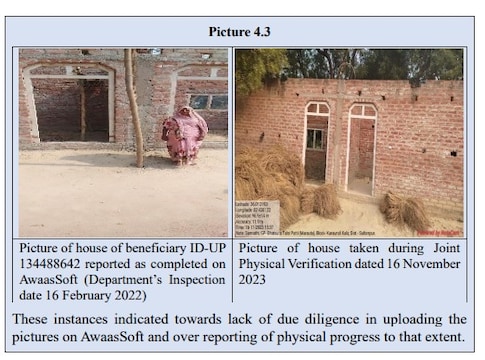
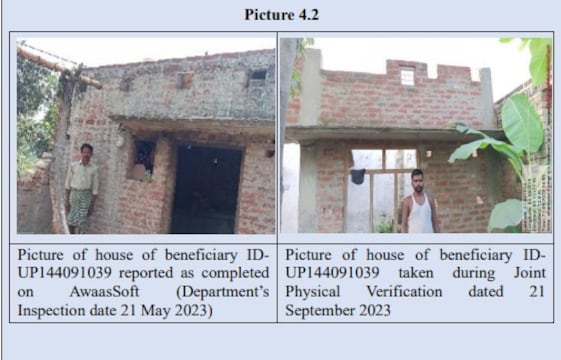
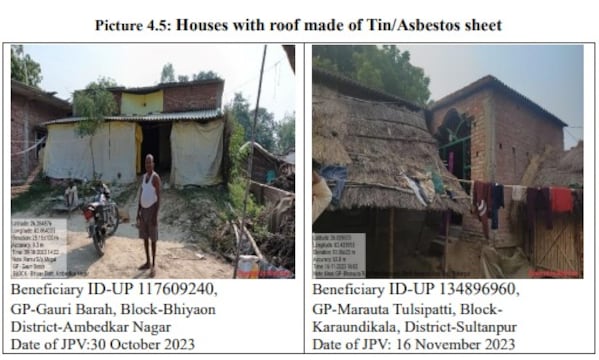
The audit found that houses lacked basic internal facilities mandated under the scheme. Out of the 2,079 completed sampled houses, 1,129 houses (54%) were constructed without a dedicated hygienic cooking space, while 1,205 houses (58%), did not have a bathing area as required under PMAY-G guidelines.
Shortages of basic amenities were found to be widespread despite official claims of completion. As per data furnished by the state government, no toilets were constructed in 1,53,062 houses under the scheme, even though toilets are mandatory. Further, 1,99,027 houses did not have cooking gas connections, 2,53,957 houses were without electricity connections and 8,66,053 houses lacked water supply connections.
Also read: Explained | Why govt raised excise duty on cigarettes, introduced machine-based cess on pan masala
The audit of 2,079 sampled houses corroborated these failures, revealing that 29% of houses did not have toilets, 39% lacked cooking gas connections, 30% had no electricity and a staggering 89% did not have water supply connections, despite the state government reporting basic amenities as completed.
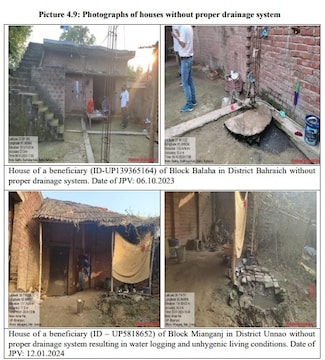
Drainage and sanitation conditions were also found to be poor. Of the 2,079 sampled houses, only 1,169 houses (56%) were connected to drains, while 904 houses (44%) did not have any proper drainage system, leading to waterlogging and unhygienic living conditions.
The audit flagged large-scale exclusion of eligible beneficiaries. A survey conducted in 2017-18 identified 43.89 lakh beneficiaries who were eligible for the scheme but were left out of the beneficiary list. Another survey in 2018-19 identified 54.32 lakh eligible households that were not included in the permanent wait list. Even as of March 2025, in three of the 19 sampled districts, 4,884 eligible beneficiaries were identified but were not included in the waiting list.
Beneficiaries were also denied labour-related entitlements. Under the scheme, beneficiaries are entitled to 90 days of unskilled labour benefit, but the audit found that 18,783 eligible beneficiaries in the 19 sampled districts were deprived of this benefit.
Also read: E-com, food delivery services largely unaffected by gig workers’ strike
The audit highlights near-total failure in meeting norms for Persons with Disabilities. While the scheme mandates that states should, as far as possible, ensure that 3% of beneficiaries are persons with disabilities, the audit found that in the 19 sampled districts during 2017-23, only 253 houses (0.02%) were sanctioned to persons with disabilities, against an expected coverage of 12.75 lakh houses.
Delays in release of funds emerged as another major concern. The first instalment is required to be released within one week of the sanction order, but the audit found that 79% of beneficiaries did not receive the first instalment on time.
Even after completion of houses, payments remained pending. An amount of Rs 27.20 cr was yet to be released to 20,009 beneficiaries even after a lapse of one to six years from completion. The state government, however, reported pending dues of Rs 20.18 cr involving 11,031 beneficiaries as of August 2024.
The audit also found that ineligible beneficiaries were wrongly included in the scheme. In 11 sampled districts, 1,838 ineligible persons were included in the permanent wait list during 2017-23. Funds amounting to Rs 9.52 cr were released to these ineligible beneficiaries, of which Rs 2.62 cr was still pending recovery as of September 2024. The state government claimed that disciplinary action was taken against officials responsible for sanctioning houses to ineligible beneficiaries.
Incomplete houses continued to block large amounts of public money. As of March 2025, 20,215 houses remained incomplete despite exceeding the prescribed completion timeline of 12 months, in some cases by as much as seven years. The audit noted that Rs 134.51 cr released to beneficiaries for these houses remained unfruitful.
Claims related to land allotment to landless beneficiaries were also found to be inaccurate. While the state government stated that 2,207 landless households were provided land, the audit revealed that in six sampled districts, 137 landless beneficiaries had not been provided land.
Quality assurance mechanisms under the scheme were found to be weak. The scheme requires states to offer beneficiaries a menu of house design options and mandates construction of a demo house in each housing zone.
However, out of 826 blocks in the state, demo houses were constructed in only 395 blocks (48%). In six sampled blocks, demo houses were not built as per the approved designs and did not use prescribed construction materials.
The audit further revealed that beneficiaries of 12.75 lakh houses could not access trained masons under the Rural Mason Training Programme, undermining the objective of ensuring quality construction.
The audit report concludes that essential exercises to ensure construction quality and habitability were not prioritised by the Uttar Pradesh government, resulting in houses being declared complete despite lacking toilets, water, electricity, kitchens, drainage and timely financial support, while lakhs of eligible beneficiaries were left out and crores of public funds remained misutilised or unproductive.