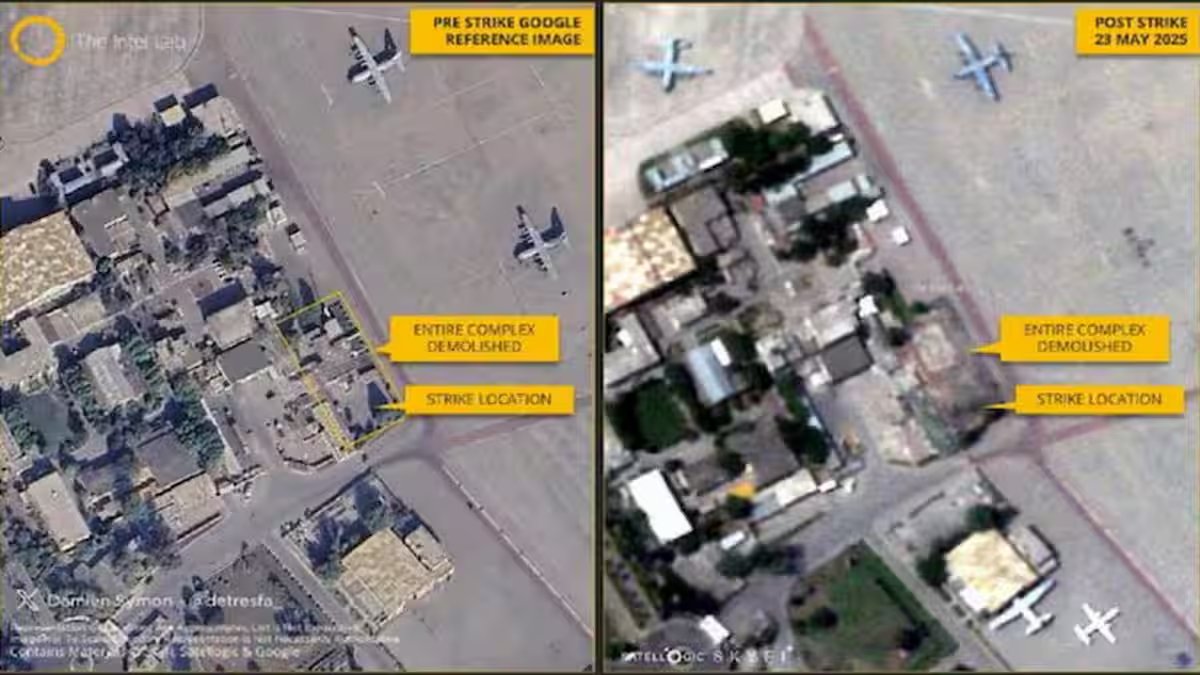
Pakistan has admitted that India’s strikes during Operation Sindoor in May caused damage to key military installations, marking a rare public acknowledgement by Islamabad. The admission came after Pakistan’s FM Dar confirmed that Indian drones hit the Nur Khan Air Base in Rawalpindi, injuring personnel and damaging the facility.
Pakistan has publicly acknowledged that India’s strategic and precision strikes during Operation Sindoor in May this year caused significant damage to the country. The admission comes months after India launched the operation in response to the April terror attack in Pahalgam that killed 26 civilians.
Pakistan’s Deputy Prime Minister and Foreign Minister Ishaq Dar confirmed that Indian drones struck the Nur Khan Air Base in Rawalpindi’s Chaklala area. Speaking at a year-end press briefing, Dar said the attack damaged the military installation and injured personnel stationed there.
Dar claimed that India sent a large number of drones into Pakistani territory within a short span of time. He claimed that at least 80 drones crossed the border within 36 hours.
Later Dar claimed that Pakistani forces intercepted 79 of them, but one drone managed to hit a military site, resulting in injuries.
High-level meeting after strikes
Dar further said that Pakistan’s civil and military leadership, led by Prime Minister Shehbaz Sharif, held a meeting on the night of May 9 to review the situation and approve certain decisions. He also stated that India “made the mistake” of attacking the Nur Khan Air Base in the early hours of May 10, again acknowledging the strike.
Key air bases hit during Operation Sindoor
Nur Khan Air Base is a major Pakistan Air Force facility located in Rawalpindi. It was among 11 air bases targeted by Indian strikes during Operation Sindoor. Other locations hit included air bases in Sargodha, Rafiqui, Jacobabad and Muridke.
Background of Operation Sindoor
Operation Sindoor was launched by the Indian Armed Forces in the early hours of May 7. It was a retaliatory action following the April 22 terror attack in Pahalgam, Jammu and Kashmir. Indian strikes initially targeted nine terror camps in Pakistan and Pakistan-occupied Kashmir, followed by attacks on key military installations.
Indian Army veteran rejects Pakistan’s version
Reacting to Dar’s remarks, Indian Army veteran Lt Gen (Retd) KJS Dhillon dismissed Pakistan’s claim of “minor damage” and “minor injuries”. He accused Dar of lying and said the extent of destruction was far greater.
Dhillon cited reports from Pakistan’s own media, saying that a list published by Samaa TV on Pakistan’s Independence Day named 138 people who were awarded gallantry honours posthumously for Operation Sindoor. According to him, this suggested much higher casualties than officially acknowledged by Pakistan.
He also referred to videos released by Pakistani civilians showing the Nur Khan base engulfed in flames and claimed that all 11 targeted air bases suffered heavy damage.
India’s strike on the Nur Khan Air Base had earlier been confirmed by Prime Minister Shehbaz Sharif. Days after the operation, Sharif said Army chief General Asim Munir personally informed him of the attack during the night of May 9 and 10.
In July, Sharif’s adviser Rana Sanaullah also admitted that Pakistan had only 30 to 45 seconds to determine whether a missile fired by India towards Nur Khan carried a nuclear warhead.
Satellite images show extensive damage
Satellite images taken in May reportedly showed extensive damage to several Pakistani air bases, including Nur Khan, Mushaf in Sargodha, Bholari and Shahbaz in Jacobabad. Pakistan had also admitted on May 10 that Indian missiles and drones targeted three of its air bases, including Nur Khan, Muridke and Rafiqui.
End of Article