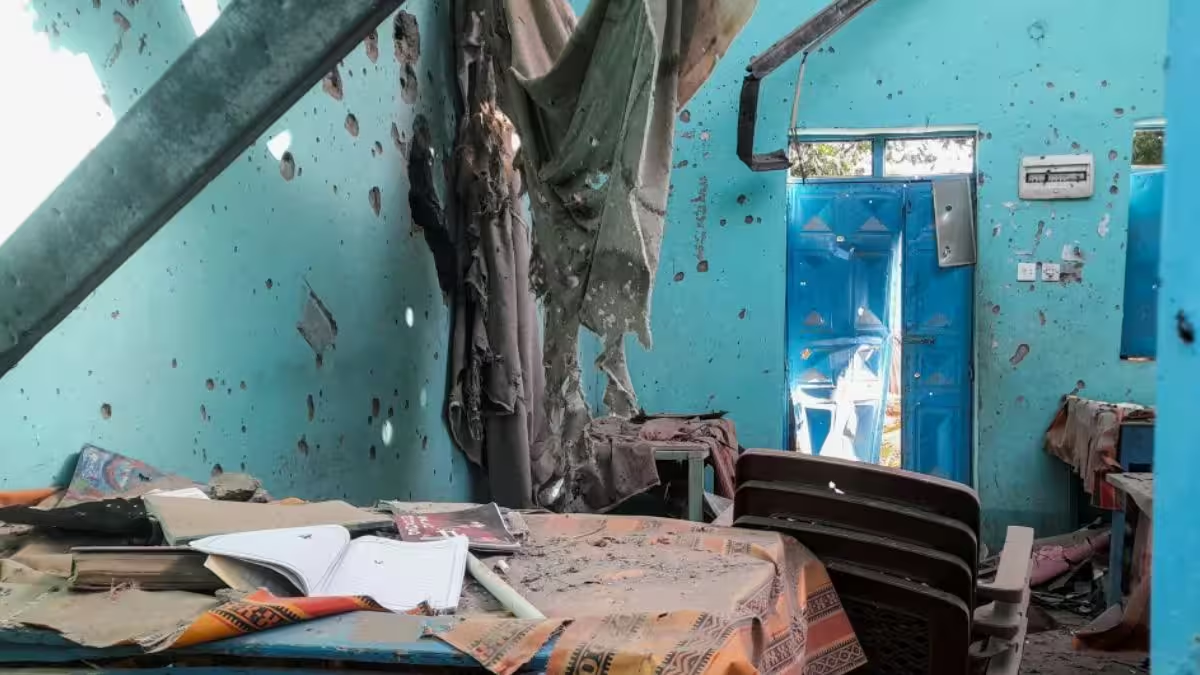
A UN report says more than 6,000 people were killed in a three-day assault by Sudan’s Rapid Support Forces on El Fasher, with widespread atrocities that may constitute war crimes and crimes against humanity.
More than 6,000 people were killed over three days in late October when Sudan’s paramilitary Rapid Support Forces (RSF) launched a final offensive to capture El Fasher in the Darfur region, according to a report released on Friday by the UN Human Rights Office in Cairo. The assault, described as “a wave of intense violence … shocking in its scale and brutality”, targeted the Sudanese army’s last remaining stronghold in Darfur and followed more than 18 months of siege.
The 29-page report said the offensive included widespread atrocities that amount to war crimes and possible crimes against humanity.
“The wanton violations that were perpetrated by the RSF and allied Arab militia in the final offensive on el-Fasher underscore that persistent impunity fuels continued cycles of violence,” said UN High Commissioner for Human Rights Volker Türk.
City overrun after prolonged siege
The RSF and allied Arab militias, known as Janjaweed, overran El Fasher on October 26 before rampaging through the city and surrounding areas.
According to the UN Human Rights Office, the violence included mass killings, summary executions, sexual violence, abductions for ransom, torture and ill-treatment, as well as detention and enforced disappearances. In many instances, the attacks were said to be motivated by ethnicity.
General Mohammed Hamdan Dagalo of the RSF has previously acknowledged abuses committed by his fighters but has disputed the scale of the atrocities.
Pattern of abuses in wider conflict
The events in el-Fasher, the capital of North Darfur province, reflect what the report described as a broader pattern of RSF conduct in its war with the Sudanese military.
The conflict began in April 2023 after a power struggle between the two sides escalated into open fighting in the capital, Khartoum, and across the country. It has since created the world’s largest humanitarian crisis, with parts of Sudan pushed into famine.
The fighting has been marked by atrocities that the International Criminal Court said it was investigating as war crimes and crimes against humanity. The RSF has also been accused by the Biden administration of carrying out genocide during the ongoing war.
Killings documented over three days
The UN Human Rights Office said it documented the killing of at least 4,400 people inside el-Fasher between October 25 and October 27. More than 1,600 others were killed while attempting to flee the violence.
The findings were based on interviews with 140 victims and witnesses, which were “are consistent with independent analysis of contemporaneous satellite imagery and video footage,” the report said.
In one incident on October 26, RSF fighters reportedly opened fire using heavy weapons on around 1,000 people sheltering in the Rashid dormitory at el-Fasher University, killing about 500. One witness said he saw bodies thrown into the air, “like a scene out of a horror movie,” according to the report.
In another case on the same day, around 600 people, including 50 children, were executed while taking refuge in university facilities.
The report cautioned that the true death toll from the week-long offensive was “undoubtedly significantly higher”.
The figures do not include at least 460 people who were killed on October 28 when RSF fighters stormed the Saudi Maternity Hospital, according to the World Health Organization.
The report also said around 300 people were killed in RSF shelling and drone attacks between October 23 and October 24 in the Abu Shouk camp for displaced people, located 2.5 kilometres northwest of El Fasher.
End of Article