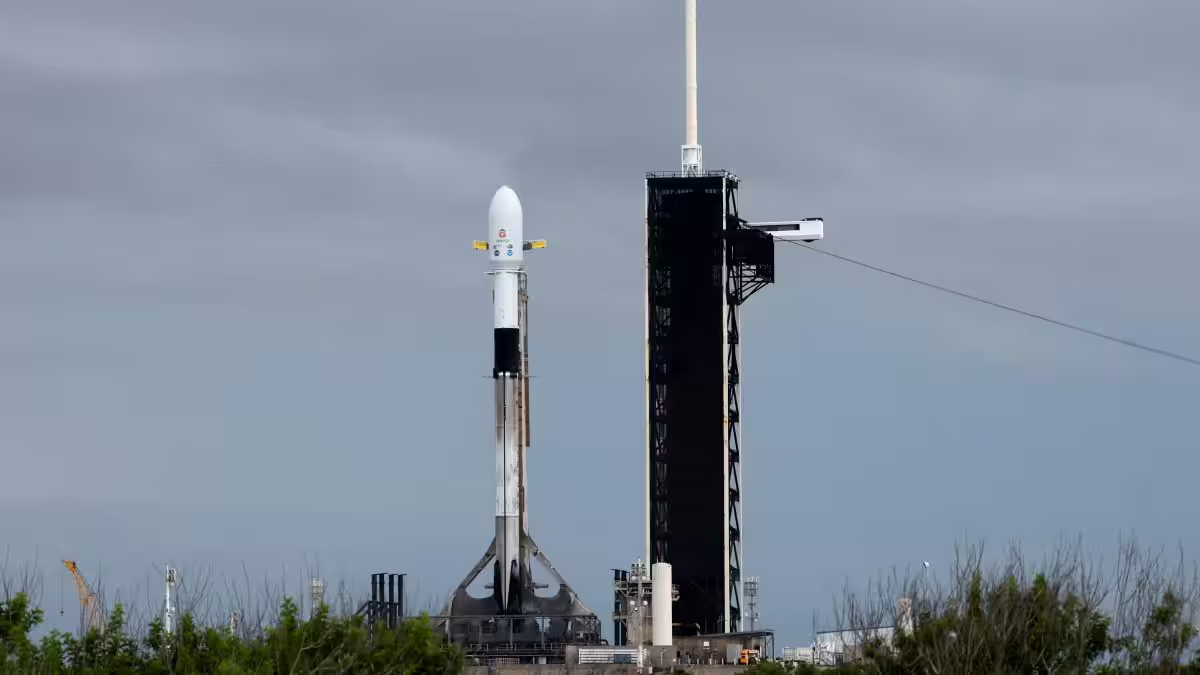
NASA and SpaceX have successfully launched the Crew-12 mission to the International Space Station, sending four astronauts into orbit aboard a Falcon 9 rocket as part of efforts to restore the station’s full crew and continue long-duration scientific research.
In a major boost for commercial human spaceflight, Nasa and SpaceX successfully launched the Crew-12 mission to the International Space Station (ISS) on Friday, February 13, 2026.
A Falcon 9 rocket roared off from Cape Canaveral Space Force Station, carrying the Crew Dragon Resilience spacecraft and its four astronauts into orbit.
The mission comes after the early return of Crew-11 in January due to a medical emergency, temporarily reducing the station’s crew strength. Crew-12 is set to restore the ISS to its full seven-member complement once it docks.
Crew Dragon is scheduled to autonomously dock with the station on Saturday, February 14, after a journey of more than 30 hours, where the astronauts will join the Expedition 74 crew.
Reusability milestone
The launch also marked a technical first for SpaceX. It was the first time a crew-rated Falcon 9 booster was launched and landed from the same facility. The first stage touched down at Landing Zone 1 just minutes after liftoff — completing its 15th flight — highlighting the company’s growing emphasis on rapid rocket reusability and reliability.
A multinational crew
Crew-12 brings together astronauts from three space agencies:
-
Jessica Meir (Nasa), Mission Commander, on her second spaceflight.
-
Jack Hathaway (nasa astronaut), Pilot, making his first trip to space.
-
Sophie Adenot (ESA), Mission Specialist, the first from her 2022 ESA astronaut class to fly.
-
Andrey Fedyaev (Roscosmos), Mission Specialist, on his second long-duration mission.
The crew is expected to spend about eight months — roughly 240 days — aboard the ISS.
Science and long-duration research
During their stay, Crew-12 will conduct more than 200 microgravity experiments across biotechnology, fluid physics and materials science.
Key studies include investigating blood clot risks in microgravity, analysing how pneumonia-causing bacteria affect heart tissue, testing systems for on-demand IV fluid generation, and examining nitrogen-fixing microbes to support sustainable food production for future Moon and Mars missions.
The extended mission duration ensures continuity of research aboard the ISS and supports preparations for deep-space exploration under Nasa’s Artemis programme.
End of Article