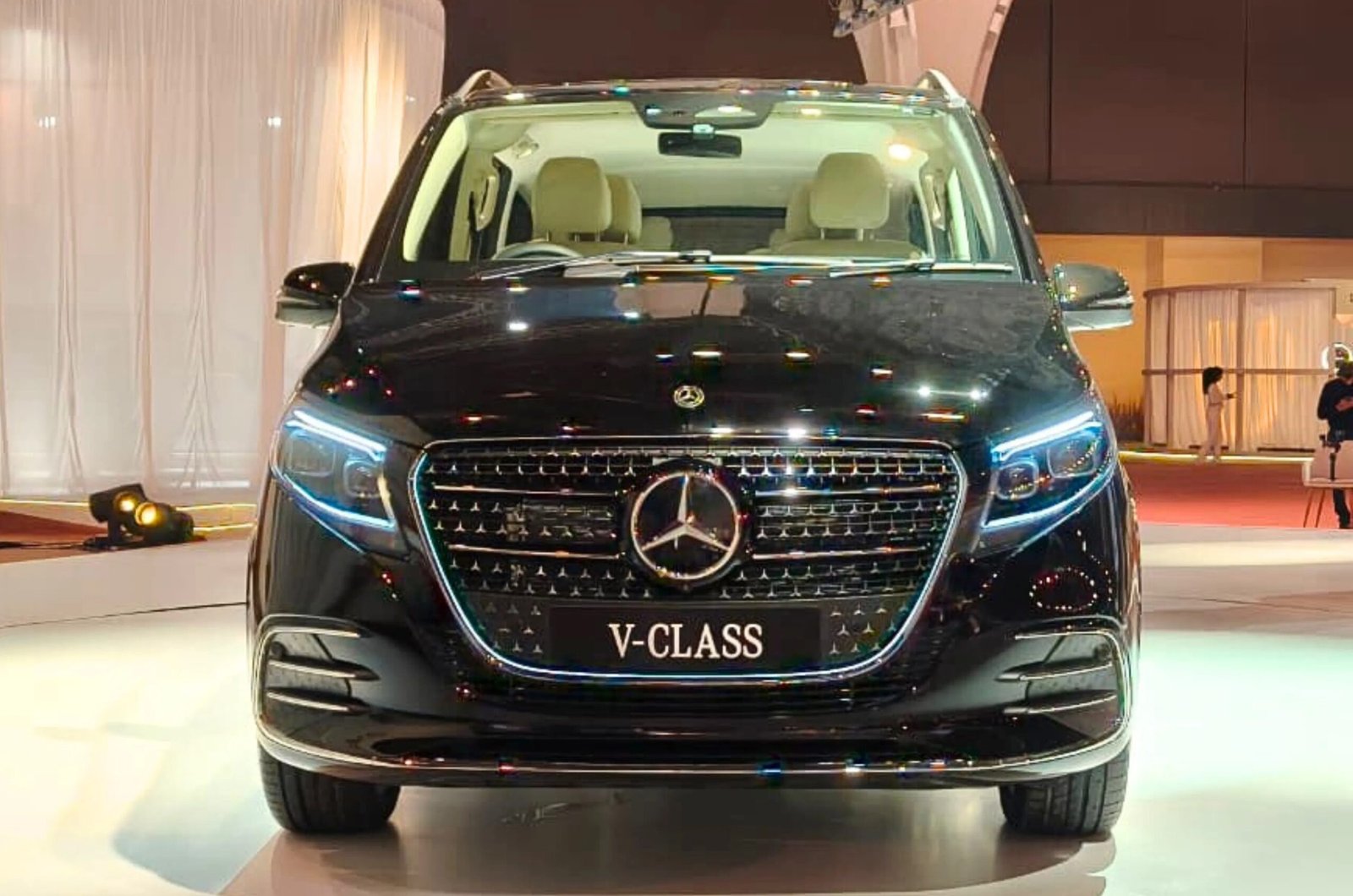
Mercedes-Benz India is targeting triple-digit annual volumes for the newly launched V-Class as it expands into the luxury MPV segment. The model is priced at Rs 1.4 crore and will initially be imported as a completely built unit (CBU) before moving to local assembly in Pune later this year.
Managing Director and CEO Santosh Iyer said that with the V-Class, Mercedes aims at expanding the addressable luxury market rather than chasing volume. “There is a clear white space in the van market,” Iyer said, adding that the company expects “certain triple-digit volumes” once the model stabilises, which supports the case for localisation.
-
Priced at Rs 1.4 crore; initially imported as a CBU
-
Positioned above mainstream premium MPVs
-
Demand driven by existing Mercedes customers seeking a high-end MPV
Positioned to fill a luxury gap
A second or third car for affluent buyers
Mercedes last offered the V-Class in India in 2019, but Iyer said the segment was not mature at the time. The new model returns with a configuration better suited to Indian preferences. “The vacant space is between Rs 1 crore and Rs 2 crore,” Iyer said. “We felt Rs 1.5 crore was the right price point. With localisation, we could introduce it at Rs 1.4 crore.”
He clarified that the V-Class is unlikely to replace existing models in a customer’s garage. “This will not be the only car in the family,” he said, positioning it as a second or third vehicle for airport transfers, weekend travel or work on the move.
If fully imported, the V-Class would have been priced closer to Rs 2 crore. Local assembly is intended to maintain competitive pricing and support sustainable volumes. “That is why we are localising,” Iyer said. “It cannot be very low.” Mercedes expects demand primarily from affluent private buyers rather than corporate fleets.
In India, the V-Class will sit between the Toyota Vellfire and Lexus LM in the luxury MPV space.
Part of a broader premium push
Top-end models drive revenue growth
The V-Class launch aligns with Mercedes’ strategy of strengthening its top-end portfolio. One in four Mercedes cars sold in India now comes from its top-end segment, which grew 11 percent last year.
The company closed 2025 with sales of 19,007 units, down around 2 percent year-on-year, but recorded its highest-ever revenue in India. The richer product mix has pushed up average selling price. “Our average selling price has now gone up to around Rs 1 crore,” Iyer had said earlier. “That clearly shows the kind of mix we are selling.”
Mercedes expects single-digit growth this year and plans to launch 12 new models across internal combustion and electric powertrains, with a strong focus on core and top-end segments. “We are not chasing volume for the sake of it,” Iyer said. “We would rather grow steadily and protect brand and residual values.”
Mercedes-Benz V-Class: Features and powertrain details
Electrification on hold for India
The V-Class is positioned as a chauffeur-focused luxury MPV, with an emphasis on rear-seat comfort and privacy. It offers luxury captain seats, Airmatic suspension, heat-insulating glass, rear blinds and a 15-speaker Burmester sound system, along with seven airbags and driver assistance features such as Active Lane Assist and DISTRONIC.
In India, it is offered with two engine options. The petrol produces 231hp and gets mild-hybrid assist, while the diesel delivers 237hp.
Electrification remains part of Mercedes’ long-term roadmap globally, with electric vans under development. However, there are no immediate plans to introduce a fully electric V-Class in India. “We will evaluate once the global car is launched. Nothing for this year,” Iyer said. A plug-in hybrid variant is also not under consideration at present.