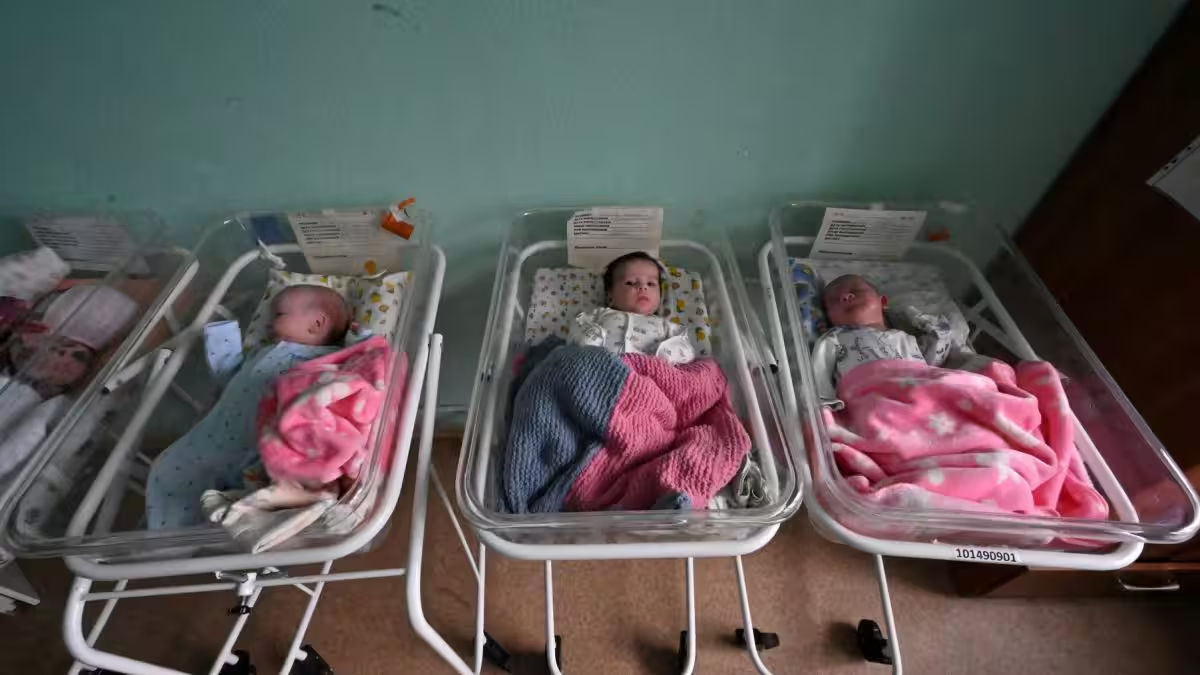
The war has left Ukraine grappling with countless challenges, but the most underestimated of all is its ‘baby crisis’—a shrinking population that could shape the nation’s post-war future
While the war in Ukraine has been defined by the boom of artillery and the constant wail of air raid sirens, a quieter—and perhaps more lasting—crisis is taking shape. The nation’s demographic foundation is experiencing what experts describe as a “catastrophic” collapse.
Ukraine’s birth rate, already among the lowest in Europe before February 2022, has plummeted into a demographic abyss that threatens the country’s post-war viability. In simple terms, even if Ukraine manages to wriggle out of the war, it won’t have enough people to work in the future.
What the data is saying
The latest numbers from the Ukrainian government show just how serious the situation has become.
In 2024, the mortality rate in Ukraine outpaced the birth rate by nearly 3 to 1. Specifically, the Ministry recorded 176,780 births against 495,090 deaths, a disparity that has widened every year since the full-scale invasion.
Before the war, in 2021, Ukraine recorded approximately 273,000 births. By 2023, that number had dropped by nearly 30%. The trend has only solidified as the conflict grinds into 2026. The Total Fertility Rate (TFR)—the average number of children a woman is expected to have over her lifetime—is now estimated at 0.9 to 1.0. This is less than half of the 2.1 required to maintain a stable population.
The triple blow: Death, displacement, and despair
Ukraine’s demographic crisis is not driven by a single factor, but by a “triple blow” that has decimated the reproductive-age cohort:
-
Mass migration: Of the approximately 6.5 million refugees who
remain outside Ukraine, the vast majority are women of childbearing age and children. Their absence represents a “lost generation” of potential births. -
Military casualties: While official figures remain closely guarded, the loss of
tens of thousands of young men on the front lines has created a profound gender imbalance in the 20- to 35-year-old demographic. -
The “psychology of the bunker”: For those remaining in Ukraine, the instability of life under constant bombardment makes family planning a secondary concern. In regions like Kherson and Donetsk, deaths now exceed births by as much as 11-fold.
Also read |
At $1,300 a month, Indian workers keep Russian economy afloat during war; Ukraine eyes to follow suit
The strategy for survival
The Ukrainian government is fully aware that this is not just a
wartime problem—it’s an existential one that could shape the country’s future for decades.
In response, the Cabinet of Ministers approved an ambitious Strategy for Demographic Development through 2040 in late 2024.
But this time, the approach is different.
Instead of relying only on financial incentives—which have rarely led to lasting baby booms across Europe—the plan focuses on fixing the bigger picture. The goal is to build a “barrier-free” society with better infrastructure, stronger safety guarantees, and stable economic opportunities. In simple terms, Ukraine hopes to create conditions that will encourage millions of displaced women and families to eventually return home and rebuild their lives.
Even so, the road ahead isn’t easy.
Even with peace and recovery, Ukraine’s population may never return to its pre-war size. Current projections suggest the population could fall to around 25 million by 2051—nearly half of what it was at its peak in 1991, when Ukraine gained independence after the collapse of the Soviet Union.
In many ways, this crisis is similar to the deep demographic wounds left by tragedies like the Holodomor famine and World War II, which wiped out millions. But there is a crucial difference today. This collapse is unfolding in a modern, globalised world where migration is easier than ever. Many Ukrainians who left may choose to build permanent lives elsewhere.
Taken together, Ukraine isn’t just fighting to reclaim its land. It is fighting to preserve its future population.
End of Article