Israel has agreed to reopen the Rafah crossing for pedestrian traffic after the remains of the final hostage in Gaza are found, amid mounting US pressure and urgent calls to expand humanitarian access
Israel announced on Monday that it would allow a limited reopening of the Rafah border crossing between Gaza and Egypt after the remains of the last hostage in the Palestinian territory are recovered.
Reopening Rafah, a key entry point for aid into Gaza, forms part of a truce framework announced by US President Donald Trump in October. However, the crossing has stayed shut since Israeli forces took control of it during the war in the Palestinian territory.
Visiting US envoys had reportedly pressed Israeli officials to reopen the crossing during talks in Jerusalem over the weekend. World leaders and aid agencies have repeatedly called for increased humanitarian convoys to enter Gaza, which has been heavily damaged by more than two years of war and relies on incoming medical equipment, food and other essential supplies.
Prime Minister Benjamin Netanyahu’s office said on Monday that Israel had agreed to a reopening “for pedestrian passage only, subject to a full Israeli inspection mechanism”.
The move would depend on “the return of all living hostages and a 100 per cent effort by Hamas to locate and return all deceased hostages”, it said on X.
The Israeli military said it was searching a cemetery in the Gaza Strip on Sunday for the remains of the last hostage, Ran Gvili. Netanyahu’s office said, “Upon completion of this operation, and in accordance with what has been agreed upon with the US, Israel will open the Rafah Crossing.”
Conflicting signals over timing
The announcement followed remarks by Gaza’s newly appointed administrator, Ali Shaath, who said the crossing would open “in both directions” this week.
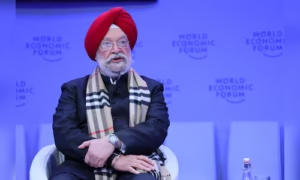
“For Palestinians in Gaza, Rafah is more than a gate, it is a lifeline and a symbol of opportunity,” Shaath said at the World Economic Forum in Davos on Thursday.
Israeli media also reported that US envoys Steve Witkoff and Jared Kushner had urged Netanyahu to reopen Rafah during their Jerusalem meetings.
Search for the last hostage
A spokesman for Hamas’ Ezzedine Al-Qassam Brigades, Abu Obeida, said on Sunday that the group had “provided mediators with all the details and information in our possession regarding the location of the captive’s body”, referring to Gvili.
Obeida added that “the enemy (Israel) is currently searching one of the sites based on information transmitted by the Al-Qassam Brigades”.
Except for Gvili, all of the 251 people taken hostage during Hamas’s October 7, 2023 attack on Israel have since been returned, whether living or dead.
A non-commissioned officer in the Israeli police’s elite Yassam unit, Gvili was killed in action on the day of the attack and his body taken to Gaza.
The first phase of the US-backed ceasefire deal had stipulated that Hamas hand over all the hostages in Gaza. Gvili’s family has voiced strong opposition to launching the second phase of the plan, which includes reopening Rafah, before they receive his remains.
“First and foremost, Ran must be brought home,” his family said in a statement on Sunday.
The Gaza war was triggered by Hamas’s October 7, 2023 attack on Israel, which resulted in the deaths of 1,221 people.
Israel’s military response levelled large parts of Gaza, home to about 2.2 million people, an area already facing severe hardship from earlier rounds of fighting and an Israeli blockade in place since 2007.
In November, authorities in Gaza said more than 70,000 people had been killed there.
End of Article