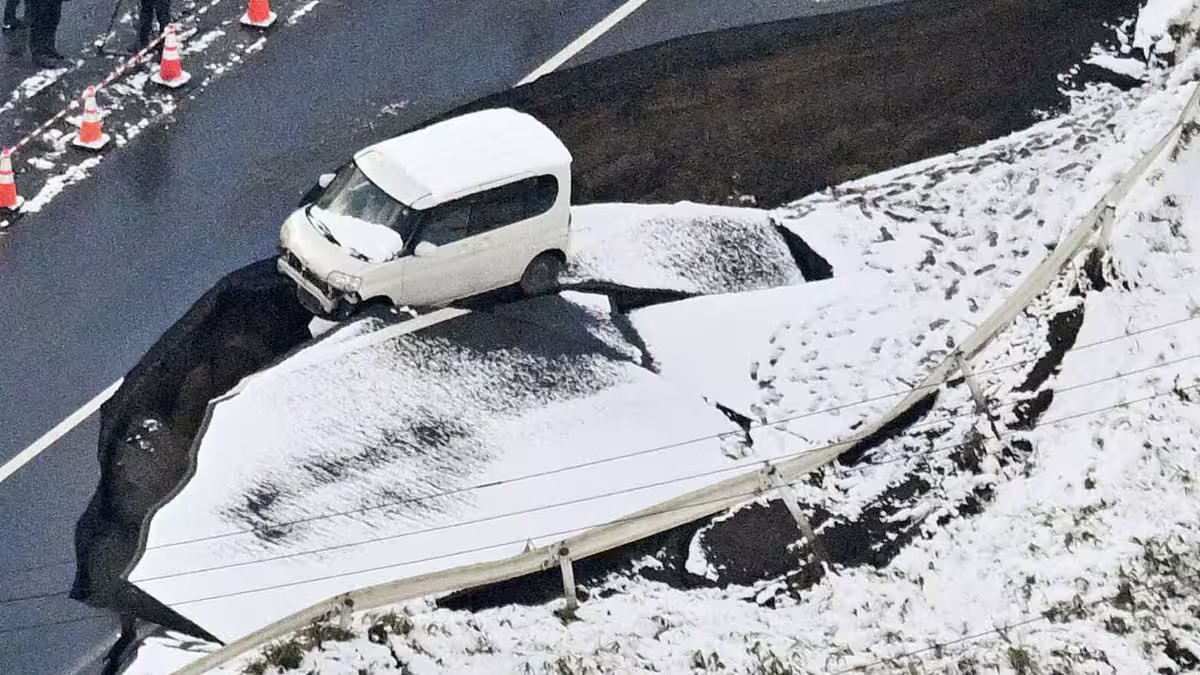
Japan’s meteorological agency is warning that a magnitude 7.5 tremblor off Aomori has temporarily raised the odds — estimated at 1 per cent — of an over 8.0 magnitude megaquake within a week. Government models show a worst-case offshore quake could generate 30-metre tsunamis, leave up to 199,000 dead, destroy 220,000 buildings, and cause $198 billion worth of damage across 182 municipalities in the north
Japan
issued a megaquake alert on Tuesday after a magnitude 7.5 earthquake struck off the eastern coast of Aomori, the northernmost prefecture of Honshu, just below Hokkaido.
The quake caused limited damage — 34 mostly minor injuries and some harm to infrastructure and buildings.
Authorities stressed that the alert is not a forecast, noting the chance of an 8.0 or stronger earthquake is only about 1 per cent.
Still, they hope the advisory prompts readiness for a disaster comparable to the 2011 catastrophe, which killed nearly 20,000 people and triggered a nuclear crisis.
Officials say the likelihood of a follow-up quake of magnitude 8 or higher is elevated over the next week. Residents, particularly along the coast, are being urged to stay prepared so they can quickly take their emergency bags and evacuate if a stronger quake strikes.
Compared with a similar notice issued last year, this advisory was more measured. In summer 2024, a “Nankai Trough” megaquake advisory for Japan’s southern Pacific coast sparked confusion, panic buying of emergency food, cancellations of major events, and temporary business closures.
A megaquake alert for Japan’s northeastern coastline
The Japan Meteorological Agency (JMA) said Monday’s strong quake briefly heightened seismic risks for regions in Hokkaido and the Sanriku coast.
This is where the Pacific Plate forms the Japan Trench and Chishima Trench, sites responsible for numerous major earthquakes.
Experts believe the deadly 2011 quake and tsunami originated from seismic movement along the Japan Trench, which runs from eastern Chiba to Aomori. The Chishima Trench extends from eastern Hokkaido to the northern islands and the Kurils.
Explaining the advisory, the JMA pointed to the sequence in 2011: the magnitude 9.0 quake that devastated much of northern Japan occurred two days after a magnitude 7.3 tremor off Iwate’s coast — the same region hit hard in Monday’s quake.
The 2011 disaster unleashed a massive tsunami that struck Iwate, Miyagi, and Fukushima prefectures, with waves reaching over 15 meters (50 feet). The surge crippled the Fukushima Daiichi nuclear plant, igniting long-term fears of radiation exposure.
A megaquake
could unleash a 98-foot tsunami and kill nearly 200,000.
Government projections show that another large offshore quake in the Hokkaido–Sanriku zone could trigger a tsunami up to 30 metres (98 feet) high, kill as many as 199,000 people, destroy up to 220,000 structures, and cause economic losses of up to 31 trillion yen ($198 billion).
As many as 42,000 people could also face hypothermia during winter.
The advisory affects 182 municipalities from Hokkaido down to Chiba Prefecture.
Japan has a separate alert system for the potentially even more destructive Nankai Trough megaquake, which threatens the southern Pacific coast. That advisory was activated for the first time last August after a magnitude 7.1 quake off Miyazaki’s eastern shore.
A 2013 government assessment for a possible Nankai Trough event suggested a magnitude 9.1 quake could generate tsunamis over 10 metres (33 feet) within minutes, kill up to 323,000 people, destroy more than 2 million buildings and inflict more than 200 trillion yen ($1.28 trillion) in damage.
Officials urge calm, caution and readiness
Authorities state that the latest advisory does not predict when or where a megaquake might occur, disaster prevention official Tsukasa Morikubo said Tuesday. He urged residents to remain careful and prepared while going about their daily routines.
People are encouraged to maintain an emergency kit with several days’ essentials, shoes, and helmets.
Families are advised to discuss evacuation steps and sleep in day clothes rather than pyjamas to allow immediate escape. Securing furniture to floors or walls is also recommended.
Municipalities covered by the advisory have posted explanations online and begun checking stocks of emergency supplies for evacuation centres.
Iwaki City in Fukushima encouraged residents to sign up for emergency alerts, and officials in Oarai, Ibaraki Prefecture, inspected wireless communication systems.
Japan’s first megaquake advisory, issued in August last year, was filled with complex scientific terminology that confused many.
Towns closed beaches and canceled seasonal events, disappointing holiday travellers.
Many people delayed trips and rushed to buy rice, dried noodles, bottled water, and portable toilets, leaving supermarket shelves bare in parts of western Japan and even in Tokyo, which lay outside the high-risk zone.
With inputs from AP