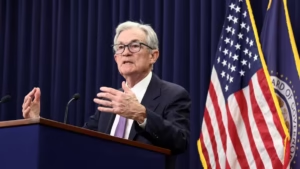
On Monday, United States President Donald Trump announced that the US and India had reached a trade agreement that would significantly reduce tariffs on Indian exports to the American market.
According to Trump, US duties on Indian goods would fall to 18 per cent from 50 per cent, contingent on India lowering trade barriers, expanding imports of US products, and ending purchases of Russian oil.
The deal, Trump said, would also remove a 25 per cent punitive tariff linked to India’s Russian oil imports that he imposed in August last year.
He added that India would shift crude purchases toward the United States and potentially Venezuela, a move Washington sees as central to weakening Moscow’s revenue streams amid
the ongoing war in Ukraine.
The agreement was later outlined in more detail by US officials, who said it included commitments by India to ramp up imports of American petroleum, defence equipment, aircraft, telecom products and pharmaceuticals under
a multi-year framework valued at $500 billion.
Despite Trump’s repeated emphasis on Russian oil, neither the Indian government nor Prime Minister Narendra Modi publicly confirmed an agreement to immediately halt such purchases.
On Tuesday, Modi welcomed the tariff reduction but made no reference to Russian energy imports in his remarks.
What Indian refiners have said
In contrast to Trump’s assertion, Indian refining sources said they had not received any instruction from the government to immediately cease buying Russian crude.
On Tuesday, two refining officials said that existing purchase agreements were still in place and would require a phased wind-down if policy guidance changed.
They noted that Indian refiners had already secured cargoes loading in February 2026, with deliveries scheduled for March 2026. These transactions, they said, could not be abruptly cancelled without commercial and logistical consequences.
The sources, who spoke on condition of anonymity to Reuters because they were not authorised to speak to the media, said any decision on future purchases would depend on formal government communication rather than political statements made abroad.
How India has been reliant on Russian crude since 2022
India became the world’s largest buyer of Russian seaborne crude after the war in Ukraine began in February 2022. As Western countries imposed sanctions on Moscow’s energy sector, Russian oil was offered at discounted prices, prompting Indian refiners to significantly increase purchases.
This shift transformed Russia into India’s top oil supplier, reshaping the country’s import mix and reducing dependence on traditional West Asian producers. The move drew criticism from Western governments seeking to curb Russia’s oil revenues and constrain its ability to finance the war.
By mid-2025, India’s Russian oil imports peaked at around 2 million barrels per day (bpd), reflecting both strong demand and attractive pricing. However, tightening US and European sanctions, along with rising compliance risks, have since slowed flows.
Trade data shows that India’s Russian oil imports fell to their lowest level in two years in December. Imports declined by about 22 per cent from the previous month to 1.38 million barrels per day, reducing Russia’s share of India’s crude imports to 27.4 per cent, the lowest level since January 2023.
At the same time, OPEC’s share of Indian oil imports rose to 53.2 per cent, an 11-month high, indicating a gradual rebalancing toward traditional suppliers.
Despite this decline, Russia remained India’s largest crude supplier in December and during the first nine months of the fiscal year ending March 31, 2026, followed by Iraq and Saudi Arabia.
Why an abrupt exit is out of the question
Industry sources say India is preparing to further reduce Russian oil imports, but not to eliminate them overnight.
One source told Reuters that New Delhi was working toward lowering imports below 1 million barrels per day, while another suggested volumes could eventually stabilise between 500,000 and 600,000 barrels per day.
Two refiners have already paused new Russian oil orders after securing volumes for February and March. One source said March cargoes might be deferred into April to manage overall intake levels.
However, refiners emphasise that future decisions hinge on government guidance and the availability of alternative supplies that meet technical specifications and price considerations.
Indian Oil Corp, Bharat Petroleum Corp and Nayara Energy have been regular buyers of Russian crude.
Reliance Industries, which paused Russian oil purchases for a month, is set to resume buying up to 150,000 barrels per day from February, according to a company executive last week.
A complete stoppage of Russian crude imports would have particularly severe consequences for Nayara Energy, a Russia-backed refiner partly owned by Rosneft.
Nayara operates a 400,000-barrel-per-day refinery that has relied exclusively on Russian oil since European Union sanctions were imposed on the company in July last year.
One refining source said that a total halt “would hurt operations at Russia-backed Nayara Energy,” highlighting the company’s limited ability to switch feedstocks under current conditions.
That said, Nayara is not planning to load Russian oil in April, as it will shut its refinery for over a month starting April 10 for maintenance. This pause, however, is operational rather than policy-driven and does not signal a permanent exit from Russian crude.
How Venezuela as an alternative is still not a realistic option for many
Trump has
repeatedly said India could replace Russian oil with supplies from Venezuela, especially after the United States eased sanctions on Venezuelan oil sales and explicitly invited India to resume purchases.
Refining sources caution that this option is limited. Only Reliance Industries and Nayara Energy have the technical capacity to process heavy crude in large volumes.
State-run refiners, they said, cannot simply switch to Venezuelan oil and would be able to replace less than 10 per cent of Russian supplies.
As a result, Venezuelan crude may supplement India’s energy mix but cannot serve as a full substitute for Russian imports, particularly for public-sector refiners.
How Russia has responded
The Kremlin has publicly rejected the notion that India has committed to halting Russian oil purchases. On Tuesday, Kremlin spokesman Dmitry Peskov said Moscow
had not received any official communication from New Delhi on the matter.
“So far, we have not heard any statements from Delhi on this issue,” Peskov said when asked whether India had decided to stop buying Russian oil.
“We respect bilateral US-Indian relations,” he added.
“But we attach no less importance to the development of an advanced strategic partnership between Russia and India. This is the most important thing for us, and we intend to further develop our bilateral relations with Delhi.”
What’s at stake for Indian companies in Russia
Indian companies hold significant investments in Russia’s upstream energy sector, complicating any attempt to sharply downgrade the relationship.
ONGC Videsh, the overseas arm of Oil and Natural Gas Corp, holds a 20 per cent stake in the Sakhalin-1 oil and gas project in Russia’s far east.
Indian Oil Ltd, Oil India Ltd and Bharat PetroResources collectively own a 23.9 per cent stake in JSC Vankorneft and a 29.9 per cent stake in Taas Yuryakh Neftegazodobycha, both subsidiaries of Rosneft. ONGC Videsh also owns a 26 per cent stake in Vankorneft.
Oil India additionally holds a 50% stake in the Russian oil block License 61.
Millions of dollars in dividends owed to Indian firms from these assets remain trapped in Russian banks, underscoring the financial exposure Indian companies continue to have in the country.
Russia has sought India’s support in boosting Nayara Energy’s local fuel sales and improving capacity utilisation, particularly as other suppliers have withdrawn.
So, what does this all mean?
Taken together, the available facts point to a gradual recalibration rather than a sudden rupture. India has already reduced Russian oil imports, diversified supply sources, and signalled willingness to expand energy trade with the United States.
At the same time, existing contracts, refinery constraints, upstream investments, and geopolitical considerations make an immediate halt unrealistic.
An Indian government official said New Delhi would gradually increase imports of US petroleum and other goods as part of the agreement.
“It will be done over the years,” the official said, adding that a more comprehensive pact between the two countries
would be negotiated in the coming months.
While Trump has framed the trade deal as resolving a “longstanding oil issue,” Indian refiners continue to lift Russian cargoes, and Moscow says it has received no confirmation of a policy shift.
Also Watch:
With inputs from agencies
(Disclaimer: Firstpost is a part of the Network18 group. Network18 is controlled by Independent Media Trust, of which Reliance Industries is the sole beneficiary.)
End of Article