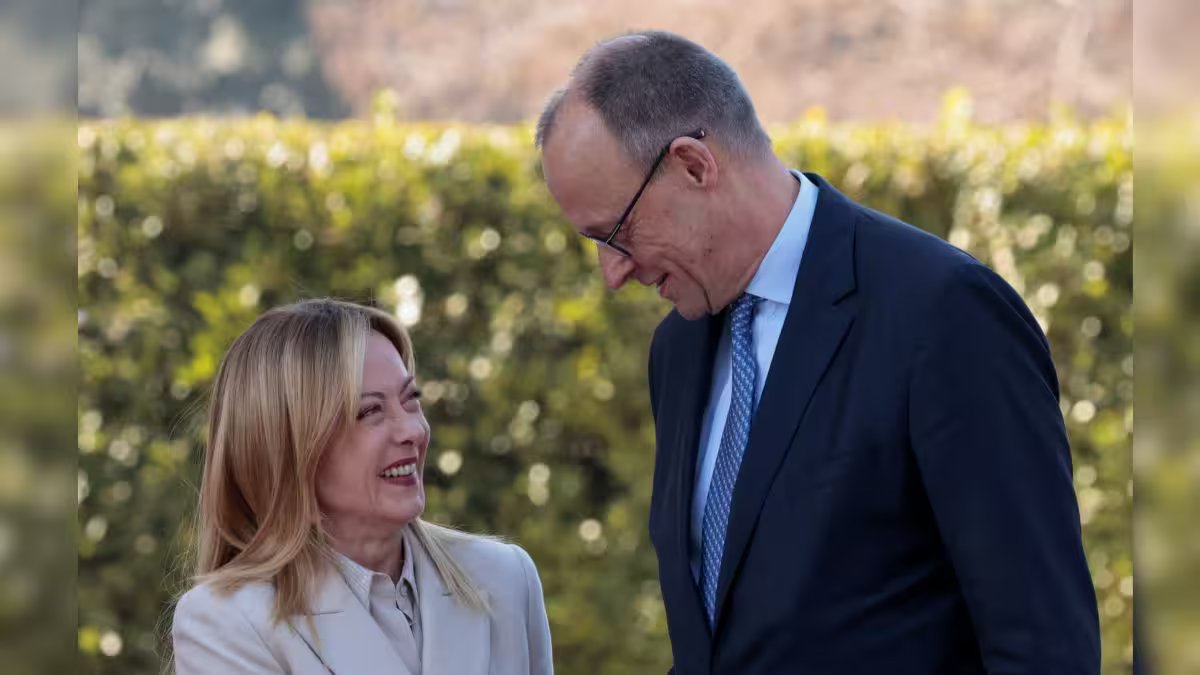
From commercial agreements to the auto industry, Italian Prime Minister Giorgia Meloni and German Chancellor Friedrich Merz are increasingly coordinating their efforts to shape the European Union’s direction — raising concerns that French President Emmanuel Macron could be pushed to the margins.
At Thursday’s EU leaders’ summit, the right-wing Meloni and centre-right Merz are expected to advocate a common blueprint aimed at strengthening the bloc’s competitiveness.
Their stance marks another step in the deepening collaboration between Rome and Berlin, prompting questions about the durability of the EU’s long-standing Franco-German partnership.
“Some observers say that 2026 will be the year of Italy and Germany,” Meloni said last month at a summit with Merz in Rome.
“We intend to give it our all… to consolidate a friendship that is strategic not only for our nations, but for Europe as a whole.”
Although the two have long shared a firm position on migration, they agreed in Rome to broaden coordination across areas ranging from trade to defence.
In recent months, they have frequently found themselves on the same side of debates in Brussels.
In January, after initial hesitation, Meloni ultimately endorsed the EU’s trade pact with South America’s Mercosur bloc — a move welcomed in Berlin.
France, traditionally Germany’s closest partner within the EU, sought unsuccessfully to halt the agreement, citing risks to its agricultural sector.
Germany and Italy also joined forces to push for easing the EU’s planned 2035 phase-out of new petrol and diesel vehicles — another initiative France opposed but failed to stop.
“What I’m hearing is that the Franco-German axis isn’t working; Meloni and Merz are doing their own thing together,” one European diplomat told AFP on condition of anonymity.
‘Parallel convergence’
Like France, both Italy and Germany were among the EU’s founding members and remain key NATO allies.
Historically, however, Rome and Berlin have frequently clashed, particularly over fiscal matters — with Germany advocating budgetary discipline and Italy grappling with heavy debt.
That equation has begun to shift. Meloni has worked to reduce Italy’s deficit, while Merz has departed from Germany’s traditional fiscal restraint by increasing borrowing and public investment.
In foreign affairs as well, both leaders have aimed to maintain constructive ties with US President Donald Trump.
“I’d describe it as a parallel convergence,” said Matteo Villa of Italy’s ISPI think tank.
“The die is cast, and the time is coming when these two are more compatible than the classic France-Germany pairing,” he told AFP.
Italian Foreign Minister Antonio Tajani told Il Messaggero daily in an interview on Wednesday that the Italy-Germany partnership echoed the close cooperation seen at the EU’s inception.
“A new season is beginning: Italy has a leading role, it wants to be one of the locomotives of the EU,” he said.
He described Italy and Germany as the bloc’s “two most industrialised and stable countries”.
‘Moving Europe forward’
French President Emmanuel Macron, whose administration has faced political turbulence since the snap elections of 2024, has dismissed claims that France is being sidelined.
In remarks to several European newspapers published Tuesday, he said it was “normal” for Rome and Berlin to put forward joint proposals following their bilateral summit.
“The Franco-German partnership is essential for moving Europe forward. But it is never enough on its own,” he said.
Macron pointed out that he and Meloni are due to convene their own Italy-France summit in the coming weeks — likely in April in Toulouse, according to diplomatic sources.
Nevertheless, relations between Macron and Merz appear to have cooled.
Diplomats indicate that France’s efforts to derail the Mercosur agreement generated friction in Brussels and among fellow member states, including Germany.
At the same time, Germany is reportedly considering withdrawing from the troubled Future Combat Aircraft System (FCAS) — a joint fighter jet initiative with France and Spain that has faced months of delays due to disputes between industry partners.
Instead, Berlin is said to be evaluating participation in Italy’s Global Combat Air Programme (GCAP), alongside Britain and Japan.
“The gaps between Paris and Berlin mean Berlin is having to look to other partners,” Thomas Maddock, a fellow at the Centre for European Reform in London, told AFP.
An editorial in Germany’s Bild newspaper was even more blunt.
“Merz knows that for Europe to have a voice internationally, he needs strong partners at his side,” it wrote. It added, “Unlike France, Italy is now a country with a stable government and a successful economy.”
Also Watch:
With inputs from AFP
End of Article