Three days after the death of Ayatollah Ali Khamenei was announced, following the US-Israeli strikes in Iran, it has been reported that the senior clerics of the Islamic Republic have met and made their choice for the next supreme leader.
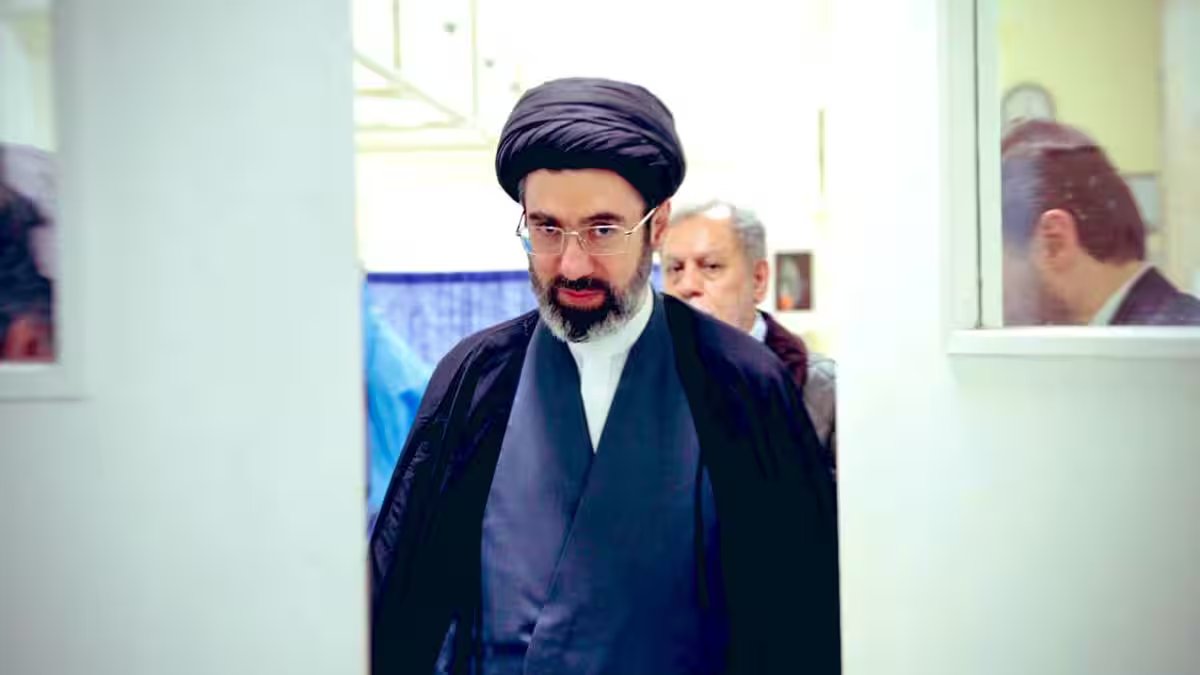
Meeting on Tuesday (March 3), the clerics deliberated on who should be elected the next supreme leader, and with a little push from the all-powerful Islamic Revolutionary Guard Corps (IRGC), the late Ayatollah’s son,
Mojtaba, has been elected to succeed him.
However, an official announcement on the same is still to be made, with reports stating that some clerics have expressed their reservations, fearing that it could expose the 56-year-old as a target for the United States and Israel.
But who exactly is Mojtaba Khamenei? How rich is he? And what does his appointment mean for the future of Iran?
Mojtaba: the next supreme leader of Iran
Fifty-six-year-old Mojtaba is the second son of the late
Ayatollah Ali Khamenei. He was born in 1969 in Mashhad, an important religious centre in Iran, about a decade before the Islamic Republic was established in 1979.
Mojtaba joined the Islamic military corps around 1987 after finishing high school. During the Iran-Iraq war, he served in the Habib Battalion, enabling him to forge relations with figures who eventually rose up in Iran’s security apparatus. When his father was elevated to the position of supreme leader, Mojtaba went on to study with the country’s most esteemed clerics in Qom, and to teach in a religious seminary himself.
In 2004, Mojtaba reportedly married Zahra Haddad-Adel, the daughter of Gholam-Ali Haddad-Adel, an Iranian conservative politician and former Chairman of the Parliament. They reportedly have three children together, though not much is known about the kids. Notably, his wife, Zahra, is among those who
died in the US-Israel strikes on Saturday.
Mojtaba has largely remained out of the limelight. However, in 2005, when conservative candidate Mahmoud Ahmadinejad was elected president, many accused Mojtaba of working with religious leaders and the Revolutionary Guards to ensure the victory of the relatively unknown candidate they preferred.
Mojtaba Khamenei also has close ties to the powerful
IRGC, which reportedly backed him to become the next supreme leader. His ties to the group go back decades. For years, he has been a key channel between his father and the Guard’s leadership. That gives him a rare position. He is close to the security core, but also linked to the civilian and clerical leadership that depends on it.
Mojtaba and his sprawling property empire
Mojtaba, the 56-year-old, has a significant overseas real estate network worth millions of dollars. A report by Bloomberg states that the future Iranian supreme leader has properties and financial assets worth well over £100 million (Rs 1,229 crore). Notably, a significant concentration of this wealth is located in London’s elite “Billionaire’s Row”, where 11 properties tied to his network are now valued at around £100 million.
However, none of the properties or assets are in Mojtaba’s name. Investigations reveal a web of offshore companies, all eventually leading to him.
Among the many assets and properties is a house worth €33.7 million (Rs 360 crore), which was purchased in 2014 in one of London’s most exclusive neighbourhoods, as well as a villa in an elite Dubai district. There are also upscale European hotels from Frankfurt to Mallorca, which are part of Mojtaba’s property portfolio.
According to the Bloomberg report, funds for the transactions have been routed through accounts at banks in the UK, Switzerland, Liechtenstein, and the United Arab Emirates. The funds originate primarily from Iranian oil sales. None of the documents lists assets directly in Mojtaba’s name. Instead, many of the purchases appear in the name of an Iranian businessman, Ali Ansari, sanctioned by the UK in October.
As Farzin Nadimi, a senior fellow at the Washington Institute for Near East Policy, said: “Mojtaba has major stakes or de facto control in various entities throughout Iran and abroad. When you analyse his financial network, Ali Ansari is the main account holder for him. This positions Ansari as one of the most influential oligarchs in the country today.”
However, in a statement through his lawyer, Ansari said he “strongly denies that he has ever had any financial or personal relationship with Mojtaba Khamenei” and said he would challenge the UK sanctions.
Interestingly, Mojtaba has US sanctions placed on him in 2019 after Washington alleged that Ali Khamenei had delegated aspects of his authority to his son, who was said to act in an official capacity without public accountability.
What Mojtaba’s appointment signals for Iran
Mojtaba’s elevation to the top could anger many Iranians, as hereditary rule has been frowned upon in the Islamic Republic. In fact, in 2024, Iran’s Assembly of Experts met to plan the supreme leader’s succession. Ayatollah Khamenei said at that time that his son should be excluded from consideration.
However, the IRGC, as per a report in Iran International, heavily pressured the body of clerics to back Mojtaba. “The IRGC heavily pressured the assembled group of clerics to select Mojtaba as the regime’s new leader,” the outlet reported.
As per the news outlet, the IRGC needs two things: control and legitimacy. And Mojtaba offers both of these aspects to the IRGC. The 56-year-old can claim direct continuity with Khamenei, and the core base can accept him without feeling the system has broken.
Moreover, selecting Mojtaba sends a message that hard-liners tied to the Revolutionary Guards remain in charge, suggesting little would soon change, reports the New York Times.
Mojtaba’s selection could also anger Iranians; many would perceive the 56-year-old to be a continuation of his father’s rule, which has been dubbed tyrannical. Mehdi Rahmati, an analyst in Tehran, told the New York Times, “A portion of the public will react negatively and forcefully to this decision, and it will have a backlash.”
However, he noted that Mojtaba is the wisest choice for Iran. “He (Mojtaba) is intimately familiar with running and coordinating security and military apparatuses. He was in charge of this already.”
With inputs from agencies
End of Article