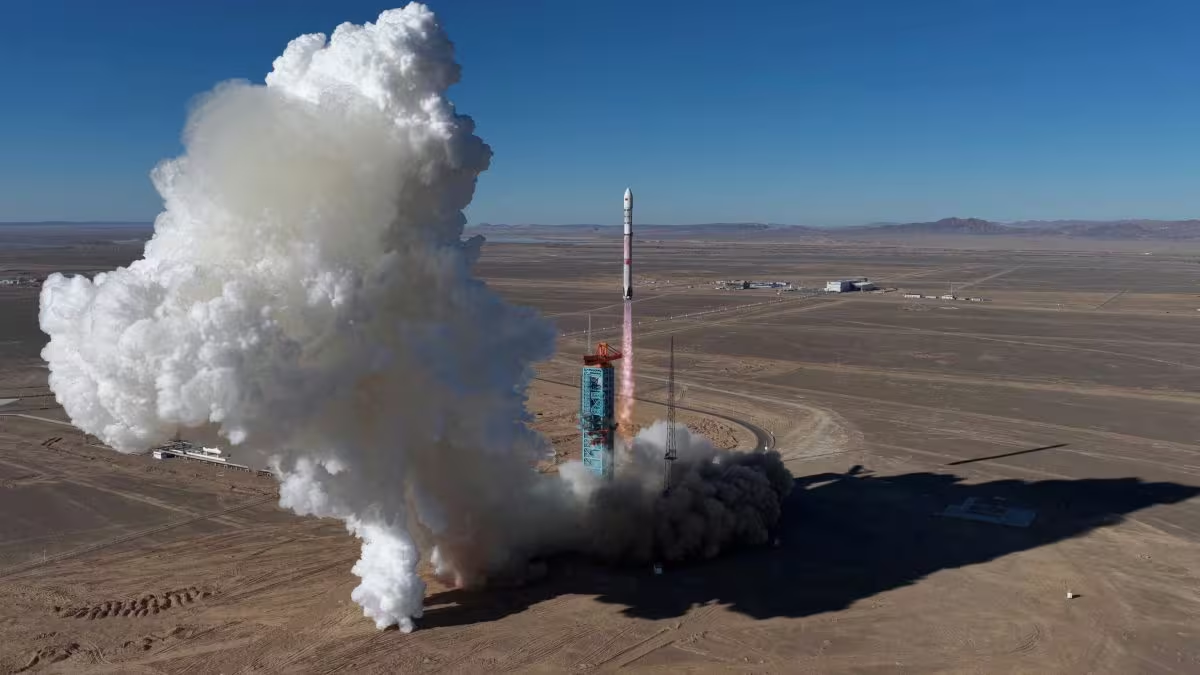
LandSpace is pushing toward public markets after attempting China’s first reusable rocket test, signalling a faster, more experimental phase in the country’s commercial space race inspired by SpaceX.
China’s commercial space race is gathering pace as private startup LandSpace moves closer to public markets after attempting the country’s first reusable rocket test. The Beijing-based company has openly drawn lessons from Elon Musk’s SpaceX, positioning itself as a low-cost launch contender at a time when China is planning vast satellite constellations and encouraging private capital into the sector.
Earlier this month, LandSpace became the first Chinese entity to conduct a reusable rocket test, placing it alongside global peers pursuing rapid iteration and recovery-based launches. Although the test of its Zhuque-3 rocket ended unsuccessfully, the attempt has energised an industry long dominated by cautious, state-owned players. The company is now preparing for an initial public offering to fund future projects, mirroring discussions around a potential IPO by its far larger and more established US rival.
“(SpaceX) can push products to the edge and even into failure, quickly identifying limits and iterating,” Zhuque-3 chief designer Dai Zheng told state broadcaster CCTV after the rocket’s inaugural flight.
Dai said his move in 2016 from the China Academy of Launch Vehicle Technology, the country’s main state-owned rocket developer, to LandSpace was partly driven by SpaceX’s emphasis on reusability and his ambition to develop a Chinese equivalent.
LandSpace’s aim of offering China a low-cost launch option comparable to SpaceX’s flight-proven reusable Falcon 9 is expected to play a central role in Beijing’s plans to deploy 10,000 satellite constellations over the coming decades.
“Falcon 9 is a successful configuration that has been tested by engineering,” Zhuque-3’s deputy chief designer Dong Kai said in a podcast interview last week. “After studying it, we recognize its rationality; this is learning, not imitation.”
“Calling (Zhuque-3) a ‘Chinese Falcon 9,’ I think, is a very high compliment.”
The company’s startup culture and openness to experimentation have already triggered a shift in China’s space industry. State-led programmes have traditionally avoided publicising failures, unlike SpaceX and other Western firms that routinely broadcast mishaps. This month, however, state media reported China’s first two failed attempts to recover a reusable rocket, including one by a state-owned company just three weeks after Zhuque-3’s maiden flight.
LandSpace has also taken the unusual step of opening its engine factory floor to Reuters, giving foreign media a first look at one of its core assets.
Since Beijing opened the space sector to private investment in 2014, a wave of startups including LandSpace has emerged. Authorities are now seeking to help leading domestic players access capital markets by easing paths to IPOs.
Dai said SpaceX’s strong financial backing had enabled it to absorb heavy losses during testing of Starship, its reusable launch vehicle.
“For us, we’re not yet able to do that,” Dai told CCTV.
“I believe our country has recognized this, allowing capital markets to support companies (in areas) like commercial space flight.”
A month before LandSpace’s Zhuque-3 launch, Musk had already commented publicly on the rocket’s design. Responding on X to a video showing its assembly, he said the Chinese rocket combined elements of SpaceX’s Starship with a Falcon 9-style layout.
“They have added aspects of Starship, such as use of stainless steel and methalox, to a Falcon 9 architecture, which would enable it to beat Falcon 9,” Musk said in October, in his first public remarks about LandSpace.
Features such as stainless steel structures and engines powered by methalox, a blend of methane and liquid oxygen, are among the approaches companies like SpaceX and LandSpace are using to drive down launch costs. The most significant saving, however, comes from launching a rocket and then recovering and reusing its first-stage booster.
As LandSpace prepares for another launch following the December failure, when Zhuque-3’s booster was unable to ignite its landing burn 3 km from the ground and crashed instead of making a controlled descent, the company may find reassurance in SpaceX’s early experience. SpaceX achieved its first successful Falcon booster landing in 2015, after two failed attempts.
End of Article