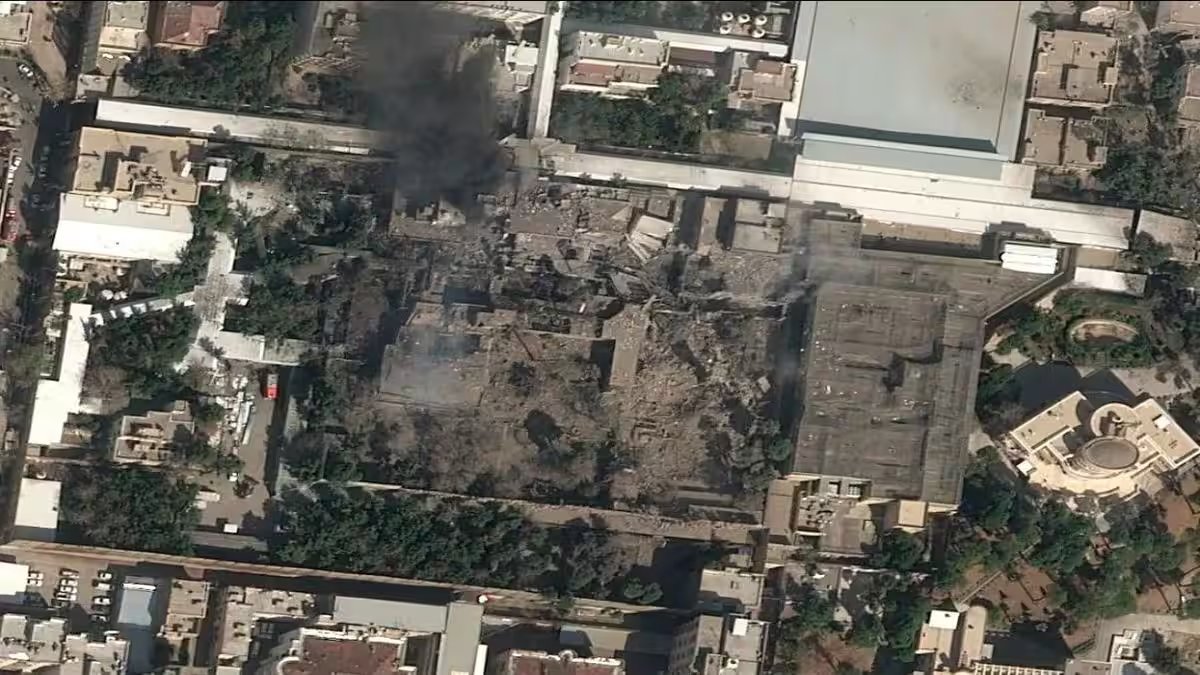
Saturday’s joint strikes by the US and Israel against Iran had one major target — the country’s Supreme Leader Ayatollah Ali Khamenei. Images have surfaced revealing the complete destruction of his presidential compound situated in Tehran. However, the 86-year-old was reportedly not at the location at the time of the attacks
Israel and the United States have launched a war on Iran, with Donald Trump declaring the start of “major combat operations” and calling on Iranians to rise up against their government.
Soon after, Iran retaliated with its own strikes on Israel and US military bases across West Asia, plunging the already volatile region to the brink of war. Explosions have been heard in Bahrain, where the US Navy’s 5th fleet is based, as well as in the UAE, Jordan and Qatar.
As fighting continues — Iran continues to deploy missiles — images have emerged of the total destruction of the compound that houses the residence and offices of Iran’s Supreme Leader, Ayatollah Ali Khamenei.
It has also prompted questions of the 86-year-old’s location. Here’s what we know so far.
Ayatollah Ali Khamenei — US and Israel’s main target
Hours after Israel and the United States launched a massive wave of strikes across Iran on Saturday (February 28), the picture of what was happening on the ground in Tehran and other cities emerged clearly.
Among the targets struck was the Tehran palace of Iran’s
Supreme Leader Ali Khamenei, which was completely destroyed, as well as dozens of other military and regime targets across the country. Khamenei, President Masoud Pezeshkian and top regime and military commanders were targeted, according to an Israeli official, though the results of the strikes were unclear.
However, several reports have stated that
Khamenei himself was unhurt as he had been moved from Tehran before the strikes. A Reuters report stated that the Iranian leader had been transferred to a secure location at the time.
In fact, Hamidreza Gholamzadeh, director of Diplo House, a think tank on Iranian foreign policy, told the BBC that it seemed that the Iranians had a “sixth sense” of the attacks. “When the news came out that Trump was saying he wants a deal with Iran, many people were saying it seemed dangerous and a cover for a possible attack against Iran,” he said. “We see that the sixth sense of people in Iran is correct when it comes to the distrust they have of the United States.”
And, perhaps, it was this foreboding that allowed the country’s supreme leader to remain untouched in the strikes.
Significant damage to Khamenei’s compound
While Khamenei may have escaped the attacks unscathed, satellite imagery published by The New York Times shows that the palace in the heart of Tehran was completely destroyed, with smouldering rubble seen where the once-grand building stood hours earlier.
Killing Khamenei was one of Trump’s earlier options
The attack on Khamenei’s compound isn’t a complete surprise.
While Donald Trump was mulling options against Iran in the days before Saturday’s strikes, Pentagon officials had presented him with one plan, which included the assassination of Khamenei and his son,
Mojtaba, according to an Axios report.
A second source, according to the US news outlet, confirmed the plan to kill Khamenei and his son was floated to Trump several weeks ago.
“They have something for every scenario. One scenario takes out the ayatollah and his son and the mullahs,” a presidential adviser reportedly said. The report said the plan was first floated to Trump several weeks ago.
Many assassination attempts against Khamenei
This is not the first time that Iran’s Ayatollah Ali Khamenei has been the target of an attack. In 1981, Khamenei narrowly survived a major assassination attempt while he was delivering a speech at the Abuzar Mosque in Tehran. At the time of the attack, he wasn’t the country’s supreme leader.
A bomb hidden inside a tape recorder was placed near the podium where he was speaking. The device exploded moments after he began his address. He was seriously wounded in the blast. His right arm was severely injured and permanently paralysed. He even suffered injuries to his lungs and vocal cords.
Years late, in 1985, a suicide bombing rocked a Friday prayer session at Tehran University, targeting Khamenei.
In 2025, Israel launched a surprise attack on key military and nuclear sites in Iran. Following the strike, Khamenei was moved to a fortified underground bunker in Tehran with his family, where he remained largely cut off from external communications.
With inputs from agencies
End of Article