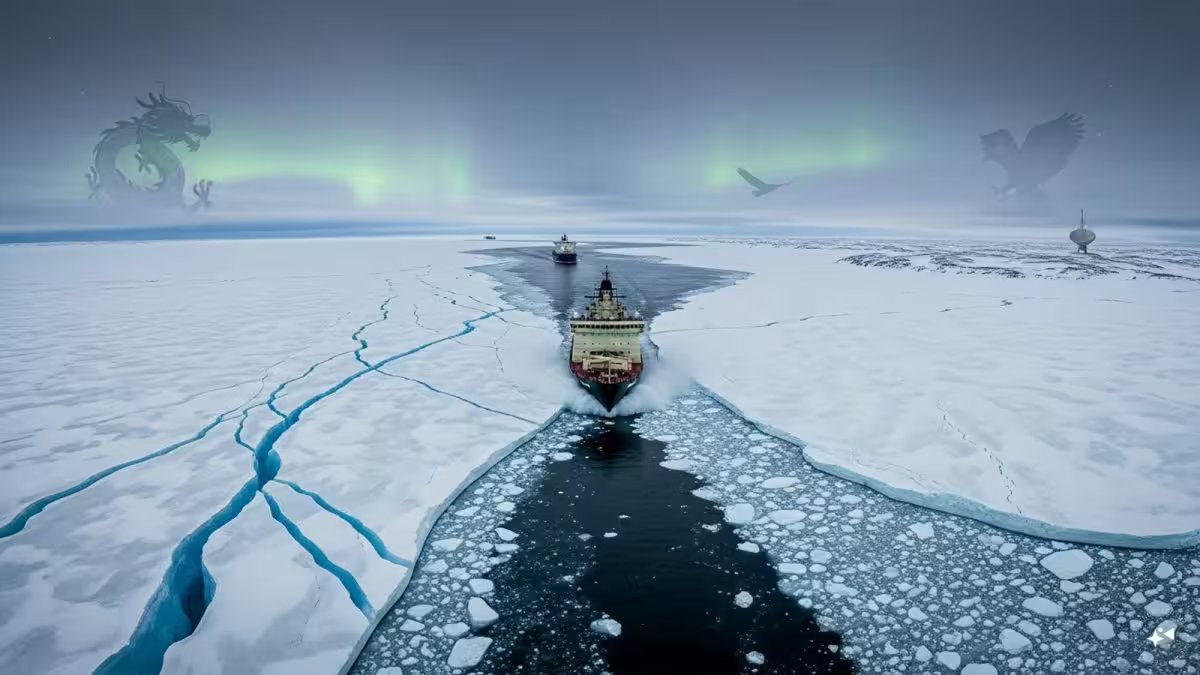
Beijing’s Polar Silk Road expansion into the Arctic triggers a fresh confrontation with Trump and the West, turning melting ice into a high-stakes battleground for global trade and military dominance.
The Arctic was once a peripheral concern for global superpowers, defined by its isolation and impenetrable ice. Today, it has emerged as a high-stakes geopolitical arena. Beijing’s formal inclusion of the “Polar Silk Road” into its Belt and Road Initiative has heralded a shift in global trade and security dynamics, causing ripples from Washington to Copenhagen.
As climate change thaws historic shipping lanes, China is positioning itself as a “near-Arctic state,” a self-appointed title that suggests its influence should extend far beyond its geographical borders.
The thawing gateway and economic leverage
The logic behind China’s Arctic push is rooted in both commerce and energy security. The Northern Sea Route (NSR), which skirts Russia’s coast, offers a shortcut between East Asia and Europe, potentially slashing transit times by up to 20 days compared to the traditional Suez Canal route. For a nation reliant on exports, this isn’t just a convenience; it is a strategic safeguard against maritime chokepoints in the South China Sea.
However, the West views these economic investments with deep scepticism. In places like Greenland, China has attempted to fund airport expansions and mining projects targeting rare earth minerals, materials essential for the green energy transition and military hardware. While Beijing frames these as purely commercial ventures, Western intelligence agencies fear they serve as “dual-use” foundations. An icebreaker built for research can easily be repurposed for surveillance and a commercial port can provide a footprint for the People’s Liberation Army Navy.
Trump’s return and the battle for Greenland
The geopolitical friction has intensified with the return of Donald Trump to the White House. During his first term, Trump’s unconventional proposal to buy Greenland was mocked by many, but the underlying intent was clear: American dominance in the North Atlantic is non-negotiable. With Trump 2.0, the focus has shifted toward aggressive “de-risking” and preventing Chinese capital from anchoring itself in the Arctic.
Washington’s strategy involves revitalizing the Thule Air Base (now Pituffik Space Base) and offering economic alternatives to Arctic nations to steer them away from Chinese loans. The US and its Nato allies are concerned that if China secures a foothold in Greenland or Iceland, it could monitor sensitive military movements and disrupt the “GIUK gap”, the naval corridor vital for North Atlantic defence. For Trump, the Arctic is not a global common to be shared, but a sovereign shield that must be protected from “predatory” Chinese investments.
Environmental diplomacy meets strategic competition
China’s Arctic trajectory is not limited to hard infrastructure. Beijing has invested in environmental research and governance initiatives, presenting itself as a player in regional climate science. However, sceptics note this activity often dovetails with broader geopolitical aims: securing influence in international governance forums and harvesting scientific data that has commercial and strategic value.
Climate change is accelerating the melting of sea ice, opening new shipping corridors such as the Northern Sea Route along Russia’s Arctic coast. For Beijing, these corridors offer shorter transit times between East Asia and Europe, presenting a commercial alternative to the Suez Canal. Chinese shipping firms, backed by state credit, are exploring these routes even as Western carriers remain cautious amid navigational risks.
At the same time, Beijing’s engagement with Russia itself an Arctic heavyweight complicates diplomatic dynamics. Joint energy projects, port cooperation and satellite data sharing solidify a Sino-Russian footprint north of the 66th parallel. For the West, managing this footprint requires coordination across defence, energy and climate policy, a challenge made harder by differing national views on engagement with China.
End of Article