
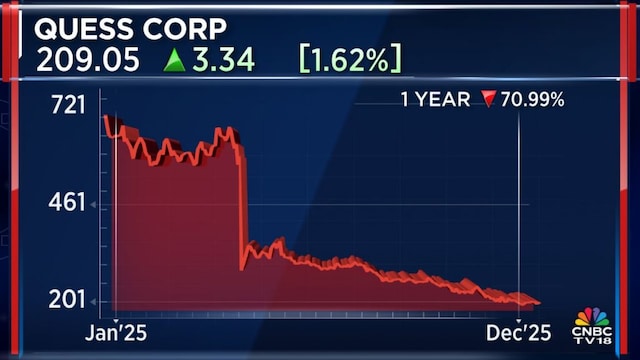
Bengaluru-based Quess Corp has a market capitalisation of about ₹3,107 crore, with its shares down nearly 71% over the past year. Bhatia noted that 2025 was policy-heavy, pointing to income tax relief, four repo rate cuts by the Reserve Bank of India, the rollout of a large production-linked incentive (PLI) scheme, and reforms such as GST 2.0 and the new labour codes.
He said these measures have improved visibility for businesses and hiring. “As we navigate into the January-March quarter of 2026 (Q4FY26) and as we go and plan for the next financial year 2026-27 (FY27), our customers and we are pretty confident that the next year and the years thereafter will be pretty resilient,” Bhatia said.
On technology, he said that while traditional IT services firms are recalibrating, demand for Global Capability Centres (GCCs) and tech talent remains strong, supported by India’s demographic advantage, deep talent pool and cost competitiveness. “India is poised to rise even further as far as the GCC and the technology space is concerned,” he added.
Also Read: Non-IT sectors lead India’s hiring rebound in 2025, AI roles surge, says Naukri’s Pawan Goyal
On BFSI, Bhatia said hiring slowed in 2025 due to regulatory headwinds but sees scope for a sharp rebound as India’s economy expands from about $4 trillion to $7 trillion over the next five years. This, he said, could drive a 75% increase in capital flows, requiring a larger financial services workforce. “This deal flow or any deal flow is just giving you an indication of things to come,” he said, referring to a recent large transaction.
He added that BFSI hiring is spreading beyond metro cities. “The expansion is now into Bharat as well, whether it’s for credit cards, whether it’s for loans and lendings, whether it is for the banking establishment,” Bhatia said, noting that wider adoption of the India Stack and easier onboarding are likely to support incremental hiring across the sector.
For the entire interview, watch the accompanying video