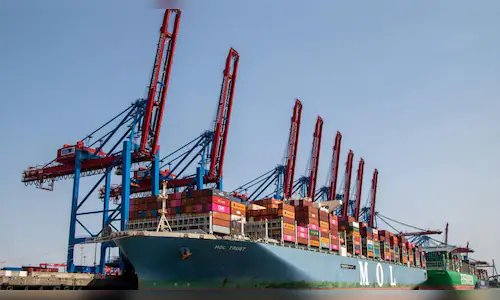
The suspension of future sailings to and from or through the Middle East by several shipping lines is being described by several exporters as a risk-management response to escalating geopolitical tensions.
President of the Federation of Indian Export Organisations (FIEO) SC Ralhan told CNBC-TV18 that in the current situation, carriers have stopped accepting fresh bookings and may roll cargo to later sailings, or even discharge containers at alternate ports, depending on risk advisories and naval guidance.
Describing the imposition of an Emergency Conflict Surcharge ranging from $2,000 to $4,000 per container as an extraordinary measure to offset sharply rising war-risk insurance premiums, additional crew allowances, security arrangements, and higher operating costs, he added that most Bills of Lading contain war-risk or liberty clauses that legally permit carriers to impose such surcharges under exceptional circumstances.
He noted that while exporters may find this increase burdensome, shipping lines typically rely on these contractual provisions to recover incremental risk costs.
As many carriers are choosing to avoid the Suez Canal and the Red Sea, rerouting vessels via the Cape of Good Hope will add nearly 10–15 days to Europe-bound cargo and even longer to North America, thus significantly increasing bunker consumption and reducing effective vessel capacity. He said that longer voyage durations may tighten global container availability, which in turn may lead to upward pressure on freight rates.
He added that exporters are understandably concerned about whether additional freight can be demanded even after issuance of the Bill of Lading. In practice, if contractual clauses allow contingency or war-related adjustments, carriers may levy supplementary charges despite earlier freight confirmation.
For perishable cargo, particularly fruits and vegetables destined for Gulf markets during the Ramadan period, he highlighted heightened risk, as marine insurance may cover physical damage but typically does not compensate for loss of market due to delayed arrival. He pointed out that although refrigerated containers can preserve temperature integrity, extended transit times may increase operational risk, potential quality deterioration, and the possibility of commercial rejection.
Cargo already under sail but yet to cross the Red Sea presents another layer of concern for exporters. He indicated that in extreme scenarios, vessels may be diverted or a General Average declared, requiring cargo owners to provide financial guarantees before release. Exporters are also apprehensive that prolonged transit will delay document presentation under Letters of Credit or other payment terms, stretching receivable cycles and affecting liquidity, particularly for MSMEs.
Further, demurrage and detention charges may accumulate if congestion or disruption persists. While FIEO expects waivers under force majeure conditions, ports and shipping lines do not automatically grant relief without formal notification or regulatory intervention. In this backdrop, he said that there is merit in considering a coordinated government-level response mechanism or “war room” to monitor developments in real time, engage with shipping lines and insurers, and facilitate policy support measures to cushion exporters and importers from systemic trade disruption.
Also Read: US-Israel-Iran War: India’s Basmati rice exports hit as 2-4 Lakh tonnes stuck at ports