Under the agreement, the United States will lower tariffs on Indian goods to 18%, down from the earlier 50% level that included a punitive levy. The announcement triggered a strong rally across Dalal Street, with benchmark indices surging, the rupee strengthening sharply against the dollar, and more than ₹12 lakh crore added to market capitalisation in a single session.
Industry leaders speaking to CNBC-TV18 said the deal removes a key uncertainty that had been weighing on export-oriented sectors, particularly labour-intensive industries such as textiles, leather, gems and jewellery, and marine exports.
Setting the tone, CII President Rajiv Memani described the development as “very positive” for the sectors that were impacted by previous tariffs. He noted that the US is India’s largest trading partner for merchandise exports, accounting for nearly 20%, and the tariffs had particularly hurt labour-intensive sectors.
“This is one sort of uncertainty off,” Memani stated, highlighting that the resolution of this issue would bolster India’s growth story. He added that the deal aligns with the ‘Make in India’ initiative and efforts to establish alternative supply chain routes, contributing positively to India’s goal of becoming a competitive manufacturing hub.
Read Here | Kotak’s Nilesh Shah on US tariff relief: ‘Devil is always in the details’
Amit Kalyani, Vice Chairman and Joint MD of Bharat Forge focused on the implications for the defence sector, noting that the strategic relationship in defence has grown much stronger over the last five years.
He believes the trade deal provides the “building blocks in place to leverage and to really scale up our relationship.” Kalyani pointed out the synergy between Indian companies’ manufacturing capabilities in components and subsystems and the US’s hold on critical, high-end technology like navigation systems and sensors.
For his company, the key benefit is clarity. “What this does is it gives a lot of clarity and transparency to our customers… It changes the perspective from a short to medium term to a longer term,” he explained, allowing for better long-term strategic engagement with customers.
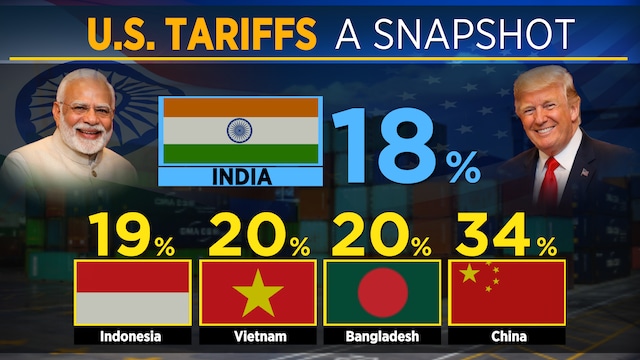
The pact is seen as a major relief for severely affected, labour-intensive industries. Sanjay Budhia, Chairman of the CII National Committee on Exports called it a “real great win-win situation,” noting that sectors like textiles, shrimp, and leather were gearing up to utilise their capacities. He viewed the agreement, coming soon after the EU trade deal, as a testament to India’s enhanced position on the global stage.
Providing a stark picture of the impact, Suvankar Sen, MD & CEO of Senco Gold & Diamonds, detailed the damage to the gems and jewellery sector, a major exporter to the US. He revealed that over the last nine months, exports of cut and polished diamonds had plummeted by 60%, studded diamond jewellery by 24.5%, and plain gold jewellery by 29%. “You can easily imagine the kind of negative impact this whole higher duties… was,” he said.
The reduction of duties from as high as 50% to a proposed 18% is a “big relief.” Sen also expressed hope that the final agreement might include a 0% duty for loose diamonds and gemstones, which would further boost the sector by allowing India to supply raw materials for US manufacturing.
For the entire discussion, watch the accompanying video
Read Here | US trade deal done, fund managers now watch earnings and foreign flows