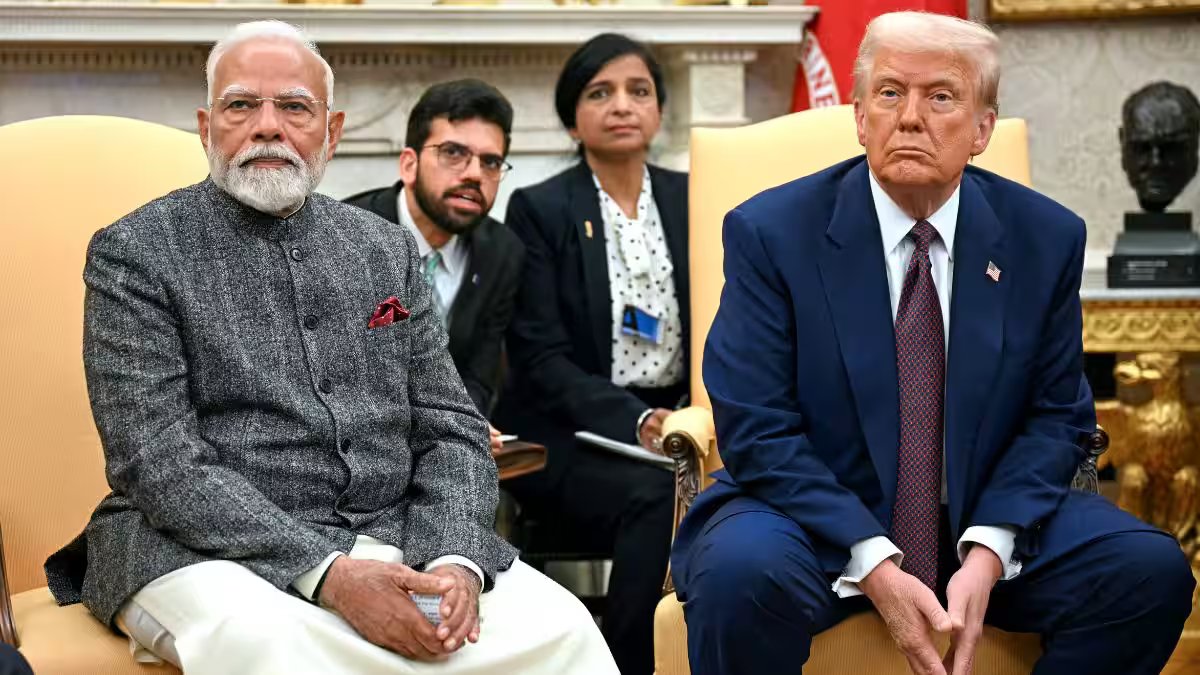
Shortly after US President Donald Trump won the 2024 election, a survey found that Indians led the world in cheering for the result — 78 per cent of Indian respondents welcomed his victory over Democratic nominee Kamala Harris.
Within weeks of assuming office, Trump plunged the India-US relationship to its lowest point since the end of the Cold War. He undermined Operation Sindoor, repeatedly violated all red lines on Kashmir, aligned himself with Pakistan, blamed India for his failure to end the Russia-Ukraine war, and strengthened China’s hand in the Indo-Pacific.
Trump topped these actions with 50 per cent tariffs on India — the highest for any country.
Commentators and officials in India misread Trump and his Maga movement, believing his second term would mirror his first, according to Anil Raman, head of the US programme at the Takshashila Institution.
In sharp contrast, Pakistan’s relationship with the United States has completely changed in Trump’s second term. While former President Joe Biden had shoved the regime into irrelevance, not holding even a call with a Pakistani leader in four years, Trump has hosted Army chief Asim Munir twice at the White House and signed a slew of deals.
Unlike India, Pakistan understood early that Trump’s second term would not be driven by ideology but by the pursuit of personal enrichment, says Raman.
For Pakistan’s kleptocratic hybrid regime of Munir and Prime Minister Shehbaz Sharif, promising Trump and his friends riches through critical mineral and cryptocurrency deals —and boosting his megalomania with unabashed sycophancy— came easily. India’s political culture would not have allowed any leader to do that.
And therein lies the fundamental shift in Trump’s second term. For more than three decades in the post-Cold War era, the India-US relationship rested on the pursuit of a mutually beneficial partnership that built upon common ground and sought middle ground in case of divergences. Trump has ended the underpinning principle of mutuality.
The year India-US ties unravelled
In the India-US relationship, some years stand out.
In 2008, the Indian parliament backed the then government in what was essentially a vote on the India-US civilian nuclear deal. In 2016, PM Narendra Modi announced in the US Congress that the India-US relationship had “overcome the hesitations of history”. In 2023, Biden hosted Modi for a state visit that marked the crowning moment of bilateral ties.
Then there is 2025 that echoes 1971 when the United States dispatched its navy to help Pakistan in a war with India — and support the Islamist genocide in East Pakistan.
In trade and economy, Trump hit India where it hurt most.
With new tariffs, Trump raised duties on critical seafood and textile sectors to more than 60 per cent. Both sectors are mass employers — textile is the second-largest employer after agriculture, and millions depend on shrimp farming in Andhra Pradesh — so any loss of exports was bound to have economic as well as political fallout as these are politically sensitive sectors and regions.
While the Modi government managed the impact of tariffs by seeking alternatives to the US export market in Europe and East Asia, the worst fallout has been in geopolitics where India has lost its principal partner in tackling China.
For more than 20 years, India had been central to American strategy to counter China’s rise. As part of his international efforts, Biden had joined hands with Modi to elevate Quad as the fulcrum to tackle China in the Indo-Pacific.
In the past 11 months, Trump has dismantled that contest and struck a compromise with Xi Jinping — after failing in the trade war and admitting defeat. Abandoning Quad, Trump has formed a ‘G-2’ with China.
Trump’s approach to China is contradictory at best and self-defeating at worst, says Sriparna Pathak, Professor and Associate Dean at Jindal School of International Affairs (JSIA) at OP Jindal Global University.
Pathak notes that while Trump promised to withdraw resources from Europe to address the threat from China, he ended up conceding defeat in a trade war and entering into a partnership with China that’s essentially an act of self-harm.
“Trump wants the United States and China to pursue a mutually advantageous trade and economic policy, but that’s self-defeating as China does not have any principle of mutuality. The ‘G-2’ will fail because China does not want to be America’s equal. It wants to beat it to become the world’s sole superpower,” says Pathak, a specialist in Chinese studies.
Every single decision Trump has taken has emboldened China — and complicated the world for India.
By abandoning Quad and withdrawing from the Indo-Pacific, Trump has incentivised China to ramp up aggression in the region. By essentially accepting China’s stand on Taiwan, he has emboldened Xi to be aggressive on all frontiers. By withdrawing restrictions on the sale of advanced American artificial intelligence (AI) chips to China, he has paved the way for the loss of technological superiority and handed China the roadmap to overtake American tech giants. By ending the foreign aid programme, he made way for China to expand its footprint and acquire soft power that the United States had acquired over many decades.
In 11 months, Trump has completely eroded trust built over decades in every sphere from economics to geopolitics, says Raman.
“For a long time, India-US ties sought mutual economic growth and tackled the Chinese threat together, but that’s now a thing of the past. Now India cannot count on Trump for anything. Unlike 2020 when the first Trump administration helped India with supplies in the standoff with China or in 2017 when it gave diplomatic support during the Doklam standoff, India cannot expect any support now as Trump has joined hands with China,” says Raman.
A long shot at restoration
As the only saving grace, the defence and security partnership has shown a semblance of continuity in the India-US relationship.
At mid-levels, Indian and US officials have continued to engage, such as holding the 2+2 Intersessional Dialogue in August and the India-US Joint Working Group on Counter-Terrorism and 7th Designations Dialogue convening earlier this month. In April, the United States also extradited Tahawwur Rana, a key accused in the 26/11 case, to India — even though the process began in the previous administration. India and the United States signed the 10-Year Defence Framework.
But considering the extent of the damage, these are not actions that mend the relationship but merely keep engagement alive and leave a possibility for a future administration in Washington to restore trust. That would be a tall task considering the extent to which Trump has broken the relationship — and has three more years to worsen it.
More than India, however, the mistaken approach will harm the United States.
“In the long term, Trump’s policies will severely harm American power and standing in the world as allies and partners like India or Japan adapt, and the United States finds itself completely alone while its adversaries stay together. But he will not be around to face consequences. If he really had America’s interests in mind, he would have never approved the sale of Nvidia’s advanced AI chips to China. There is no rationale for the approval other than enrichment,” says Raman.
Moreover, Pathak says the harm Trump is doing is institutional, not impulsive, and could be difficult for a future president to undo easily.
“Everything from tariffs to the alignment with China is an institutional shift, not just Trump’s personal whims that could be downplayed. For the next three years, the India-US relationship will remain distrustful despite continuing engagement. While a future president could restore trust, the concern in India is that the damage might become too institutional to be reversed with a change of guard,” says Pathak.
End of Article