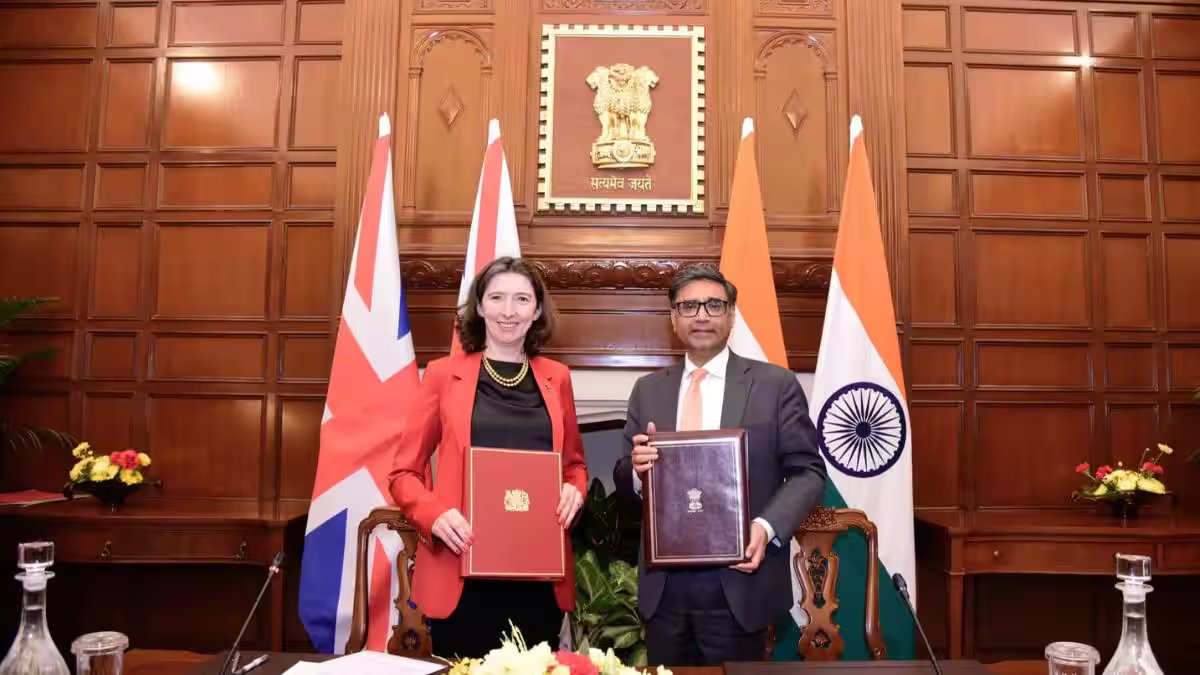
India and the United Kingdom have signed an agreement to eliminate double social security contributions of employees on temporary overseas assignments. Indian technology companies like TCS and Infosys are set to gain from the move.
India and the United Kingdom signed an agreement to eliminate double social security contributions of employees on temporary overseas assignments, the Ministry of External Affairs (MEA) said on Tuesday.
Last year, India and the UK had agreed to negotiate a reciprocal Double Contributions Convention (DCC) at the time of signing the India-UK trade deal.
“By eliminating double social security contributions of employees on temporary overseas assignments, the Agreement will support mobility of talent between the two countries and enhance competitiveness,” MEA Spokesperson Randhir Jaiswal said.
Indian technology companies like TCS and Infosys, who often send staffers on overseas assignments, are set to gain from the move.
Foreign Secretary Shri Vikram Misri and the British High Commissioner to the Republic of India, Ms. Lindy Cameron CB OBE signed the Agreement on Social Security relating to Social Security Contributions between the Government of the Republic of India and the Government of the… pic.twitter.com/UsJPhBFXGa
— Randhir Jaiswal (@MEAIndia) February 10, 2026
Under the agreement, employees moving between the UK and India, and their employers like TCS and Infosys, will only need to pay social security contributions in one country at a time.
For example, an Indian temporarily working in the UK will only pay social security contributions like provident fund (PF) in India — instead of paying in both India and the UK. It would not just avoid ‘dual payment’ burden but would also ensure that the social security record is not fragmented between two jurisdictions.
India and the UK have such agreements with many countries. Whereas India has such agreements with at least 19 countries, such as Germany, Switzerland, France, Norway, Canada, Australia, Japan, the UK also has such agreements with many countries like the United States, Japan, South Korea, The European Union (EU), Canada, Israel, and Turkey.
In a previous factsheet, the British government said the net impact of such an impact would be positive on exchequer.
“When agreeing to negotiate a DCC [Double Contributions Convention] with India, the government took account of the benefits of the wider trade deal, which could add £4.8 billion to UK GDP every year and boost UK wages by £2.2 billion every year in the long run. The indicative results of DBT [Department for Business and Trade] analysis also suggest the trade deal could increase public sector receipts by £1.8 billion annually in the long run,” the factsheet said.
End of Article