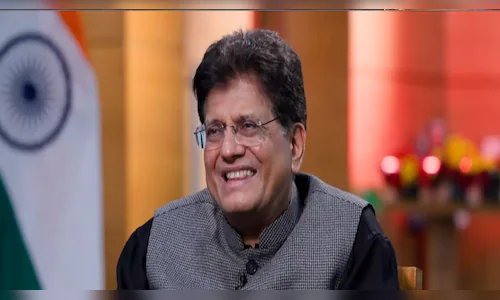
“The Chinese story is not something India should ever look to emulate,” he said, underlining that India would not displace citizens — citing Palghar residents in the context of infrastructure projects like the bullet train — in pursuit of rapid industrialisation.
Goyal said India’s rise would instead be powered by technology, talent and trade openness. Drawing a parallel with the Y2K moment, he described artificial intelligence as being at the cusp of a “very powerful revolution.”
“Like the Y2K moment we never looked back, I see AI at the cusp of a very powerful revolution,” he said, adding that as technology adoption deepens, cyber security threats will also rise, requiring greater human capacity and vigilance.
He said India showcased its talent to the world at the recent AI summit and expressed confidence that the technology wave would prove to be a “win-win” for the country.
On trade, Goyal said India has signed nine free trade agreements (FTAs) in the past three-and-a-half to four-and-a-half years, covering nearly two-thirds of global trade. “No country has become a developed nation by keeping their borders closed,” he said, arguing that FTAs will help Indian companies go global.
He added that every country wants to enter into a trade deal with India. Negotiations are under way with Chile, while talks with Canada are expected to gather momentum during Prime Minister Mark Carney’s visit. Discussions with Mexico on a possible trade arrangement have been deferred by a week due to local developments there. India has also launched talks with the sixth GCC nation for a trade pact.
Goyal said that while certain imports will continue, India must ensure resilient supply chains and support domestic industry to achieve self-reliance.
Expressing confidence in the country’s youth, he said young India would not let the nation down and should aspire to be among the world’s top two economies, echoing industry leader Uday Kotak’s vision.