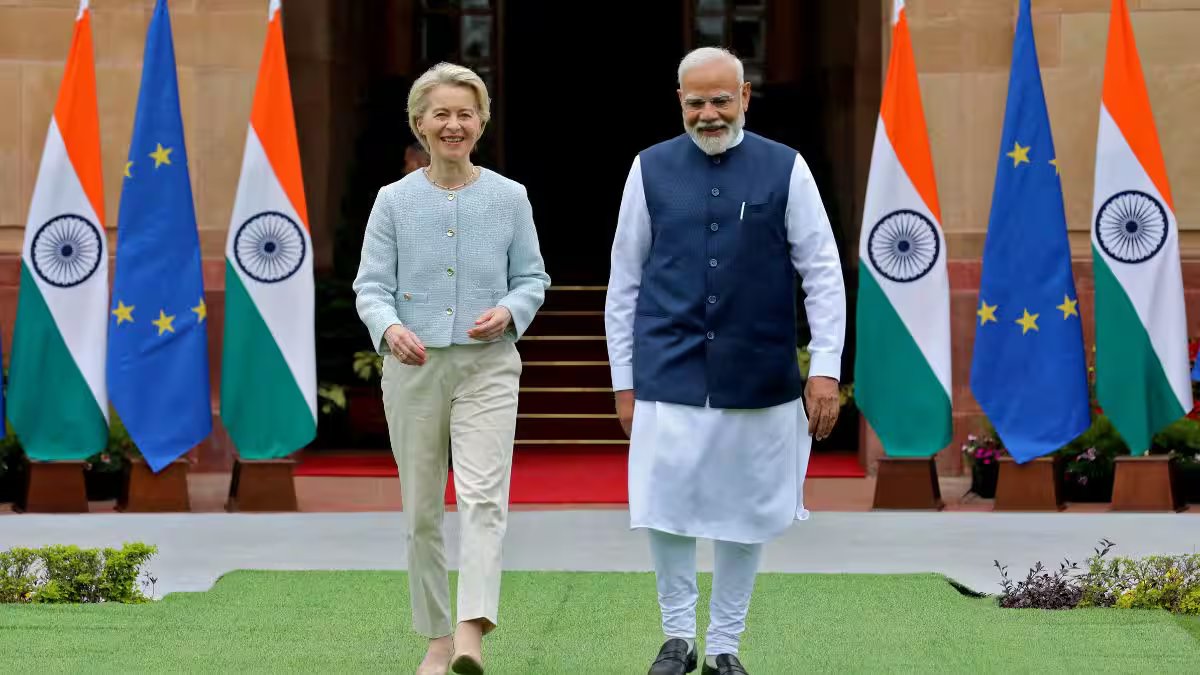
The last year marked a realignment of the world powers along trade and geostrategic lines with trade and tariff wars shaping the new global order. Amid the churn, India and the European Union turned the times of global crisis into an opportunity to speed up their process for a free trade deal. On Monday, Indian officials announced that the talks for the India-EU Free Trade Agreement (FTA) had concluded, and
a formal announcement was likely on Tuesday following the summit talks between Prime Minister Narendra Modi-led Indian delegation and the visiting top leadership of the EU.
The India-EU trade deal is a strong sign that the world has begun moving away from American centrality, not necessarily against the US, but independent of the world’s biggest economic powerhouse. With the agreement, India and the European Union (EU) have not only reached a win‑win bilateral arrangement but also strengthened their hand in ongoing negotiations with both the US and China, which has faced criticism for trying to arm-twist its trade partners to agree to terms best suited to its interests.
While India-EU trade negotiations predate Trump’s second term, they gained urgency after
he unleashed a tariff war and political coercion that hit India and the EU particularly hard. He imposed 50 per cent tariffs on India —the highest in the world, and waged a subversive campaign that undermined India on Operation Sindoor, and emboldened Pakistan and China with his casual comments— while maintaining that PM Modi is “a great friend” and “a fantastic man”. He also slapped tariffs of between 10 and 50 per cent on the EU and mounted a political offensive by
throwing his weight behind anti‑EU far‑right parties across Europe.
Against this background, India and the EU accelerated talks, moving closer to the trade deal, and viewing one another as ‘shock absorbers’ for trade disruption. Their partnership can also act as a geopolitical counterweight to the United States.
ALSO READ:
India-EU FTA could give major fillip to trade growth, boost exports by $50 billion
Firstpost has learnt that the changed geopolitical situation due to new tariff politics gave impetus to India-EU talks, pushing the two negotiating sides to go ahead with the announcement of the trade deal even as negotiations on four chapters —EU carbon tax, the issue of geographical indicators (GIs), totalisation agreement, and data security— were yet to be concluded.
The guiding principle of the India-EU trade deal —and the broader India-EU relationship— has been to focus on convergences that far outweigh divergences, maximising mutual benefit while quietly ironing out remaining differences as the gains begin to flow, a person familiar with the thinking guiding the India-EU engagement told Firstpost.
Moreover, the finalisation of the India-EU Free Trade Agreement (FTA) shortly after the announcement of the
EU-Mercosur trade deal shows that countries are now coming together to deliberately minimise the centrality of the United States in world trade and reduce their dependence on the American market, according to Ram Singh, professor of business and international trade at the Indian Institute of Foreign Trade (IIFT).
“Countries all over the world are seeking alternatives to the United States for their exports as President Trump has weaponised trade. As they also increasingly see the United States as a declining power, they are minimising engagement with the United States. The short‑term effect would be that they would offset the loss of access to the American market and the long‑term effect would be that America would move from the centre of world trade to lower in the pecking order — if not to the margins entirely,” said Singh.
How India and the EU came closer — thanks to Trump and India’s longstanding ties
For years, the thinking in New Delhi was not in favour of trade agreements.
Then, the supply‑chain disruptions of Covid‑19 nudged a shift in thinking. As a result, negotiations with the EU, which had stalled in 2013, resumed in 2022.
But urgency set in after Trump hurried the world into trade realignment with his tariff announcements, drawing criticism from across continents. His critics in the US came out to say that he did not believe in the principle of mutuality and expected the world to bend to his will.
However, the shared challenge posed by Trump’s tariffs was not the only driver of India-EU convergence. India’s longstanding relationships with two major European powers, France and Germany, have helped bridge gaps with the EU, Firstpost has learnt.
Within the 27‑member bloc, France and Germany have emerged as the champions of the India-EU trade deal and have worked behind the scenes to rally support not only for the EU’s increased trade and economic engagement with India but also for ramping up security and strategic ties, Firstpost has learnt.
As a result, India and the EU are also set to announce a security and defence partnership alongside the trade deal at the India-EU Summit on Tuesday.
Earlier this month, German Chancellor Friedrich Merz visited India. French President Emmanuel Macron is scheduled to visit next month.
Owing to India’s longstanding ties with these countries —which have helped build rapport with the EU— the FTA has ensured that India’s red lines on agriculture and dairy are respected. At the same time, India has accommodated the EU’s concerns on automobiles, spirits, wines, and machinery. India will gain significantly from access to the EU market for textiles and chemical exports, sectors that have been hit hard by Trump tariffs.
ALSO READ:
As Trump tariffs kick in, India refuses to take the bait with a cautious tread
Singh told Firstpost that India and the EU have emerged as major ‘shock absorbers’ for each other — absorbing up to 25-30 per cent of exports that have lost access to the American market because of tariffs.
“The India-EU FTA is part of a broader strategy in which India has secured deals with the United Kingdom, Oman, and New Zealand, and is negotiating agreements with the Eurasian Economic Union (EEU) and Latin American countries such as Peru and Chile. The EU has also struck a deal with South America’s Mercosur bloc. These trade agreements give both India and the EU leverage in negotiations with the Trump administration as it is becoming increasingly clear in Washington that the world is moving on without them and they risk being left behind,” said Singh.
For long, the United States has been a stabiliser force in the post-Second World War decades. But the emergence of economic powers such as China, India, and Brazil has seen a realignment of the global order. External Affairs Minister S Jaishankar has emphasised the new world order based on multilateralism.
Trump’s tariff measures expedited multilateralism in 2025 that saw many economic powers looking for new trade deals. India and the EU have come closer over the past one year, however, New Delhi continues to emphasise that it aims to deepen trade ties with the United States. But with the world pivoting to the new emerging global order, India and the EU have found themselves shaping the dawn.
EU foreign minister Kaja Kallas noted that, after the trade deal, India and the EU would be a formidable bloc representing 25 per cent of the world’s GDP — and she did little to sugarcoat the threat from the United States.
“The FTA will create a market for 2 billion people, which accounts for about one‑fourth of global GDP. It also provides a chance to reduce reliance on China, Russia, and the United States. At a time when free trade is under pressure and supply chains are being weaponised, deepening our economic partnership makes perfect sense,” Kallas told The Indian Express.
ALSO READ:
With ‘G-2’, Trump elevates Xi as equal, carves spheres of influence with China
With a combined GDP of around $25 trillion, India and the EU would stand near parity with the United States. And the partnership is now set to go beyond trade and commerce.
Under the defence partnership set to be announced, European powers are looking to establish manufacturing hubs in India in a win‑win arrangement, Firstpost has learnt.
As Russian hybrid warfare has threatened European defence manufacturing units, establishing a second line of production in India would not only secure supplies for Europe at a distant location where Russian sabotage would be unlikely, but also provide India with investment and the technical know‑how of sophisticated arms manufacturing. This, a person familiar with the thinking behind the partnership told Firstpost, would support India’s Make in India initiative and its wider indigenisation efforts in the defence sector.
End of Article