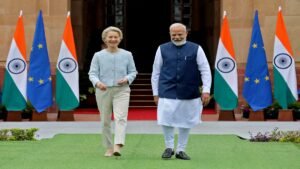
Prime Minister Narendra Modi and European Commission President Ursula von der Leyen on Tuesday announced the conclusion of negotiations on the India-EU FTA, nearly two decades in the making. Covering economies that account for about 25% of global GDP and close to one-third of global trade, the deal is expected to be signed later this year and come into force by 2027, after legal vetting and ratification by the European Parliament.
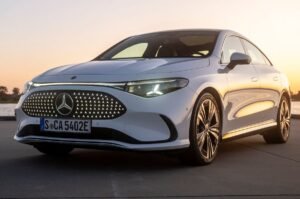
Under the agreement, tariffs will be eliminated on 99% of Indian exports and 97% of EU shipments. Made-in-India cars will get duty-free access to the EU, while India will sharply cut tariffs on EU cars priced above ₹25 lakh, from as high as 110% to 10%, subject to an annual quota. Duties on a wide range of manufactured products — from chemicals and engineering goods to textiles, footwear and gems and jewellery — will also fall to zero.
Industry leaders say the real significance of the pact lies not just in tariff reductions, but in the scale of opportunity it opens up for Indian manufacturing.
Calling the deal “very positive from both sides”, CII President Rajiv Memani said labour-intensive manufacturing sectors stand to benefit the most. “Whether you look at textiles, leather, gems and jewellery, chemicals, auto components or engineering, all of them will benefit significantly. EU imports are almost $3 trillion, and India’s share is just 2–3%. Even moving that to 5–6% is a very meaningful gain,” he said, pointing out that duties on several products will drop from 12%, 8% or 4% to zero.
For MSMEs, which form the backbone of India’s manufacturing ecosystem, the FTA could be transformative. Anjali Singh, Chair of CII’s Northern Region and Executive Chairperson of the Anand Group, said the agreement “propels India towards Make in India” and opens up fresh opportunities for small manufacturers to integrate with European value chains. “This will drive huge potential for both the automotive and auto component industries, bringing together innovation and possibilities on both sides,” she said.
Deepak Shetty, Chairman of the CII Manufacturing Committee and President of ICEMA, said the deal creates a strong value-addition opportunity, especially for MSMEs. Excluding petroleum and diamonds, India’s key manufacturing exports to the EU already include auto parts, smartphones, steel products and rubber tyres. “With zero tariffs, this becomes an opportunity not just on cost, but on value addition,” he said, adding that Europe’s manufacturing strengths — particularly Germany’s Mittelstand model — offer valuable lessons for Indian firms looking to scale up.
The agreement is also expected to lower the cost of industrial modernisation in India. Capital goods companies importing advanced machinery from Europe will benefit from tariff elimination, while the presence of nearly 6,000 European companies already operating in India is likely to expand further as global supply chains diversify amid geopolitical shifts.
From the auto industry’s perspective, the FTA is less about immediate price cuts and more about demand creation and portfolio expansion. Santosh Iyer, CEO of Mercedes-Benz India, cautioned against expectations of sharp car price reductions. “About 90% of the cars we sell in India are already at a 15% duty under CKD or local manufacturing. Yes, that could come down further, but exchange rate movements largely offset that,” he said, noting that price stability rather than outright cuts is the more likely outcome.
Also Read | India-EU FTA deal: What is set to get cheaper and what could cost more
The bigger change, Iyer said, will be in fully built units (CBUs), where duties will gradually fall from 110% to 10%. “That helps us get more cars and more variety. Today, there are models where allocations are constrained because of the high duty structure,” he said. At the same time, he stressed that the FTA should not be viewed purely through a tariff lens. “The biggest impact is demand. As the economy grows stronger, consumption grows, and that ultimately drives manufacturing investments.”
Beyond autos, the deal is expected to deepen India-EU collaboration in chemicals, food processing, leather and other manufacturing segments. Piruz Khambatta, Chairman of the CII National Committee on Taxation, said Europe opening up to Indian manufacturing makes this FTA fundamentally different from earlier trade pacts. “This is a real game-changer for Make in India. Manufacturing sectors like leather, chemicals and food processing will benefit, GI tags will be protected, and there will be time-bound dispute resolution,” he said.
Also Read | India-EU FTA: Textiles, footwear to get zero-duty access to Europe, says EU Trade Commissioner
Looking ahead, CII President-Designate and Tata Chemicals MD & CEO R Mukundan said investments are likely to accelerate even before the agreement becomes operational. “From commitment to ground-breaking can take up to 24 months, so companies will start planning immediately. Europe brings strong R&D and technology capabilities, particularly in sustainable solutions, which are very relevant for India,” he said.
With combined access to markets covering nearly $45 trillion in GDP through multiple FTAs, industry leaders believe the India-EU pact positions the country as a reliable manufacturing and supply-chain partner for all 27 EU nations. For Indian manufacturing — especially autos, components and MSMEs — the agreement is being seen as a structural reset that could drive exports, demand and long-term investment well beyond the impact of tariff cuts alone.
Watch accompanying video for entire discussion.