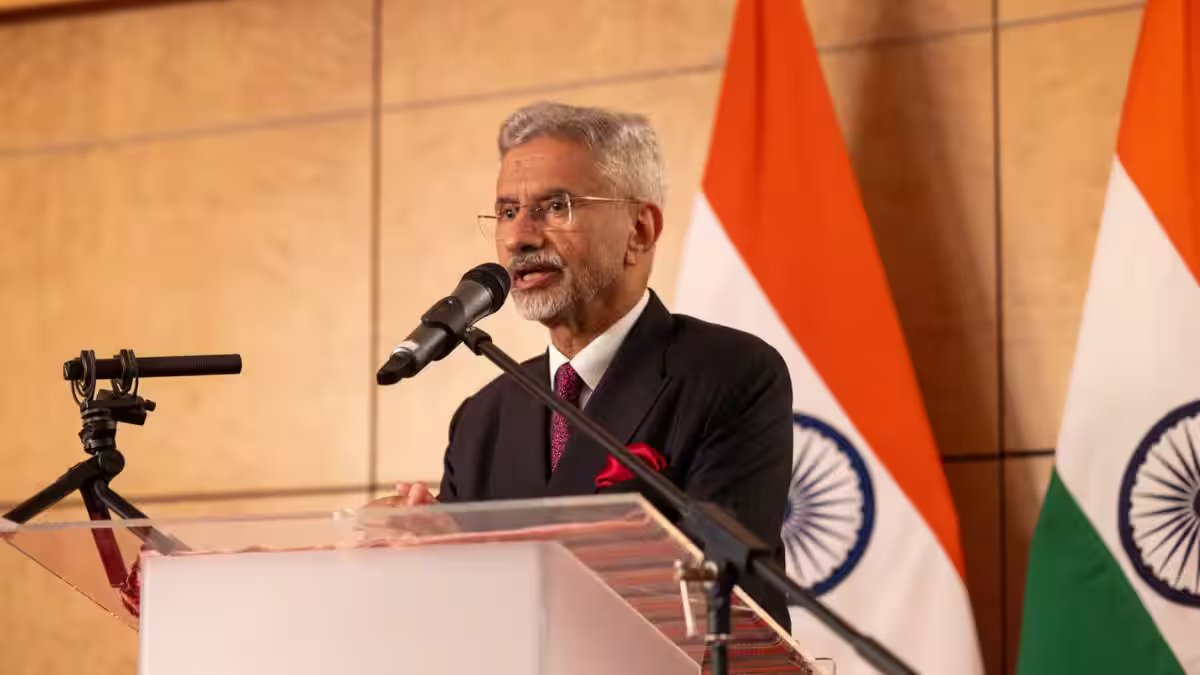
India remains firm and uncompromising in its opposition to terrorism in all its forms, External Affairs Minister S Jaishankar said, asserting there can be no justification, especially when innocent lives are targeted.
India remains unwavering in its fight against terrorism in all its forms, External Affairs Minister S. Jaishankar said, stressing that attacks on innocent civilians can never be justified under any circumstances.
Addressing the High-Level Segment of the 61st session of the United Nations Human Rights Council (UNHRC) virtually on Wednesday, Jaishankar called for a united global stand against terrorism and urged the Council, as well as the broader United Nations system, to uphold a zero-tolerance approach to terrorist acts.
He emphasised that India seeks to build common ground in a world grappling with conflict, polarisation and uncertainty. “We have consistently underlined dialogue over confrontation, consensus over division, and human-centric development over narrow interests,” he said.
Reiterating India’s position, Jaishankar described terrorism as one of the gravest violations of human rights, asserting that confronting it demands collective determination from the international community.
India, he said, approaches the Human Rights Council with the belief that rights are best protected through dialogue, capacity building and genuine partnerships, rather than politicisation or selective standards. He added that instability in any region or marginalisation of any community ultimately weakens the rights and well-being of all.
Jaishankar also highlighted India’s humanitarian outreach, noting that the country’s assistance — ranging from disaster relief and vaccines to food supplies and development partnerships — has been guided by empathy rather than proximity.
“For us, human rights are not abstract ideals, but an integral part of our civilisational ethos of Vasudhaiva Kutumbakam that sees the world as one family,” he added.
The minister underscored how in recent years, the devastating impact of pandemic, climate change, geopolitical tensions and economic stress have exacerbated existing inequities, and how, for many communities, these translate into lost years of schooling, pressures on food and fuel security, and mounting debt burdens. “All these erode the promise of human rights and backsliding on the achievement of Sustainable Development Goals,” Jaishankar added.
The minister also spoke about how India has been investing in developing human capacities at an unprecedented scale and how the Digital Public Infrastructure (DPI) has enabled hundreds of millions to access welfare benefits, financial services and public schemes, with transparency and minimal leakage.
“Our DPI experience has also been shared as a global public good with our partners, reaffirming that technology can and must be a force multiplier for human rights, not a new fault line,” he added.
With inputs from agencies
End of Article