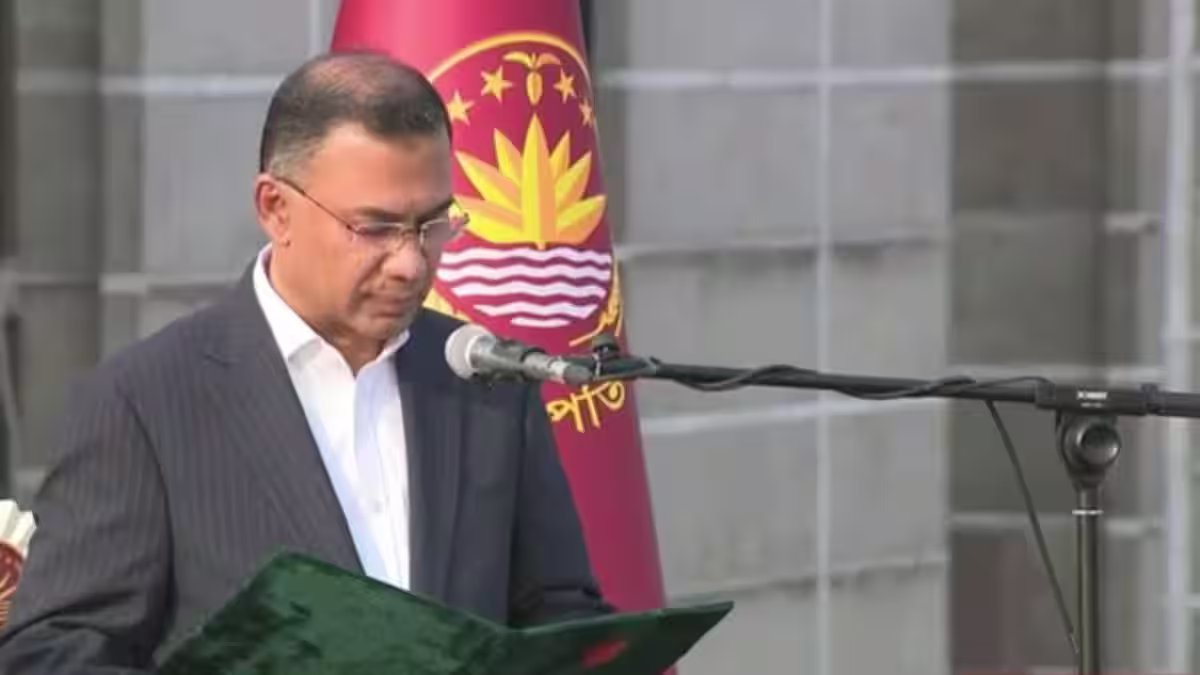
Bangladesh’s newly elected Prime Minister Tarique Rahman on Wednesday vowed to strengthen the rule of law and uphold a pluralistic society, remarks that carry added significance following a series of attacks on the Hindu community after the ouster of former prime minister Sheikh Hasina in August 2024.
According to a PTI report, the 60-year-old leader, in his maiden televised address to the nation after assuming office, said his government would ensure the country remains a safe home for people of all faiths, regardless of party affiliation, opinion, religion or ethnicity.
Rahman outlined his administration’s key priorities, placing improvement of law and order and a strict crackdown on corruption at the top of the agenda, and said restoring peace and security would be central to his government’s efforts.
“We want to turn this country into a safe land for every citizen. Muslims, Hindus, Buddhists, Christians – regardless of party, opinion, religion, or ethnicity – whether living in the hills or the plains, this country belongs to all of us,” said the prime minister, who is also the chief of the Bangladesh Nationalist Party (BNP).
“Whether you voted for BNP, or did not vote for BNP, or did not vote at all – everyone has equal rights over this government… As a Bangladeshi, every one of us has equal rights in this country, in this state,” he asserted.
Rising violence against minorities
Under the interim government led by Muhammad Yunus since August 2024, Bangladesh has witnessed a surge in mob violence, alleged extrajudicial killings and attacks on minority communities, particularly Hindus.
Rights group Manabadhikar Shongskriti Foundation said it documented 21 lynchings and 28 incidents of mob beatings in January 2026 alone.
Meanwhile, the Bangladesh Hindu Buddhist Christian Unity Council reported 522 communal attacks in 2025, including killings, rapes and temple vandalism, and said 116 people from minority faiths — mostly Hindus — were murdered between June 2025 and January 2026.
The reports indicated that many victims were leaders and activists of the Awami League, which was disbanded by the Yunus-led administration.
India has repeatedly raised concerns over attacks on minorities in Bangladesh.
Law and order priority
Earlier, senior minister Mirza Fakhrul Islam Alamgir said restoring law and order was among the government’s top three priorities and pledged action to end “mob violence.”
“This (mob violence) will be controlled,” PTI quoted Alamgir, who is also the party’s secretary general and entrusted with the charge of the local government ministry, as saying.
“We must strive to improve the law and order situation, regardless of how much it has deteriorated,” he added.
Home Minister Salahuddin Ahmed also said, “The mob culture in no way can be tolerated.”
In his address, Rahman vowed to uphold the rule of law and build a “self-reliant, secure, humane, and democratic Bangladesh”.
“Not party or political influence or force, but the rule of law will be the final word in governing the state,” he said, pledging that all constitutional, governmental, and non-governmental institutions would operate according to established laws and regulations.
Rahman framed his government’s mission against the backdrop of a fragile economy and years of misrule, corruption, and a weakened law-and-order system.
“In a Bangladesh freed from subservience, a new government accountable to the people through their votes has begun its journey,” he was quoted as saying.
Acknowledging the holy month of Ramzan, Rahman urged citizens to embrace self-purification without increasing suffering and assured uninterrupted gas, water, and electricity supply during iftar, tarawih, and sehri.
Referring to the party’s commitment to justice, he said, “I believe that this decision of the BNP parliamentary party reflects that very ideal of justice,” while pledging to dismantle all syndicates of wrongdoing without harming businessmen or consumers.
Highlighting human capital as a key priority, Rahman said, “If we can transform our large population into a skilled workforce, then this population will become our human resource… the world is entering the era of artificial intelligence, and survival with dignity and prosperity requires expertise in specific fields.”
He also assured students and youths of government support to develop intellectually and scientifically.
Rahman, 60, was sworn in as Bangladesh’s 11th prime minister on Tuesday after leading the BNP to a decisive victory in the February 12 parliamentary polls, replacing interim leader Muhammad Yunus.
Alongside him, 25 ministers and 24 state ministers took the oath. The prime minister returned from a 17-year self-exile in London last December.
With inputs from agencies
End of Article