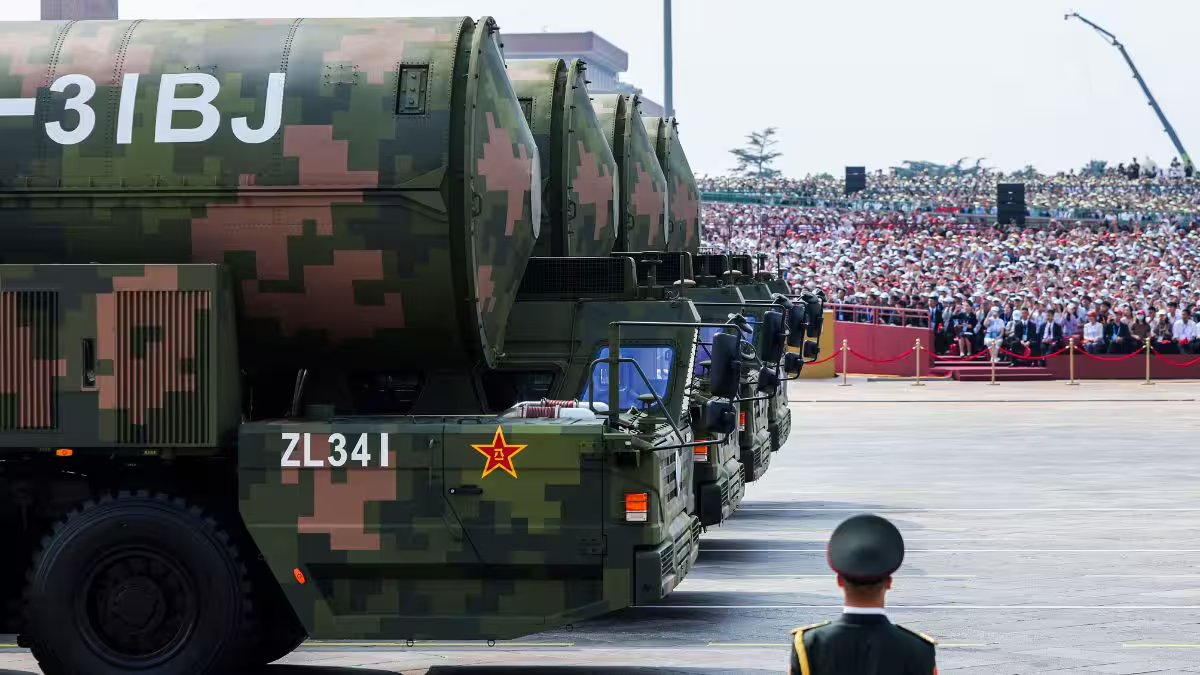
China’s accelerated expansion of its nuclear weapons programme in southwestern Sichuan province has come into sharper focus following
detailed satellite imagery analysis published by _The New York Times (NYT)_ on Sunday.
The imagery reveals sustained construction and modernisation at multiple nuclear-linked sites located roughly 800 kilometres from Arunachal Pradesh, placing them geographically closer to India’s eastern frontier than to China’s coastal flashpoints.
China’s nuclear stockpile has expanded rapidly over the past decade and now ranks as the world’s third largest.
Estimates place the number of Chinese nuclear warheads at about 600 as of early 2026, behind only Russia, which holds around 5,400 warheads, and the United States, which possesses between 5,100 and 5,200.
Projections from the Pentagon indicate that China’s arsenal is on course to exceed 1,000 warheads by 2030.
Although the absolute numbers remain far below those of Washington and Moscow, the speed of China’s buildup has become a major factor in global nuclear stability calculations, particularly as arms control mechanisms weaken and strategic mistrust deepens.
The renewed attention on Sichuan’s nuclear facilities arrives at the expiry of the last major bilateral nuclear arms control agreement between the United States and Russia which has removed the most significant remaining constraint on the world’s two largest arsenals.
American officials argue that future frameworks cannot be effective without China’s participation, but
Beijing has shown no interest in joining any such arrangements.
From Mao’s Third Front to China’s inland nuclear complex
The origins of the nuclear installations now undergoing modernisation in Sichuan lie in strategic decisions taken more than six decades ago,
reported NYT.
During the Cold War, China launched the “Third Front” programme under Mao Zedong to relocate critical defence industries away from vulnerable coastal regions and into the mountainous interior.
The objective was to reduce the risk of destruction in the event of strikes by the United States or the then Soviet Union. As part of this initiative, nuclear production facilities, laboratories and support infrastructure were carved into remote valleys across southwestern China.
Tens of thousands of scientists, engineers and workers were mobilised to build this concealed industrial ecosystem, creating what later came to be described by an American nuclear scientist as an “inland nuclear empire.”
These sites were designed to operate with high levels of secrecy, protected by terrain and distance from likely theatres of conflict. Over time, however, geopolitical conditions shifted. As tensions with Washington and Moscow eased in the 1980s, many of the Third Front facilities were either shut down or saw significant reductions in activity.
Personnel from several of these locations were transferred to a newer weapons research complex in the nearby city of Mianyang.
For years after this transition, activity at remaining Third Front sites such as Zitong and Pingtong was limited, reflecting China’s longstanding emphasis on maintaining a relatively small nuclear deterrent. This period of restraint, however, has gradually given way to a new phase of expansion.
Over the past two decades, and particularly since around 2019, construction work and infrastructure upgrades at multiple nuclear-related locations across China have accelerated, indicating a strategic reassessment of the role nuclear weapons play in Beijing’s national security planning.
Geospatial intelligence expert Renny Babiarz, who analysed satellite imagery of the Sichuan facilities and shared his findings with NYT, described the pattern of change as both broad and sustained.
“The changes we see on the ground at these sites align with China’s broader goals of becoming a global superpower. Nuclear weapons are an integral part of that,” he said.
Babiarz noted that individual locations should be understood as components of a larger system, comparing the network of facilities to pieces of a mosaic that collectively illustrate the pace and scale of China’s nuclear expansion.
“There’s been evolution at all of these sites, but broadly speaking, that change accelerated starting from 2019,” he said.
Zitong Valley: High-explosive testing and warhead development
One of the focal points of the recent satellite imagery analysis is Zitong Valley, where significant new construction has been identified. The valley hosts newly built bunkers and reinforced structures positioned within a mountainous setting.
The addition of ramparts and extensive piping networks suggests that the site handles hazardous materials associated with weapons development.
Specialists assessing the layout and configuration of these structures believe the facility is being used to conduct tests involving high explosives, a critical component in the design and functioning of nuclear warheads.
High explosives are used to compress nuclear material in a precise manner to initiate the chain reaction required for detonation. Perfecting this process requires repeated experimentation under controlled conditions, and the configuration of the Zitong complex aligns with the requirements of such testing.
“You have a layer of high explosives and the shock wave at the same time implodes into the center. This needs blast tests to perfect them,” Hui Zhang, a physicist who researches China’s nuclear programmes at the Harvard Kennedy School and reviewed Babiarz’s analysis, told NYT.
The Zitong facility also features an oval testing area comparable in size to approximately ten basketball courts, indicating that large-scale experiments may be conducted on-site.
While the presence of such infrastructure does not in itself confirm the volume of warhead production underway, it highlights the technical focus on refining weapon components and improving reliability.
Zhang cautioned that satellite imagery can reveal structural changes but does not provide definitive information about the number of warheads being assembled or the specific timelines associated with production cycles. “We don’t know how many warheads have been produced, but we just see the plant expansion,” he said.
Zhang also noted that not all recent upgrades necessarily point to increased output. Some modifications could be related to improved safety standards, reflecting the hazards inherent in handling explosive materials and radioactive components.
Others may support alterations to warhead designs intended for newer delivery platforms, including submarine-launched ballistic missiles, which impose different technical requirements compared to older systems.
Pingtong Valley: Plutonium pits and specialised production
Another key location identified in the satellite imagery is the Pingtong Valley facility, characterised by a double-fenced perimeter and a prominent ventilation stack rising approximately 360 feet above the main structure.
Experts believe this complex is dedicated to the manufacture of plutonium “pits,” the metal cores that form the heart of nuclear warheads.
The architectural design of the site bears resemblance to similar facilities in other nuclear-armed states, including the pit production installations at Los Alamos National Laboratory in the United States.
Recent refurbishments at Pingtong include the addition of new ventilation systems and heat dispersers, along with ongoing construction adjacent to the main building.
Such features are consistent with the stringent safety and environmental controls required for handling plutonium and other radioactive materials. The site’s configuration suggests a focus on precision manufacturing processes that demand controlled airflow, temperature regulation and containment measures.
Above the entrance to the Pingtong complex, large Chinese characters display a message attributed to Xi Jinping: “Stay true to the founding cause and always remember our mission.”
The scale of the lettering is such that it is visible from satellite imagery, reflecting both a symbolic and political dimension to the site’s modernisation.
The presence of this slogan highlights the leadership’s framing of nuclear modernisation as part of a broader national mission tied to China’s historical trajectory and future ambitions.
Pingtong is one of several nuclear-linked locations in Sichuan that have undergone expansion and upgrades in recent years. In addition to these production-oriented sites, the region also hosts a large laser ignition laboratory in Mianyang.
This facility is believed to support research on nuclear weapons physics without requiring live detonations, allowing scientists to study aspects of warhead performance through advanced simulations and experimental techniques.
Strategic signalling, Taiwan and crisis behaviour
Beyond the numerical growth of China’s nuclear stockpile, analysts are paying close attention to how a larger and more survivable force might shape Beijing’s behaviour during crises.
One concern articulated by US officials and researchers is that an expanded nuclear deterrent could alter China’s calculations in conventional conflicts, particularly in scenarios involving Taiwan.
Michael S Chase, a former US deputy assistant secretary of defence for China who is now a senior political scientist at the RAND Corporation, argued that China seeks to reduce its vulnerability to nuclear pressure from Washington.
“China wants to be ‘in the position where they believe they’re largely immune from nuclear coercion by the United States,’” he told NYT. “I think they probably judge that could come into play in a conventional conflict over Taiwan.”
The inland location of Sichuan’s nuclear facilities is significant in this context. Positioned far from coastal theatres such as Taiwan, these sites benefit from geographic depth that reduces their exposure to potential strikes from US forces.
At the same time, their relative proximity to India’s eastern sector introduces additional strategic considerations for New Delhi.
Although there is no indication that the Sichuan facilities are oriented specifically towards India, their placement enhances China’s overall deterrence posture across multiple theatres.
Implications for India’s security calculus
For India, the developments in Sichuan intersect with a broader pattern of Chinese military activity along the Himalayan frontier.
While Beijing’s nuclear expansion in Sichuan is not formally linked to border infrastructure projects, China has concurrently accelerated the construction of roads, airfields
and so-called civilian villages near Arunachal Pradesh.
These settlements are widely viewed as having dual-use potential, serving both civilian and military functions by improving logistics and presence in contested areas.
A larger arsenal, supported by hardened inland facilities, could strengthen Beijing’s belief that it is protected against nuclear escalation, potentially affecting its willingness to apply pressure along disputed borders during periods of heightened tension.
What remains unknown
Despite the detailed satellite imagery and expert analysis, significant uncertainties persist regarding the precise objectives and outcomes of China’s nuclear modernisation efforts.
While the expansion of facilities in Sichuan indicates increased capacity for testing, production and research, analysts caution against drawing definitive conclusions about the number of warheads produced at specific sites or the operational timelines associated with new infrastructure.
Hui Zhang emphasised the limitations of remote sensing in providing granular insights into production output. “We don’t know how many warheads have been produced, but we just see the plant expansion,” he said.
For India, the significance of these developments lies less in immediate proximity and more in the strategic implications of a more confident and capable Chinese nuclear posture.
As Beijing strengthens the survivability and sophistication of its deterrent, New Delhi must factor these changes into its long-term defence planning, even as it continues to address conventional challenges along the Himalayan frontier.
With inputs from agencies
End of Article