Nicolas Maduro. There’s many ways to describe him; for some, he’s the Venezuelan president, for others, he’s the Venezuelan authoritarian. But for a few people, he’s a Sathya Sai Baba follower.
Following his
capture, the world’s attention has shifted to Nicolas Maduro and his life before US forces captured him from his compound in Caracas in the wee hours of Saturday (January 3). And it has emerged that the former bus driver-turned-politician has been an ardent follower of the teachings of the famous Indian godman.
Here’s what we know about Maduro’s relationship to Sathya Sai Baba and India.
Maduro and the Indian godman
Raised Catholic, Maduro was first introduced to Sathya Sai Baba in 2005 by his wife,
Cilia Flores, even before they were married. It is said that Flores, also known as the Iron Lady, was a devoted follower of the Indian godman, believed by many to be the reincarnation of Shirdi Sai Baba.
Then in 2005, Maduro, then the foreign minister of Venezuela, visited Sai Baba at Puttaparthi in Andhra Pradesh, along with his wife Cilia and sought the spiritual guru’s blessings. A statement from the Sathya Sai Central Trust said: “When he visited Prashantinilayam in 2005 along with the minister of education, Baba gave an audience to him and his family. He was then minister of foreign affairs.”
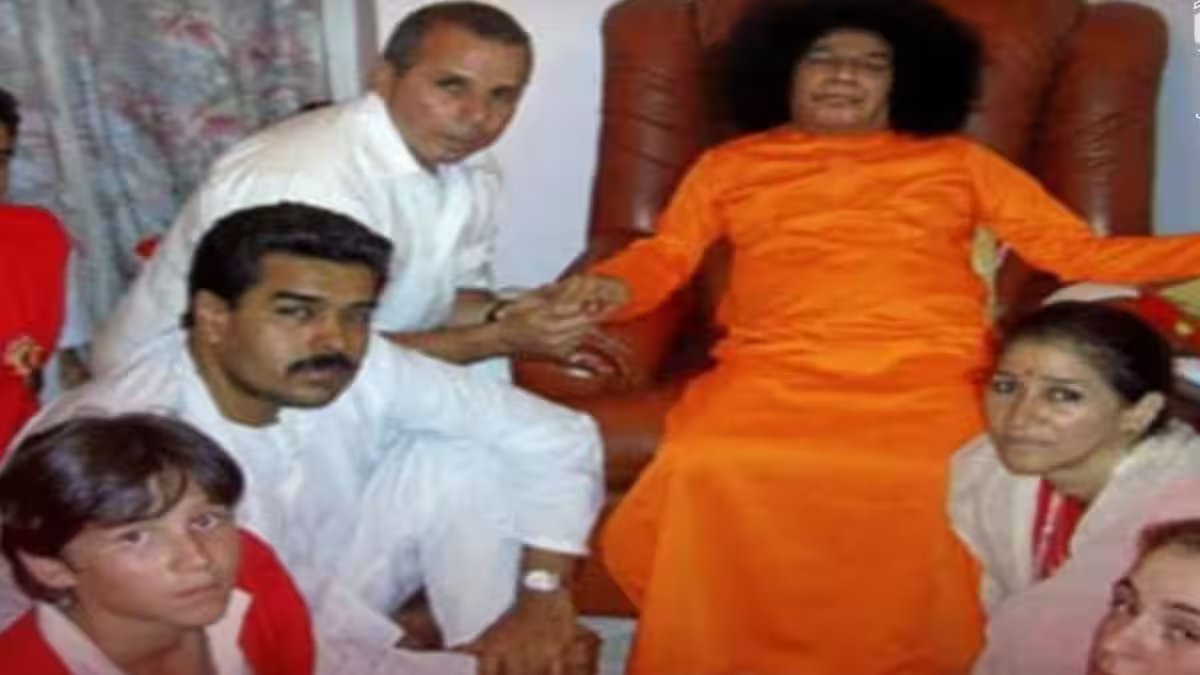
In fact, an image of Maduro and Flores seated on the floor, listening to Sathya Sai Baba has gone viral following his capture and now detention in a
prison in New York City.
Maduro’s ties to the Indian godman run deeper than just the 2005 India visit. Reports claim that as Maduro rose to power, a portrait of Sai Baba hung prominently alongside Simon Bolivar and Hugo Chavez on the walls of his private office in Miraflores Palace in Caracas.
Also, it is said that during moments of political crisis, including coups and mass protests, Flores reportedly turned to Sai Baba’s teachings on destiny and patience to guide Maduro. The devotion became a shared family belief system that remained strong even as international accusations against the regime intensified.
Moreover, when Sathya Sai Baba passed away in 2011, Maduro even pushed for an official condolence resolution. Under his guidance, Venezuela’s National Assembly passed an official condolence resolution and declared a day of national mourning to formally recognise the guru’s “spiritual contribution to humanity”.
And on November 23, 2025, days before Maduro was seized by US forces, he commemorated the centenary of Sathya Sai Baba with an official public statement. “I always remember him when we met… May the wisdom of this great teacher continue to enlighten us,” Maduro had then said, describing the guru as a “being of light.”
The life and teachings of Sathya Sai Baba
But who exactly was Sathya Sai Baba? Born in the village of Puttaparthi in south India as Sathyanarayan Raju, Sathya Sai Baba was just 14 years of age when he announced to his family that he was the reincarnation of a 19th Century holy man called Sai Baba.
In the years to come, Sathya Sai Baba amassed a large following. A report by TIME magazine noted that it was easy to be the Indian godman’s follower. Followers were not required to adhere to any particular set of beliefs or renounce worldly pleasures; non-Hindus did not need to change their religion. His main teaching was — “Love all, serve all; help ever, hurt never.” Some of Sathya Sai Baba’s most popular followers include former Indian Prime Minster Atal Behari Vajpayee and cricket legend Sachin Tendulkar.
Moreover, Sathya Sai Baba’s organisation has financed health and education projects, among them hospitals and clinics across the country.
On April 24, 2011, Sathya Sai Baba passed away at the age of 84, causing deep grief to his followers not just in India but across the world.
Sathya Sai Baba and Venezuela
Beyond Maduro, Sathya Sai Baba has an ardent following in Venezuela. In fact, it is one among the 113 countries where the Sathya Sai Baba movement is active. The first Sai Centre was opened in Caracas in 1974. This came about after two individuals — Arlette Meyer and Elizabeth Palmer — visited the godman in 1972. After becoming his followers, they opened the centre in Caracas on August 22, 1974. Years later in 1987, the first workshop for EHV (education in human values) teachers was held.
Sathya Sai Baba became even more prominent in Venezuela after his so-called miracle of saving a plane flying over South America. According to the story, in 1985, a passenger plane was flying over the coast of South America when the engine suddenly failed. The pilot knew that a Venezuelan stewardess on board was a supporter of Sai Baba and shouted, “Pray to your guru to save us from disaster!” No sooner had the stewardess shouted for Baba than he appeared in the sky outside the cockpit. Meanwhile the engine began to function and the plane was saved from crashing.
This contributed to Sathya Sai Baba’s fame in Venezuela. And in following years, the Sai trust opened several centres and institutes in the country. It has also organised public meetings to inform the public about the godman and his work in several cities such as Caracas, Maracay, Maracaibo, Barquismeto, Cumana, Ciudad, Bolivar, Puerto Ordaz, Merida, and Margarita Island, which have been attended by more than 3,000 people.
And at a time when Venezuela expelled many foreign NGOs, Sai Centres continued to operate freely — highlighting the importance Maduro placed on Sathya Sai Baba and his teachings.
Maduro now faces an uncertain future, awaiting trial in New York City on charges of narco-terrorism. Perhaps, he will seek solace from the teachings of Sathya Sai Baba while being behind bars.
With inputs from agencies
End of Article