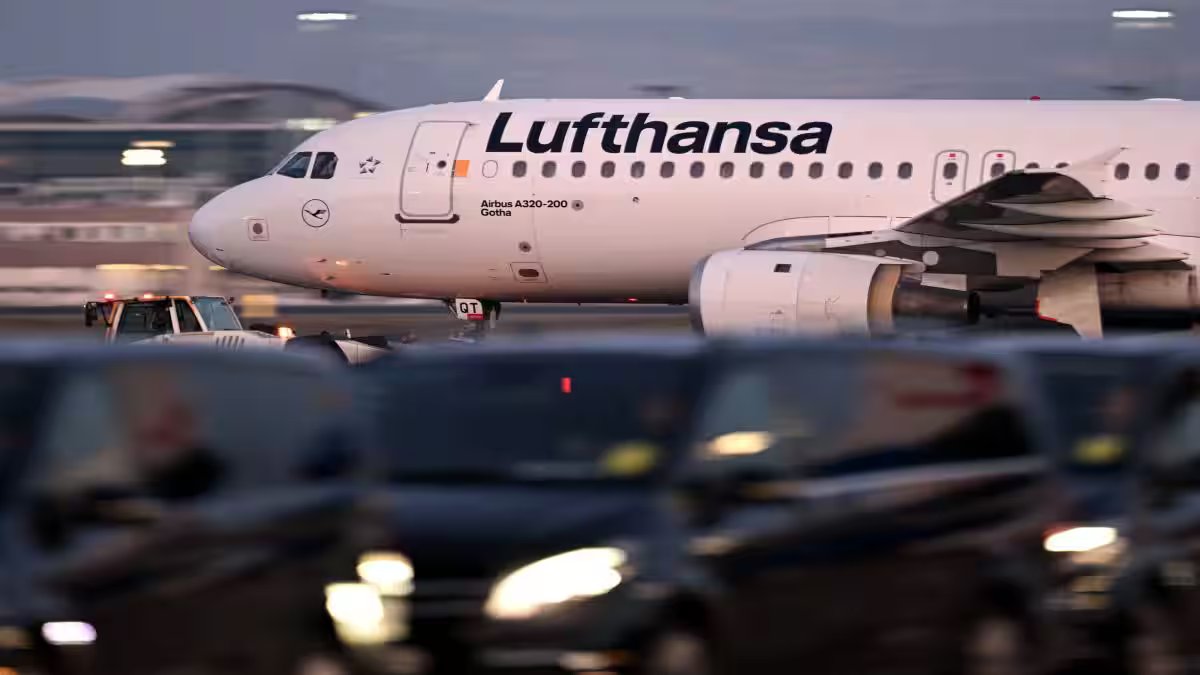
Today, when you think of German aviation, Lufthansa comes to mind. The German national carrier, which was also the fourth-largest airline by revenue in 2023, has come a long way since its foundation in January 1926. In fact, on January 6, Lufthansa completed 100 years of operations, making it one of the oldest airlines in the skies.
To mark this moment, Lufthansa is reappraising its history to take on greater responsibility for its actions during the Nazi era, breaking with earlier attempts to separate its pre- and post-war identity.
Speaking on the same, Lufthansa CEO Carsten Spohr said: “We at Lufthansa are proud of what we are today. To then ignore the difficult, dark, terrible years would simply have been dishonest.”
But how exactly was the German national carrier tied to the Nazis? What does history reveal?
The birth of Lufthansa
On January 6, 1926, Deutsche Luft Hansa, as it was called then, was formed. The airline’s birth was the result of the merger of Junkers Luftverkehr and Deutscher Aero Lloyd. The two companies, Germany’s largest airlines at the time, were forced to merge by the German government, while all other airlines were shut down. This reorganisation was intended to reduce the amount of financial support the government provided to the airline industry.
Months later, on April 6, Luft Hansa saw its maiden flight take off.
In the following years, Deutsche Luft Hansa built its network and covered all the big cities of Germany. It soon began international flights, flying to cities as far as Tokyo in Japan.
Luft Hansa and its Nazi ties
By the early 1930s, affected by the Great Depression, Luft Hansa was struggling to survive. According to German historian Lutz Budrass, an expert in German aviation history, the Nazis “saved Lufthansa.”
Under the Treaty of Versailles, which ended World War I, it was forbidden for Germany to have an air force. But with only minor restrictions on civil aviation, Budrass notes that Luft Hansa became a front for National Socialist (Nazism) rearmament.
Lufthansa’s entanglement with the Nazi regime was extensive. Its board and supervisory board members joined the Nazi Party from 1930, and as the state airline, it transported government officials. In 1932, a Luft Hansa airline was even made available to Adolf Hitler during his presidential campaign. The Nazi Party even used footage of these flights as part of their propaganda efforts. Moreover, by using flights, Hitler achieved an advantage over other party candidates, who relied largely on rail transport.
By 1939, when World War II broke out, Luft Hansa’s flight operations came to an end, and its fleet and staff came under the command of the Luftwaffe, the aerial branch of Germany’s armed forces.
After 1941, the airline played a prominent role in aircraft repair workshops behind the front lines and, unlike other companies, procured forced labourers, including many children who were kidnapped from Nazi-occupied territories across Europe.
According to historian Manfred Grieger, who has studied the airline’s past, more than 12,000 people were exploited in Hansa’s arms production and its repair and maintenance operations.
Even Budrass agrees with this finding, telling Deutsche Welle in one report, “There were about seven million forced labourers in Germany. Yet compared to other companies, Luft Hansa really exploited the forced labourers to accumulate funds to allow it to re-enter civil aviation after the war. Luft Hansa made a profit off slave labourers.”
In his book, Adler und Kranich. Die Lufthansa und ihre Geschichte 1926 – 1955, (The Eagle and the Crane: the History of Lufthansa from 1926 – 1955), Budrass added that from the beginning of World War II, Jews were forced to work at Tempelhof airport and later sent to extermination camps, with the airline never doing anything to stop the deportations.
A new Lufthansa is born
Following the end of World War II and the fall of the Nazis, Luft Hansa was forced to liquidate, as it was considered by the Allies to have been part of the Luftwaffe. As historian Manfred Grieger told El Pais: “This symbiosis led to Luft Hansa’s downfall at the end of World War. The company went down completely with the regime to which it had chained itself.”
A new company was founded in 1953, with management stressing that the only link between the two was the name, colours, and the logo. The company also changed to Lufthansa, foregoing writing it as two words in the past.
But as DW notes in one report, Many of the same men returned to its management board, including Kurt Weigelt, who led the economic department of the NSDAP Office of Colonial Policy. After the war, he was placed on a list of wanted war criminals and was eventually sentenced to two years in prison and a fine. But by 1953, he was the chairman of Lufthansa’s supervisory board and, in retirement, became its only ever honorary board member.
Since then, Lufthansa asserted that it is not the legal successor of the company founded in 1926, maintaining that “the legal foundation of today’s Lufthansa was laid in 1953.”
In the 1990s, Lufthansa’s ties to the Third Reich once again gained attention when former forced labourers of German companies, including Lufthansa, filed a lawsuit in the US. This resulted in many German companies established the Foundation for Remembrance, Responsibility and Future (Stiftung EVZ) to provide compensation in 2000. However, since most of the over 20 million former forced labourers in the German Reich and the territories it occupied had already died by then, only 1.7 million received financial support from the EVZ.
Marking their 100th anniversary, Lufthansa is now taking concrete steps to reconcile with its past, something they haven’t done so far. One of the steps is a new book on the company’s history that will be distributed to all of its more than 100,000 employees, along with an exhibition in the new visitors’ centre.
Perhaps, Lufthansa’s move may prompt other German companies to take a deeper look into its historical responsibilities.
With inputs from agencies
End of Article


