The United States has entered one of its most consequential military confrontations in decades after launching Operation Epic Fury alongside Israel on February 28, 2026.
With US President Donald Trump indicating that operations against Iran may continue for four to five weeks — and potentially longer — the financial implications are not lost on Washington and the American taxpayer.
From the immediate expense of cruise missile launches and bomber sorties to the broader economic shock of energy market disruption, the price of war is mounting on multiple fronts.
How extensive is US Operation Epic Fury?
Operation Epic Fury represents
one of the largest coordinated US military campaigns in West Asia in recent years. According to the US military’s Central Command (CENTCOM), more than 1,000 targets within Iran have been struck since the operation commenced.
In a separate announcement, CENTCOM said 11 Iranian ships had been hit and destroyed.
The Pentagon has confirmed the use of over 20 different weapons systems spanning air, land, sea and missile defence forces.
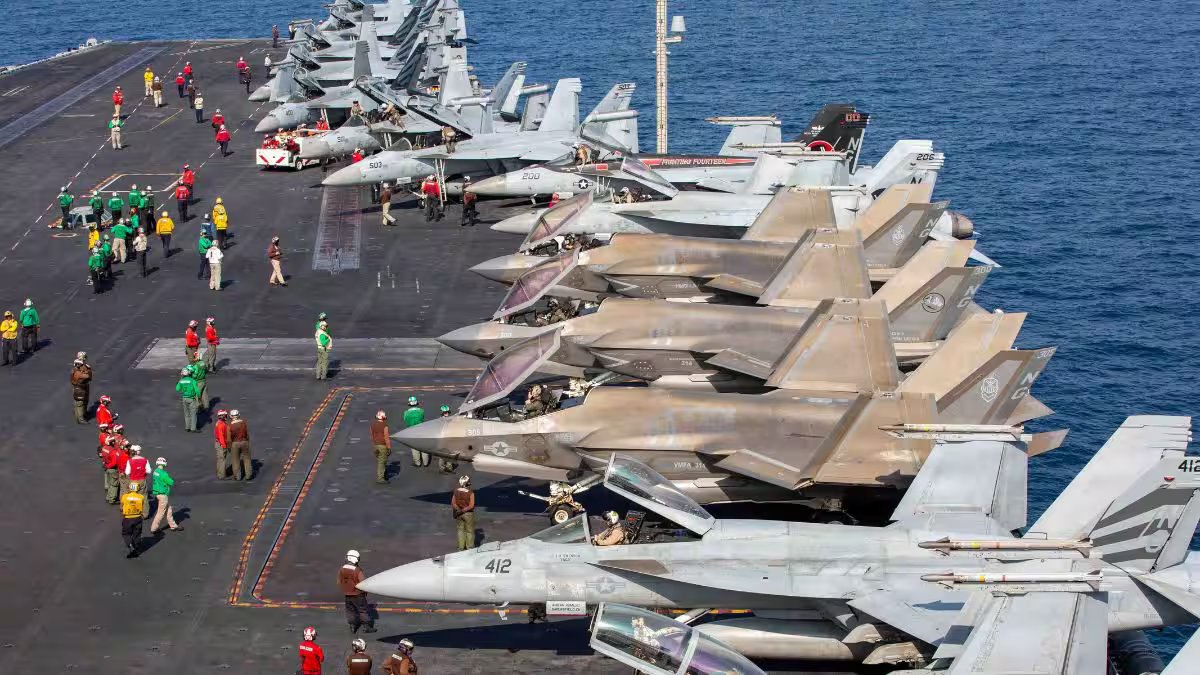
Air power and strike capabilities relied on a wide range of aircraft comprising B-1 bombers; B-2 stealth bombers, deployed against critical nuclear and military installations; F-35 Lightning II and F-22 Raptor stealth fighters; F-15 fighter jets, which have been used extensively; three were lost in an incident over Kuwait on March 1; F-16 Fighting Falcons; F/A-18 Super Hornets; and A-10 attack aircraft.
Electronic warfare has been conducted by EA-18G Growlers, tasked with neutralising enemy air defence systems. Airborne early warning and control aircraft (AWACS) have provided command-and-control coordination, ensuring synchronised battlefield operations.
Uncrewed systems have featured prominently. LUCAS drones — described as “low-cost unmanned combat attack system” one-way drones reverse-engineered from Iranian designs —
have been deployed in combat for the first time.
In addition, MQ-9 Reaper drones are active in both reconnaissance and precision strike missions.
On the ground, M-142 High Mobility Artillery Rocket Systems (HIMARS) have been utilised, while Tomahawk cruise missiles have been launched from naval assets.
Iranian retaliatory missile and drone launches have triggered defensive responses. The United States has deployed Patriot interceptor systems and THAAD (Terminal High Altitude Area Defense) to intercept incoming ballistic missiles.
Counter-drone systems have also been activated to neutralise aerial threats.
Two carrier strike groups are also operating in the region, led by aircraft carriers USS Gerald R Ford and the USS Abraham Lincoln. These strike groups form the backbone of American sea-based projection capabilities in the conflict zone.
Maritime surveillance is being conducted by P-8 Poseidon aircraft. Meanwhile, logistics and sustainment operations depend on C-17 Globemaster and C-130 Hercules aircraft, as well as aerial refuelling tankers that maintain continuous sortie operations.
The breadth of forces deployed shows that this is not a limited engagement but a sustained and integrated military campaign.
The financial outlay began even before the first strike was launched. The pre-combat military buildup included repositioning more than a dozen naval vessels and over 100 aircraft to the West Asian theatre.
Elaine McCusker, a former senior Pentagon budget official now at the American Enterprise Institute, told the Wall Street Journal that this preparatory phase cost approximately $630 million.
According to her assessment, these expenses are expected to be absorbed within the Pentagon’s fiscal year 2026 defence allocation of $839 billion.
Once operations commenced, spending accelerated sharply. Reports by Anadolu news agency estimate that US strikes conducted during the first 24 hours of Operation Epic Fury cost roughly $779.174 million.
That single-day expenditure represents about 0.1 per cent of the 2026 US defence budget.
In addition to munitions and aircraft operations, naval deployments contribute a daily financial burden. The Center for New American Security estimates that operating a single carrier strike group costs around $6.5 million per day.
With two deployed in the Persian Gulf region, daily naval operating costs reach approximately $13 million.
Equipment losses further compound expenses. At least
three US fighter jets were shot down in Kuwait in what American officials described as a friendly-fire incident. Replacement of aircraft, munitions and other assets adds to the total fiscal commitment.
When the initial mobilisation costs and first-day strike expenditures are combined, more than $1.4 billion had already been committed within the opening phase of the conflict.
How high could the direct military bill climb?
While initial expenditures are measurable in the billions, projections for sustained operations point toward far larger figures.
Kent Smetters, director of the Penn Wharton Budget Model (PWBM), provided a range of potential costs in an interview with Fortune. He estimated that direct budgetary costs to taxpayers could range between $40 billion and $95 billion.
His central projection stands at approximately $65 billion, covering military operations as well as replenishment of equipment and supplies. “If the war lasts more than two months, then this number goes up,” he added.
The Penn Wharton Budget Model is widely used in Washington for analysing fiscal and macroeconomic implications of federal policies.
Beyond direct military spending, Smetters projected additional economic losses to the United States of around $115 billion. However, he indicated that the range of uncertainty is wide, stretching from $50 billion to as much as $210 billion.
Taken together, the combined fiscal and economic burden could therefore approach or exceed $200 billion if the conflict persists and broader disruptions intensify.
The potential costs of Operation Epic Fury must also be considered within the context of existing fiscal pressures.
According to the Institute of International Finance, US government debt reached 122.8 per cent of GDP at the end of 2025, up from 119.9 per cent a year earlier. Debt held by the public is nearing 100 per cent of GDP,
approaching levels last recorded in the aftermath of World War II.
Although initial operational costs may be absorbed within the existing defence budget, prolonged military engagement could increase borrowing requirements or reallocate spending priorities.
How are energy markets reacting to the conflict?
One of the most immediate economic consequences
has been visible in global energy markets.
Brent crude futures rose more than $3 on Tuesday, marking a third consecutive day of gains. Prices reached $80.89 per barrel, up 4.1 per cent. During the previous session, Brent surged to $82.37 — its highest level since January 2025 — before settling 6.7 per cent higher.
US West Texas Intermediate crude climbed $2.55, or 3.6 per cent, to $73.78 per barrel. It had earlier touched its highest point since June 2025 before easing slightly.
The escalation widened on Monday as Israel attacked Lebanon and Iran responded with strikes targeting energy infrastructure in Gulf countries and tankers in the Strait of Hormuz.
The Strait of Hormuz carries approximately 20 per cent of the world’s oil and gas supply.
Concerns increased after Iranian media reported that a senior Iranian Revolutionary Guards official
said the strait had been closed and warned that Iran would fire on any ship attempting to pass.
As a result, tankers and container ships began avoiding the waterway. Insurers cancelled coverage for vessels operating there, driving global oil and gas shipping rates sharply higher.
Refined product markets have also reacted. Saudi Arabia
shut its largest domestic oil refinery following a drone strike.
US ultra-low-sulfur diesel futures rose 8.3 per cent to $3.1404 per gallon after hitting a two-year high.
Gasoline futures gained 3.8 per cent to $2.4620 per gallon.
European gasoil futures climbed 9.2 per cent to $967.75 per metric ton after an 18 per cent surge in the prior session.
Bernstein raised its 2026 Brent oil price forecast to $80 per barrel from $65, while noting that prices could reach between $120 and $150 in an extreme and prolonged conflict scenario.
Sustained elevated oil prices would affect transportation, manufacturing and consumer costs, amplifying the war’s indirect economic toll.
So how much could the war ultimately cost the United States?
We have to keep in mind the broader US commitments in the region. According to Brown University’s 2025 Costs of War report, since October 7, 2023, the United States has provided approximately $21.7 billion in military aid to Israel.
In addition, US operations in support of Israel in Yemen, Iran and across the wider region have cost between $9.65 billion and $12.07 billion.
Combined, total US spending linked to the regional conflict amounts to between $31.35 billion and $33.77 billion — and continues to increase as operations expand.
So altogether, taking in consideration the current situation, the answer depends on the duration and operational intensity of the conflict.
In the opening phase of the immediate conflict alone, over $1.4 billion was spent on mobilisation and first-day strikes. Ongoing carrier strike group operations add around $13 million daily in naval costs. Aircraft losses and munitions replacement will further increase expenditures.
Direct military costs could range from $40 billion to $95 billion, with a central estimate of approximately $65 billion.
If operations extend beyond two months, those figures may rise further. Broader economic losses could push the overall impact toward $210 billion.
Overlaying these projections are energy market disruptions, rising shipping costs, refinery shutdowns and elevated fuel prices — all of which feed into macroeconomic outcomes.
At the same time, US government debt already stands at historically high levels relative to GDP.
With inputs from agencies
End of Article