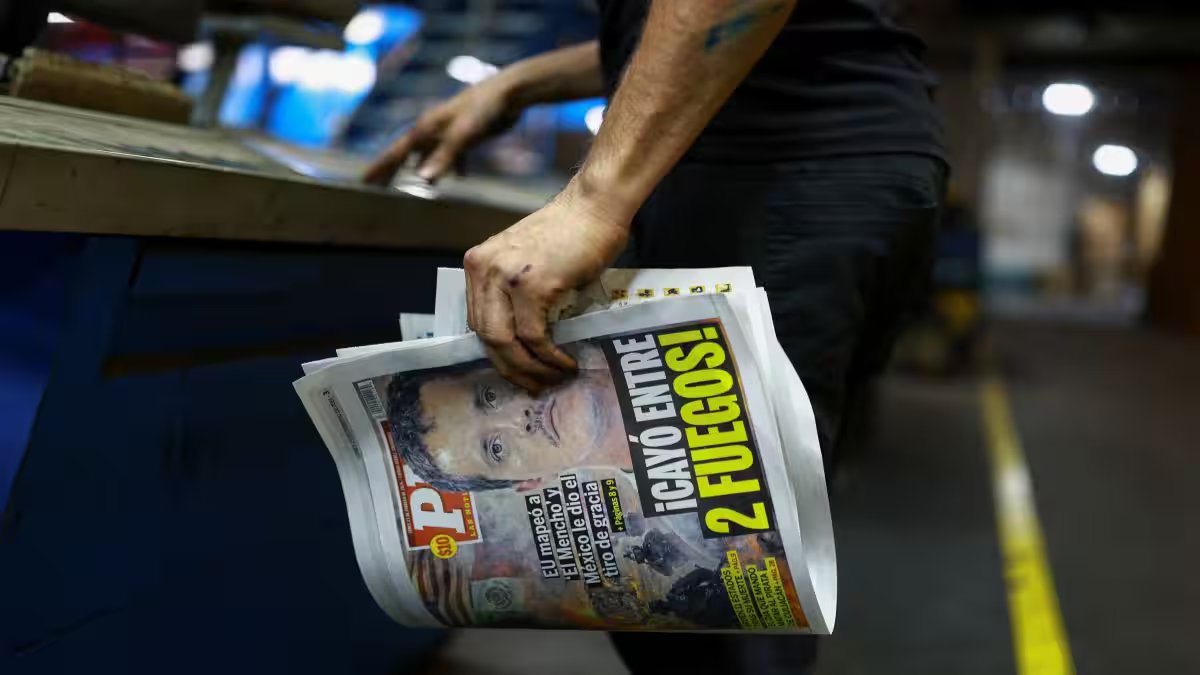
How do you nab a drug cartel leader? Do you follow the money or the trail of narcotics? In the case of Nemesio Ruben Oseguera Cervantes, known as El Mencho, it was neither. Instead, his capture and eventual death came after Mexican authorities followed his girlfriend, who led authorities to a cabin where the head of the Jalisco New Generation Cartel (CJNG), a man long considered one of the country’s most ruthless criminal figures, was hiding.
A day after El Mencho’s death, which caused widespread violence in Mexico, officials have revealed how a tryst with his girlfriend led to the cartel leader’s location. Moreover, a newly formed US-military-led task force played a role in the Mexican military raid on Sunday that killed the 59-year-old cartel leader.
Here’s how the capture of Mexico’s most powerful cartel leader and one of the United States’ most wanted fugitives unfolded.
Tracking El Mencho
After pursuing
El Mencho for years — he carried a bounty of $15 million — the Mexican authorities caught a break on February 20 when they received a tip they had been eagerly waiting for.
A close associate of El Mencho, who was known to the Mexican military, delivered one of the kingpin Oseguera Cervantes’ girlfriends to a property in Tapalpa, Jalisco, which lies about two hours south of Guadalajara. It is this popular tourist site that turned out to be the hideout of one of Mexico’s most wanted men.
The following day, the lover left Oseguera’s cabin complex on the outskirts of Tapalpa, but the drug lord remained at the hideout with his security detail.
Mexican authorities swoop into action
Once the woman left after spending the night with “El Mencho,” Mexico’s special forces finalised their plans, having confirmed he was staying in the area with a security detail.
They put together a plan and launched a raid within the next 24 hours. According to Mexican Defence Secretary General Ricardo Trevilla Trejo, units from the Mexican army and the National Guard established a ground cordon, while six helicopters and additional special forces stood by in states bordering Jalisco.
They established a perimeter around El Mencho’s cabin and began to move in.
Fire in the streets
As the Mexican authorities approached El Mencho’s cabin, a firefight broke out as the cartel’s members opened fire. General Trevilla told reporters later that El Mencho’s men had a “large amount of weaponry,” and the battle was “violent”.
“Honestly, it was a pretty violent attack,” Trevilla said, adding that the cartel members used assault weapons and two rocket launchers. He added that while some of the Mexican troops stayed to engage the group at the cabin, a team of Special Forces personnel split off in pursuit of Oseguera, who had fled into the forested area surrounding the cabin.
However, the Mexican special forces were able to track down Oseguera and another group of his associates to a nearby wooded area. “They found him hiding in the brush,” the general said.
Trevilla noted that after more shooting, the Mexican troops captured El Mencho and two of his bodyguards. All three had been seriously wounded, and it was determined that they would need to be evacuated if they were to survive.
It was decided to move Oseguera to a hospital in the nearby city of Guadalajara by helicopter. However, Oseguera and his two guards died while being transported, said General Trevilla. Their bodies were eventually sent to Mexico City instead.
Retaliatory violence sweeps Mexico
As news of El Mencho’s death broke, CJNG fighters launched coordinated attacks across multiple regions, blocking roads, setting vehicles ablaze, attacking businesses, and opening fire on security forces.
According to a USA Today report, the kingpin’s right-hand man, Hugo ‘H,’ known as ‘El Tuli,’ began ordering up the chaos that paralysed the beach city and tourist mecca of Puerto Vallarta on February 22. Moreover, he offered 20,000 pesos, or about $1,000, for every soldier killed.
The cartel’s members began destroying everything in their sight — from vehicles to gas stations and even government buildings. Thick plumes of black smoke obscured the sky over Puerto Vallarta. Terrified locals and American tourists locked themselves indoors as violence exploded.
Later, authorities confirmed that even El Tuli was killed in a clash with security forces as they attempted to arrest him.
Security Minister Omar Garcia Harfuch told reporters at the press conference that 30 cartel members were killed in these attacks, as well as one bystander. At least 70 people were arrested in seven states. No foreigners were reported to have been harmed, the government said in a statement.
America’s helping hand
It has also been revealed that
America had provided intelligence support to Mexico to help in the capture of Oseguera. On Monday, White House Press Secretary Karoline Leavitt told reporters that the US provided “intelligence support” to the Mexican government to “assist” in the operation that “eliminated” the cartel leader.
Mexico’s defence ministry, confirming the same, added that American authorities provided “complementary information” that assisted with the execution of the operation. A Mexican official further told Reuters that the operation was designed and executed by the Mexican government and that no US military personnel were physically involved.
A former US official told the news agency that Washington had provided the Mexican government with a target package with information on Oseguera compiled by US law enforcement and intelligence agencies.
Reuters also reported that the Joint Interagency Task Force-Counter Cartel, a new task force involving multiple US government agencies, was involved in the raid. The task force was launched in January in order to “identify, disrupt, and dismantle cartel operations posing a threat to the United States along the US-Mexico border,” according to its website. It aimed to map out drug cartel networks along the US-Mexico border, said American officials told Reuters.
Mexico’s Sheinbaum urges calm
In the wake of the violence, Mexican President Claudia Sheinbaum, on Sunday, urged citizens to stay calm. A day later, she made a plea for peace and tried to reassure her people.
“The most important thing right now is to guarantee peace and security for the entire population of all of Mexico. And that is what is being done,” she said. “People can be assured that peace, security, and normalcy are being maintained in the country.”
However, the atmosphere remains tense in parts of the country. Schools and businesses remain closed in some of the areas hit hardest, and many residents have stayed home.
With inputs from agencies
End of Article