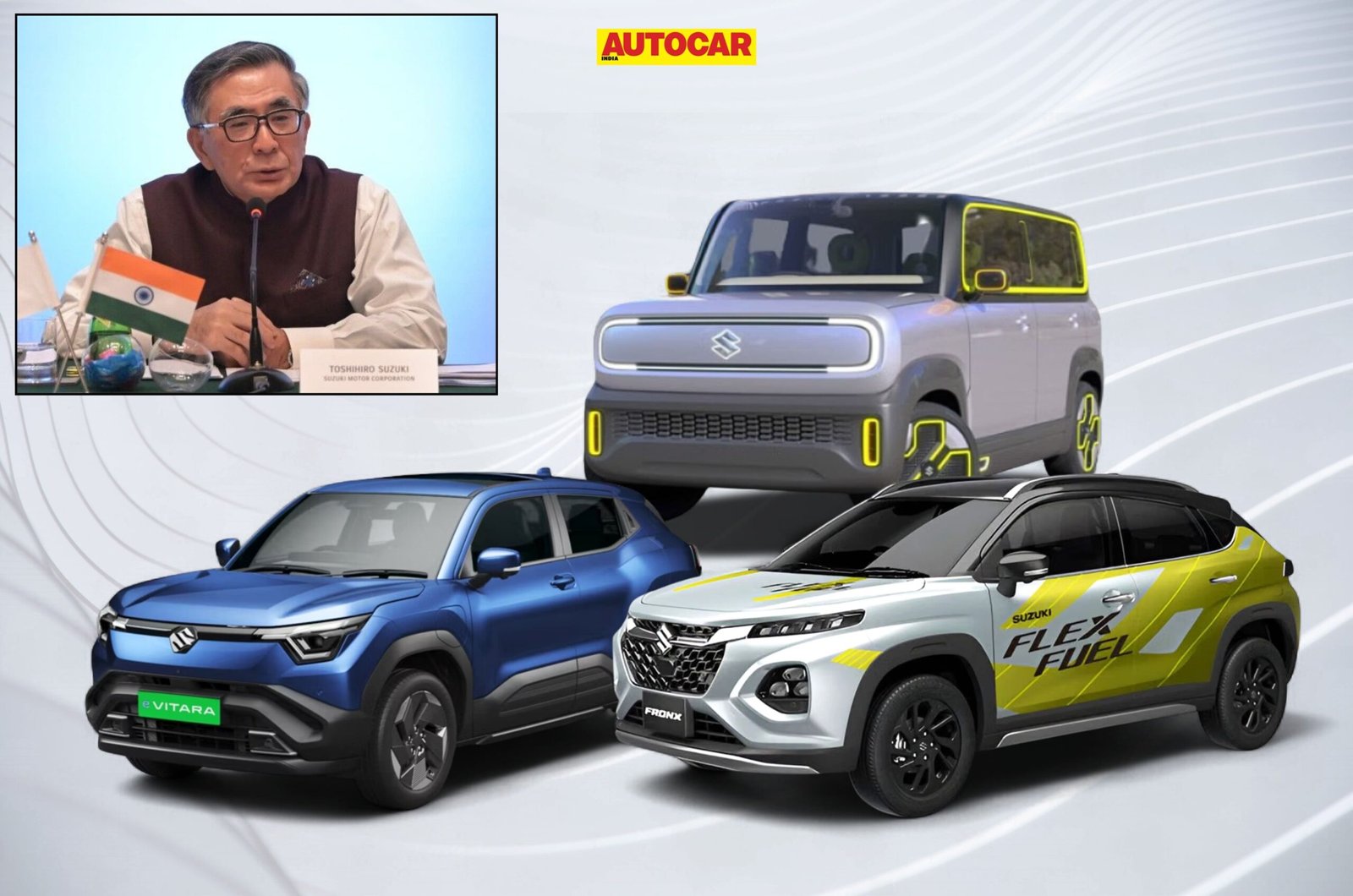
Maruti Suzuki aims to regain a 50 percent share of India’s passenger vehicle market, a level it last held in FY2018-19. Its share has since fallen to around 40 percent, as competitors capitalised on the rapid shift toward SUVs.
Toshihiro Suzuki, Representative Director and President of Suzuki Motor Corporation, said India continues to be Suzuki’s most critical market globally. “We remain committed to achieving a 50% market share and becoming number one in electric vehicle production, sales, and exports,” Suzuki told reporters on the sidelines of the Japan Mobility Show 2025.
- Small cars to remain Maruti’s foundation
- Diversified powertrain mix to bridge EV transition
- Expanding SUV and MPV portfolio
Small cars remain the core
Balancing affordability with evolving demand
Small cars remain central to Maruti Suzuki’s strategy. Managing Director & CEO Hisashi Takeuchi has said “small cars will remain our core business,” while Chairman R.C. Bhargava has reiterated that the company “will never forget customers who cannot afford expensive cars.”
Maruti is also developing a new micro SUV positioned below the Brezza to rival the Tata Punch and Hyundai Exter. The model will target budget-conscious buyers looking for SUV styling at an accessible price point. This allows Maruti to maintain its focus on affordability while adapting to changing customer preferences and regulatory requirements.
Multi-fuel, multi-powertrain strategy
CNG and hybrids to bridge the gap till EVs arrive
While several rivals are accelerating their shift to electric vehicles, Maruti Suzuki is taking a more diversified route. Its portfolio will continue to include petrol, CNG, hybrid, and flex-fuel models, alongside a gradual rollout of EVs.
The company plans to launch four electric vehicles by 2030, starting with the eVitara SUV in 2025. Until then, hybrid and CNG models are expected to account for the bulk of its sales. The Grand Vitara and Invicto already use Toyota’s strong-hybrid technology, and factory-fitted CNG options are available across most of Maruti’s high-volume models.
A flex-fuel version of the Fronx, showcased at the Japan Mobility Show 2025, is also expected to launch in India next year, capable of running on petrol with up to 85 percent ethanol content.
SUVs: The core growth driver
Expanding presence in India’s largest vehicle segment
Maruti Suzuki lost ground during India’s SUV boom, as Hyundai, Tata Motors, and Mahindra grew faster with new launches. SUVs now account for about 60 percent of passenger vehicle sales.
To address this gap, the company has lined up nine new SUVs and MPVs for launch by 2028. The plan spans sub-4-metre, midsize, and three-row models, along with EV derivatives based on the eVitara platform.
Maruti also plans to expand production capacity to four million units annually by 2030, including exports. The additional capacity will support its SUV and MPV pipeline, though sustained demand will be crucial in an increasingly competitive market.
Also see:
Toyota Land Cruiser FJ India launch in end 2028
Maruti Baleno turns 10: evolution of India’s most successful premium hatchback