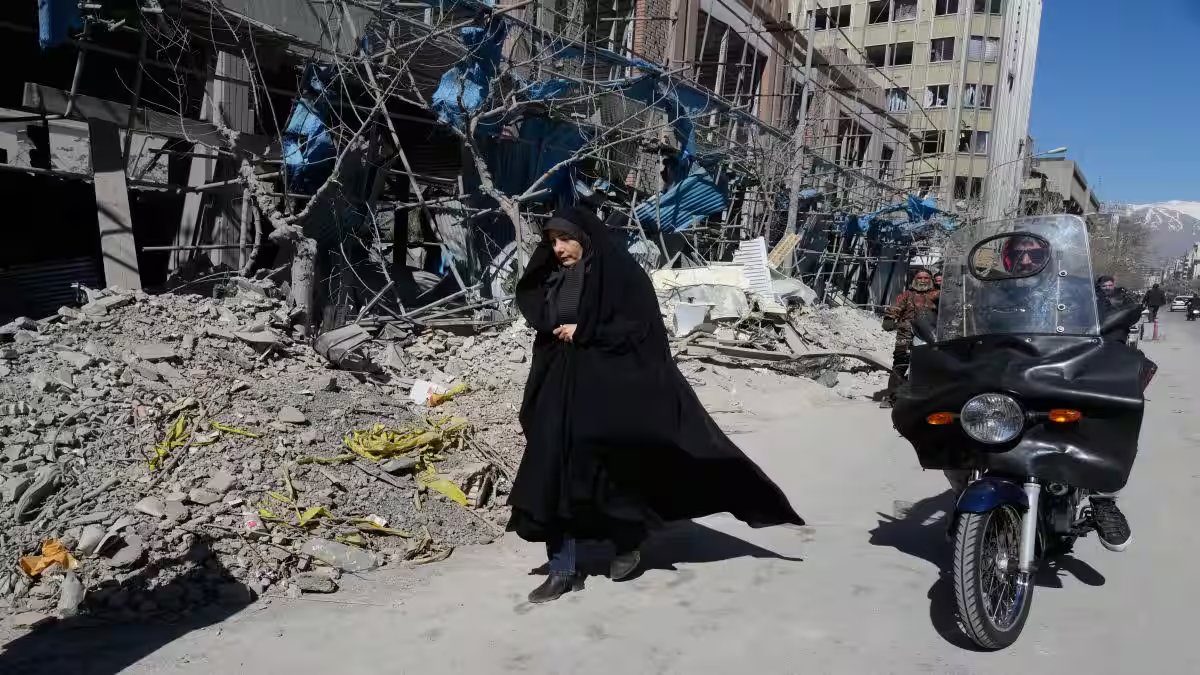
As of Wednesday (March 4) — five days since the US and Israel began bombarding Iran — 2,000 targets have been struck inside the Islamic Republic, said Washington. In fact, according to Admiral Brad Cooper, commander of US Central Command, the first day’s barrage was comparably bigger than the so-called “shock and awe” against Saddam Hussein’s Iraq in 2003.
And it’s not over yet. US President Donald Trump has warned that the campaign against Tehran could last four to five weeks, but could “go far longer than that”.
“We projected four to five weeks, but we have the capability to go far longer than that. We’ll do it … Somebody actually said, from the media, I think you’ll get bored after about a week or two. No, we don’t get bored. I never get bored, if I got bored, I wouldn’t be standing here right now. I guarantee you that. To go through what I had to go through,” said the American leader on Monday (March 2), adding later that “just about everything’s been knocked out” in Iran, including its navy, air force, and air detection, and said the attacks had killed even leaders who could have taken over.
But even as Trump boasts of the joint US-Israel strikes, there are concerns rising if America has enough ammunition stockpiles to sustain this conflict.
What are the weapons the US is deploying in Iran war?
The US military’s Central Command (Centcom) has said that a vast array of more than 20 types of
weapons systems have been used by them across the air, land, and sea in the war against Iran.
The US has deployed B-1 bombers, B-2 stealth bombers, F-35 Lightning II stealth fighters, F-22 Raptor jets, F-15s, and EA-18G Growlers. It is also using drones and long-range strike systems, including the Low-Cost Unmanned Combat Attack System (LUCAS) one-way drones, MQ-9 Reaper drones, M-142 High Mobility Artillery Rocket Systems (HIMARS), and Tomahawk Cruise Missiles.
In addition to this, the Patriot missile systems, as well as
Terminal High Altitude Area Defense (THAAD) batteries and Airborne Warning and Control System (AWACS) aircraft, have been deployed amid this war.
Two US aircraft carriers, the USS Abraham Lincoln and the USS Gerald R Ford, were in the Middle East when the attack on Iran began.
Could the US run out of weaponry?
Until now, the US, in its own words, has struck 2,000 Iranian targets with more than 2,000 munitions. “We have severely degraded Iran’s air defences and destroyed hundreds of Iran’s ballistic missiles, launchers and drones,” said Admiral Brad Cooper.
He further acknowledged that the Iranian military had launched more than 500 ballistic missiles and over 2,000 drones in response to the US and Israeli attacks. “We are seeing Iran’s ability to hit us, and our partners, is declining, while our combat power, on the other hand, is building,” Cooper claimed.
But there are concerns that if the war continues, the US would experience shortages in precision, high-end munitions, and interceptors like the THAAD. An Al Jazeera report states that as the war drags on, finite stockpiles of advanced interceptors will run down at very high cost, as each interception can cost hundreds of thousands or even millions of dollars to take down a missile that may only have cost a few thousand dollars to build.
Kelly Grieco, a senior fellow at the Stimson Center think tank who used to teach at the Air Command and Staff College, told the Wall Street Journal, “We’re using them faster than we can replace them,” when asked about the use of US’ long-range and precision missiles amid the war.
In fact, the Wall Street Journal had reported earlier that Pentagon officials and General Dan Caine, chairman of the Joint Chiefs of Staff, had warned the US president about a prolonged campaign against Iran. Moreover, according to a Washington Post report, Caine had told Trump that a lack of critical munitions and support from regional allies could hinder efforts to contain a possible Iranian retaliation in the event of an attack by the US.
What is even more concerning is that the US is already witnessing a depletion in the stocks of Standard Missile-3 (SM-3). This is primarily owing to slow production, strikes on Yemen’s Houthi rebel group, and earlier clashes with Iran.
Christopher Preble, a senior fellow at the US think tank, Stimson Center, weighed in on the issue. “It is reasonable to speculate that the pace of operations right now, in terms of numbers of interceptions, could not continue indefinitely, certainly, and perhaps could not continue for more than several weeks,” he told Al Jazeera.
He further added that the pace of manufacturing wouldn’t be able to keep up with the demands of the war. “A Patriot missile or an SM-6 … is a very complicated piece of equipment. It’s not like they’re cranking them out, hundreds or thousands a day. That’s not the pace of manufacturing.”
The US could also see a shortage of Tomahawk cruise missiles, widely known as TLAMs. “The Trump administration has fired TLAMS at an extraordinary rate in operations around the globe, in West Asia against Iran and the Houthis as well as in Nigeria on Christmas Day,” Becca Wasser, a senior fellow at the Center for a New American Security, was quoted as saying to The Wall Street Journal.
Zhang Junshe, a military affairs expert, told the Global Times on Monday that if the US maintains its current level of high-intensity bombardment, it may not be able to sustain it for too long, after which the intensity would likely decline.
What about Israel and other Gulf countries?
And it’s not just the US that is seeing a depletion of weapons.
Israel has concerns about its munitions supply as well. It is still low on Arrow 3 air-defence interceptors, said a US official. Israel is also low on air-launched ballistic missiles.
Israel is also now battling on another front, after missile strikes from the Iranian proxy
Hezbollah. If other Iran-linked militias jump into the fight, strains on US supplies will be even more severe.
Other Gulf countries could also witness a munitions crunch as Iran continues to target them. Countries such as Bahrain, Qatar, the UAE, and Saudi Arabia have been trying to intercept every projectile from Iran.
However, if the conflict drags on, these countries could change tactics, said Becca Wasser, a defence lead for Bloomberg Economics. She believes that eventually these nations may become “more selective” in what they target, potentially focusing on shooting down things like large swarms of drones or short-range ballistic missiles.
How are US officials responding?
It seems Trump is aware of the problem of dwindling US munitions. In a late-night post on Truth Social on March 2, he said that the US munitions stockpiles “have, at the medium and upper medium grade, never been higher or better” but added, “At the highest end, we have a good supply, but are not where we want to be.” However, he made it a point to blame his predecessor, Joe Biden, for not replacing weapons provided to Ukraine.
Notably, the Trump administration has called for a meeting with the biggest US defence contractors at the White House on Friday to discuss accelerating weapons production, as the Pentagon works to replenish supplies after strikes on Iran and several other recent military efforts, reported Reuters.
Companies such as Lockheed Martin and Raytheon, along with other key suppliers, have been invited to attend the meeting.
At least one of the people said the gathering was expected to focus on pressing weapons makers to move faster to boost output.
For analysts overseeing the war, the winner of this conflict would be decided by who runs out of missiles or interceptors first.
With inputs from agencies