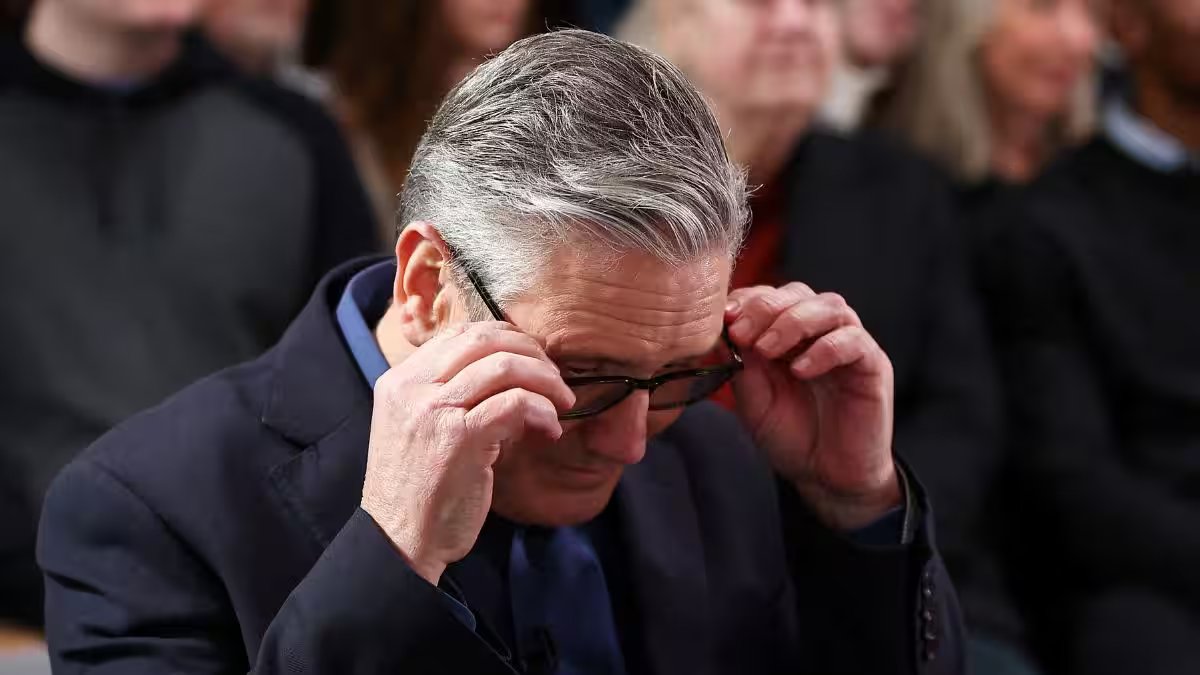
British Prime Minister Keir Starmer is confronting the gravest challenge to his leadership after his as appointment of Peter Mandelson as the United Kingdom’s ambassador to the United States was put under the lens.
Damaging revelations linked to Jeffrey Epstein, followed senior resignations inside Downing Street and internal dissent within the Labour Party has placed Starmer’s leadership under unprecedented strain less than two years after Labour returned to power.
Despite the scale of the pressure, Starmer has chosen to resist calls to step aside, telling his party and the country that he intends to fight on.
How the Epstein files crisis reached Starmer
The current turmoil has its roots in the resurfacing of documents connected to the late financier Jeffrey Epstein, whose criminal history and associations continue to reverberate across political systems on both sides of the Atlantic.
Although Starmer has repeatedly stated that he never met Epstein and is not implicated in any wrongdoing, the controversy has focused sharply on his judgment in appointing
Peter Mandelson to one of Britain’s most important diplomatic roles in 2024.
Mandelson, a senior and long-standing Labour figure, was dismissed as ambassador to Washington in September after emails emerged showing that he had maintained a personal relationship with Epstein even after Epstein’s 2008 conviction for sex offences involving a minor.
The issue escalated dramatically after US authorities released a new tranche of Epstein-related files on January 30. These documents further detailed Mandelson’s interactions. This renewed political pressure on Starmer and shifted the issue from one of individual misconduct to the
British prime minister’s leadership judgment and accountability at the highest level of government.
Starmer moved to address the fallout by apologising publicly to Epstein’s victims and acknowledged his own error in trusting Mandelson’s account of events. He said he was sorry for “having believed Mandelson’s lies.”
At the same time, he committed to publishing documents linked to Mandelson’s appointment, arguing that these would demonstrate that officials had been misled about the nature of Mandelson’s ties to Epstein.
However, the release of those documents has proven complicated. Government officials have said publication could take weeks because the material must be vetted on national security grounds and checked for any overlap with an active police investigation.
The process was further complicated when Starmer’s initial proposal for No 10 to oversee the release prompted anger among backbenchers, leading to a decision that the cross-party intelligence and security committee would instead determine what is made public.
Mandelson is now facing a police inquiry that relates to documents suggesting he may have passed sensitive government information to Epstein more than a decade ago, including material connected to discussions around possible UK asset sales and tax changes during the global financial crisis.
The offence under investigation carries a maximum sentence of life imprisonment. Mandelson has not been arrested or charged, and no allegations of sexual misconduct have been made against him. He has also not commented publicly on the claims.
How Starmer’s chief of staff took the fall
On Sunday, Starmer’s chief of staff, Morgan McSweeney, resigned after accepting responsibility for advising the prime minister to appoint Mandelson. In a statement, McSweeney said he “advised the prime minister to make that appointment, and I take full responsibility for that advice.”
McSweeney’s departure marked a significant moment for the Labour leadership. He had been Starmer’s most influential aide since 2020 and
was widely regarded as a central architect of Labour’s landslide general election victory in July 2024.
His role in shaping Labour’s campaign strategy and organisational discipline made him one of the most powerful figures in the prime minister’s inner circle.
However, McSweeney had also become a lightning rod for criticism within the party, with some Labour figures blaming him for a series of political misjudgements and communications failures since the election.
His resignation was followed swiftly by that of Tim Allan, Starmer’s communications chief, compounding the sense of instability at the top of government and leaving the prime minister without two of his most senior advisers in the space of days.
Senior Labour MP Emily Thornberry described McSweeney as a “divisive figure” and said his departure created an opportunity for a reset. She also commented on Starmer’s leadership style, saying he is “a good leader in that he is strong and clear. I think that he needs to step up a bit more than he has.”
Others within the party, however, warned that losing McSweeney risked leaving Starmer weakened and isolated at a critical juncture.
How internal Labour dissent shook Starmer
The pressure only heated up further when Anas Sarwar, leader of the Scottish Labour Party, publicly called on Starmer to resign, becoming the most senior Labour figure to do so.
Speaking at a press conference, he said “there have been too many mistakes” and argued that “the distraction needs to end and the leadership in Downing Street has to change.”
Sarwar said his decision had been made “with a heavy heart,” citing the need to defend Scotland’s political interests at a time when Labour’s support north of the border has declined since the 2024 election.
His intervention added to an already febrile atmosphere in Westminster, where MPs were openly questioning the prime minister’s judgment and authority.
Starmer
responded by refusing to accept the calls to quit. Addressing Labour MPs behind closed doors in Parliament on Monday evening, he adopted a combative tone.
“Every fight I have ever been in, I’ve won,” he told the meeting. He also made clear that he had no intention of stepping away from office, saying, “I’m not prepared to walk away from my mandate and my responsibility to my country.”
In a broader statement, Starmer framed the crisis as a test of resolve not just for himself but for the Labour government as a whole. He warned against plunging the country into instability and argued that his focus remained on preventing the rise of the hard-right Reform UK party.
How UK Cabinet members backed Starmer
Despite visible divisions, Starmer
received backing from senior members of his Cabinet and from figures seen as potential leadership contenders. UK Deputy Prime Minister David Lammy urged unity, writing on X, “We should let nothing distract us from our mission to change Britain and we support the Prime Minister in doing that.”
UK Foreign Secretary Yvette Cooper echoed the sentiment, saying, “At this crucial time for the world, we need his leadership not just at home but on the global stage.”
Angela Rayner, a former deputy leader and widely viewed as a possible successor, also moved to support Starmer publicly. She said he “has my full support” and later added on X, “I urge all my colleagues to come together, remember our values and put them into practice as a team. The Prime Minister has my full support in leading us to that end.”
Labour MPs who attended the closed-door meeting said the prime minister managed to stabilise the mood in the room. Chris Curtis acknowledged that the session was tense but said, “Of course, there were tough moments. But he really brought the room round.” Another MP told Reuters bluntly that “he [Starmer] is safe for now.”
A Downing Street spokesperson stated that Starmer had “a clear five-year mandate from the British people to deliver change, and that is what he will do.”
How Opposition attacked Starmer
Conservative leader Kemi Badenoch accused Starmer of repeated failures and questioned his ability to govern. She said the prime minister “has made bad decision after bad decision” and argued that “his position now is untenable.”
In a separate interview with Sky News, she added, “He’s like a plastic bag blowing in the wind. We need him to get a grip and if he can’t do it then someone else in the Labour Party needs to do that, or they should have an election.”
Starmer has sought to shift attention toward what he describes as a broader political battle against Reform UK, which has been polling ahead of Labour in several surveys.
He warned that the party’s agenda would “tear this beautiful country apart,” and described the campaign to defeat it as “the fight of our times.” He told MPs, “As long as I have breath in my body, I’ll be in that fight.”
Labour’s continued struggle in the polls, along with its inability so far to reverse economic stagnation, had already prompted quiet discussion of a leadership challenge even before the Mandelson revelations emerged.
Why Labour wants to avoid a change in leaders
Under the UK’s parliamentary system, a change of prime minister does not automatically require a general election. If Starmer were to resign or face a successful internal challenge, the Labour Party would hold a leadership contest, with the winner assuming the role of prime minister.
The prospect has revived memories of recent Conservative instability. Between the 2019 and 2024 general elections, the Conservatives cycled through three prime ministers, including Liz Truss, whose tenure lasted just 49 days.
Starmer had campaigned on a promise to end the political chaos of those years, positioning Labour as a force for stability.
Labour MP Clive Efford warned colleagues against repeating what he described as the Conservatives’ mistakes. He said critics should “be careful what you wish for,” telling BBC, “I don’t think people took to the changes in prime minister when the Tories were in power. It didn’t do them any good.”
What next for Starmer-led Labour
Although Starmer has survived the immediate threat to his leadership, a series of looming events could yet prove decisive. A by-election scheduled for February 26 in a Manchester seat that Labour won comfortably in 2024 now carries the risk of a damaging result.
There is a real prospect that Labour could finish behind both the Greens and Reform UK, a scenario that would only increase pressure on the prime minister.
UK Chancellor Rachel Reeves, a key Starmer ally, is preparing to deliver a spring statement on March 3. She is keen to avoid the leaks and reversals that undermined the autumn budget and has stressed the need to project “stability and certainty” to financial markets.
There have been reports that she faces pressure to delegate the statement to a junior minister to downplay its significance.
Beyond Westminster, elections scheduled for May 7 — covering local councils, the Scottish Parliament and the Welsh Senedd — are widely regarded as the most serious electoral test of Starmer’s leadership to date.
With the prime minister recording the lowest approval rating of any serving leader, expectations within Labour are low.
Policy challenges also remain acute. A schools white paper expected later this month is set to outline Labour’s plans for special educational needs provision in state schools, an area already under intense financial strain.
Spending on SEND (Special Educational Needs and Disabilities) is projected to reach £14 billion within two years, and warnings have been issued that the escalating costs could bankrupt four out of five English councils.
For now, Keir Starmer remains in office, having weathered a storm that threatened to engulf his leadership. By accepting responsibility, removing senior aides, apologising publicly and securing visible backing from his cabinet, he has managed to buy himself time.
With inputs from agencies
End of Article