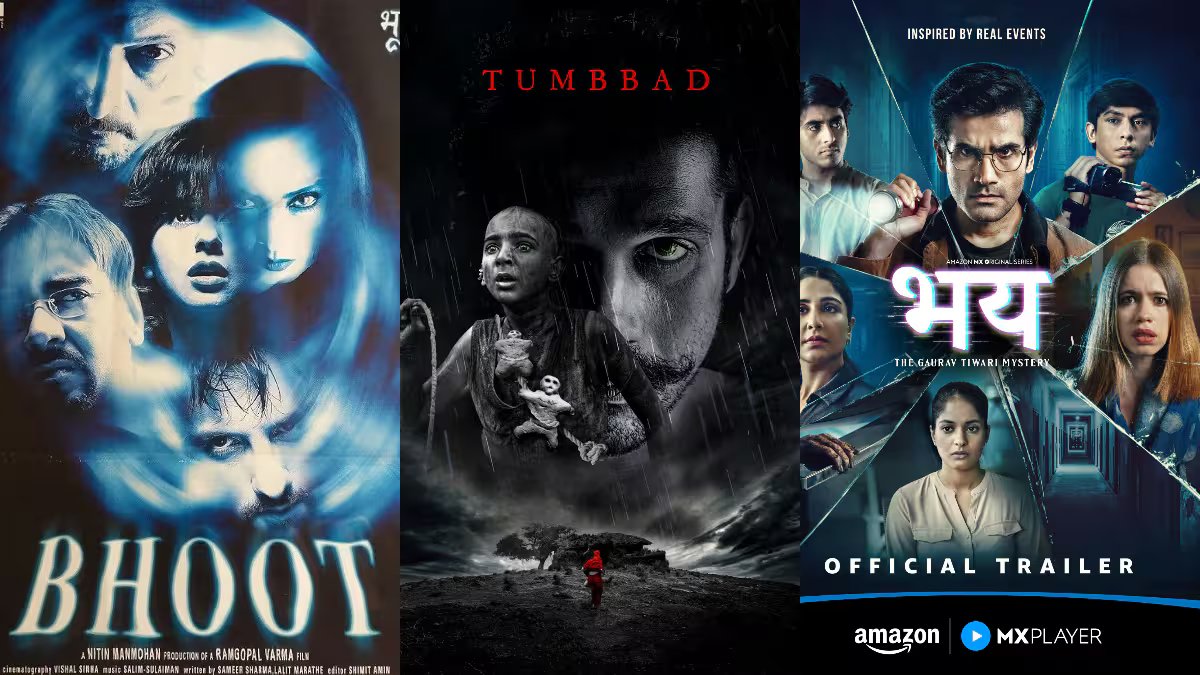
Over the last many years, the landscape has evolved, changed, and become a lot more classy and coherent
Indian horror has never been about monsters alone. At its best, it has reflected society’s deepest fears of the unknown, faith, isolation, guilt, and of what lies beyond death. While the genre has often been misunderstood or reduced to clichés, a handful of landmark films and series have changed the perception of horror entirely, leaving behind cultural impact, cult followings, and creative benchmarks.
Over the last many years, the landscape has evolved, changed, and become a lot more classy and coherent. The frames have improved and the stakes have gone higher. Since the dawn of cinema, here are the horror monikers that stood the test of time and pushed the envelope of the genre:
Veerana (1988) directed by Ramsay Brothers, this theatrical film became a Cult Phenomena. It became one of the most iconic horror films of its time, blending sensuality, supernatural terror, and gothic imagery. The film introduced an unforgettable female antagonist and cemented the Ramsay Brothers’ place as pioneers of Indian horror. Despite limited resources, Veerana achieved something rare — it entered pop culture memory. Even decades later, its imagery, music, and atmosphere are instantly recognisable, making it one of the earliest films to prove that horror could command loyal audiences in India.
Raat (1992) , directed by Ram Gopal Varma this film had a Critical Reappraisal of Horror & it changed the grammar of Indian horror. Stripped of excess, it relied on realism, silence, and everyday settings. There were no elaborate sets or exaggerated performances, just a creeping sense of dread that felt disturbingly real. The film proved that horror could be psychological, restrained, and intelligent, influencing an entire generation of filmmakers and redefining how fear could be portrayed on screen.
“Kaun (1999)”, directed by Ram Gopal Varma, this film serves as a Psychological Horror Masterclass. Set almost entirely inside a single house with just three characters, Kaun dismantled traditional horror tropes. It replaced ghosts with paranoia, unpredictability, and moral ambiguity. The film demonstrated that true horror lies in the human mind, and that minimalism, when executed with precision, can be more terrifying than spectacle. It remains one of the most studied psychological thrillers in Indian cinema.
“Bhoot (2003)”, directed by Ram Gopal Varma, this theatrical film had a Mainstream Revival of Horror. At a time when horror had slipped into formula, Bhoot brought credibility back to the genre. Set in a modern urban environment, it told a deeply emotional story of loss, possession, and unresolved trauma. The film’s grounded performances and absence of typical horror clichés made it a commercial and critical success. Bhoot proved that serious horror could work with mainstream audiences, opening doors for future theatrical horror films.
“
Tumbbad (2018)”, directed by Rahi Anil Barve, this film had a Global Recognition for Indian Horror. Tumbbad is widely regarded as a milestone in Indian cinema. Rooted in folklore and mythology, it explored greed, legacy, and moral decay through stunning visuals and atmospheric storytelling. The film gained international acclaim, festival recognition, and long-term audience appreciation. It proved that Indian horror could be cinematically ambitious, culturally rooted, and globally respected without compromising its soul.
“Brahmayugam (2024)”, directed by Rahul Sadasivan, this film redefined regional Horror. The Malayalam-language horror film elevated folklore into philosophical terror. Set in a stark, period world, Brahmayugam used atmosphere, performance, and existential dread rather than conventional scares. It reinforced how regional cinema continues to push boundaries, proving that horror deeply rooted in culture and history resonates powerfully with audiences.
“
Bhay – The Gaurav Tiwari Mystery (2025)” , directed by Robbie Grewal & created by Almighty Motion Picture, this web series released on Amazon MX Player and had a massive impact on the audience for its Authentic Paranormal Storytelling.
Bhay – The Gaurav Tiwari Mystery marked a significant shift in Indian horror on OTT. Based on real investigations and inspired by the life of India’s most respected paranormal investigator Gaurav Tiwari, the series approached horror with sincerity, restraint, and emotional depth.
End of Article