West Asia and its adjoining strategic theatres are witnessing a gradual reordering of security alignments.
This transformation is not being announced through formal treaties or grand summits, nor is it framed in ideological declarations.
Instead, it is unfolding through carefully calibrated defence engagements, and strategic signalling among key regional and extra-regional players.
At the centre of this evolving landscape are two emerging security currents.
One involves India, the United Arab Emirates (UAE) and Israel — a grouping built on defence capability, technological integration and shared threat assessments.
The other revolves around Pakistan and Saudi Arabia, with Turkey frequently mentioned as a potential pillar, and is often described by analysts as an “Islamic Nato”.
This realignment is taking place against a backdrop of changing global power dynamics. With the United States under President Donald Trump adopting a more inward-looking posture
and treating alliances as transactional arrangements, long-held assumptions about external security guarantees in West Asia are being reassessed.
As Washington focuses increasingly on tariffs, border control and hemispheric priorities, regional actors are adjusting to a world in which they must shoulder greater responsibility for their own security.
A six-hour journey for a three-hour engagement
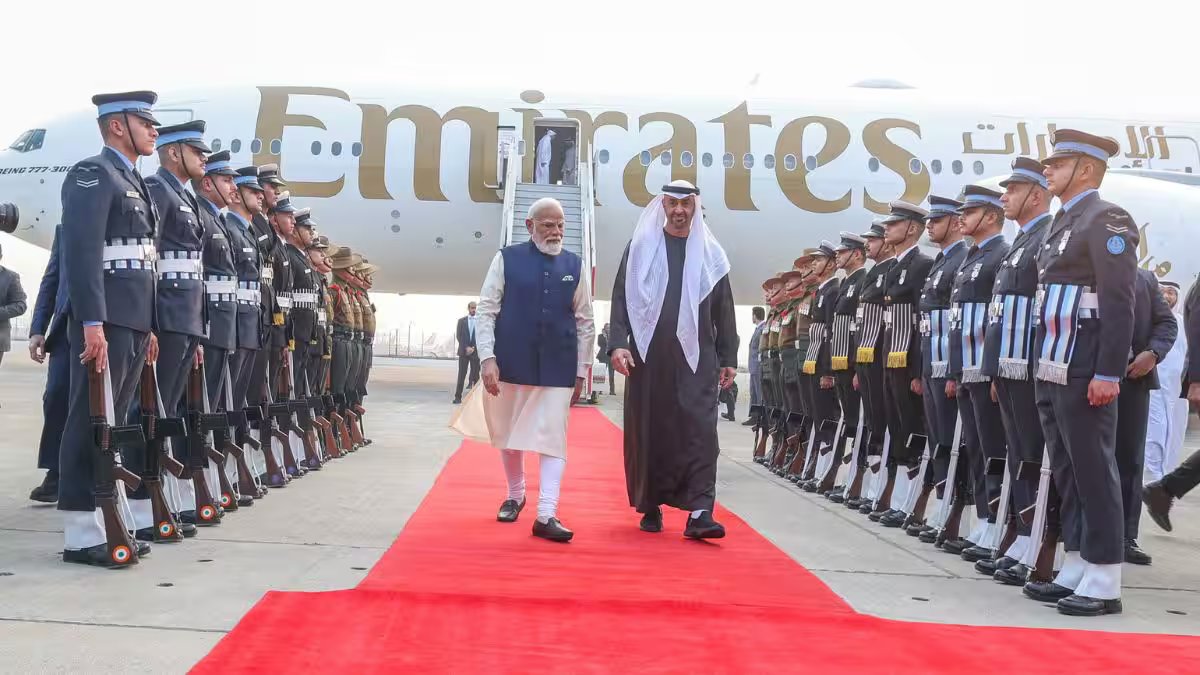
One of the most striking signals of this shift came earlier this week, when UAE President Sheikh Mohamed bin Zayed Al Nahyan made a brief but highly consequential visit to New Delhi.
The trip lasted just three hours, during which Sheikh Mohamed bin Zayed Al Nahyan met Prime Minister Narendra Modi, held discussions on bilateral and regional issues,
signed a defence-related understanding, and departed the same day.
Despite its brevity, the visit resulted in India and the UAE announcing their intention to finalise a “framework agreement” for a strategic defence partnership.
This marked Sheikh Mohamed bin Zayed Al Nahyan’s
fifth visit to India in the past decade.
Central to the visit was the signing of a “letter of intent”, which observers believe goes well beyond symbolism. According to analysts, this document could form the basis of a structured India-UAE defence cooperation agreement, with the potential for expansion to include Israel at a later stage.
While New Delhi has publicly maintained that it is not forming any formal geopolitical bloc, the direction of its defence and strategic engagements points to a deliberate and pragmatic alignment.
What is driving India’s strategic concerns
A key concern for New Delhi is the expanding influence of Pakistan within certain segments of the Islamic world and the emergence of what is often referred to as an Islamic or Muslim Nato.
This concern has been sharpened by developments in Saudi Arabia’s defence posture. While
the specifics of nuclear cooperation remain unclear, Pakistan’s Defence Minister Khwaja Asif has stated that Saudi Arabia may seek assistance from Pakistan’s nuclear arsenal.
Such statements have added to apprehensions about the strategic implications of deepening Saudi-Pakistani defence ties.
At the same time, India has been steadily strengthening its relationship with Israel. While New Delhi continues to formally support a two-state solution to the Palestinian question, its cooperation with Israel has expanded significantly in recent years.
Media reports have suggested that India supplied missiles to Israel during its recent conflict with Hamas. More broadly, India-Israel collaboration spans counterterrorism, cyber security, maritime security, defence manufacturing and advanced technology.
India also sees Israel as a critical partner in areas beyond hard security, including trade corridors, food security and the energy transition.
There is also an understanding that closer coordination among India, Israel and the UAE could be complemented by the United States, effectively reinforcing the I2U2 framework without creating a formal military alliance.
How an India-UAE-Israel defence bloc is built on capability
Italian political advisor and author Sergio Restelli, writing in a
blog on The Times of Israel on Tuesday, argues that West Asia is reorganising itself along hard security lines.
Beneath the rhetoric of neutrality and non-alignment, he identifies two distinct defence architectures shaped by sharply different worldviews.
“At the heart of one stands the growing strategic alignment between India, the United Arab Emirates, and Israel reinforced by the brief but significant visit of Mohamed bin Zayed to New Delhi. Opposite it is a looser but ideologically coherent bloc centred on Pakistan and Saudi Arabia, with the potential inclusion of Turkey and Egypt.”
Restelli emphasises that this emerging configuration does not resemble Cold War-era alliances. “This is not a return to Cold War binaries. It is something more fluid, more transactional, and in many ways more dangerous.”
According to Restelli, the India-UAE defence partnership reflects a pragmatic assessment of today’s security environment.
Rather than relying on symbolic guarantees, it is grounded in tangible cooperation, including joint military exercises, defence industrial collaboration, maritime security in the Arabian Sea, intelligence sharing, and engagement in emerging domains such as cyber and space.
For India, the UAE is far more than an energy supplier or financial hub. It occupies a critical position in the security of the Indian Ocean and the Gulf, through which India’s trade flows, diaspora movements and energy supplies pass.
For Abu Dhabi, India offers scale, technological depth and strategic reach without the ideological conditions often associated with Western security arrangements.
How Israel’s role is vital in the equation
Restelli describes Israel’s involvement as structural rather than incidental, noting that the India-UAE defence relationship is intertwined with a broader trilateral convergence involving Jerusalem.
India and Israel already maintain one of the world’s most extensive defence technology relationships, covering missiles, drones, air defence systems, electronic warfare capabilities and intelligence platforms.
The UAE’s decision to normalise relations with Israel transformed what had been largely bilateral cooperation into a wider regional force multiplier.
“This is not about public symbolism or photo-ops. It is about integrated security thinking,” Restelli writes.
He notes that India, the UAE and Israel face overlapping threats, including state-sponsored militancy, drone and missile proliferation, maritime disruption, and the use of ideology by non-state actors.
Their cooperation is rooted in a shared belief that deterrence, technological superiority and intelligence fusion are essential for long-term stability.
For Israel, this alignment embeds it within a broader Asian-West Asian security framework, reducing isolation and weakening the effectiveness of traditional pressure campaigns.
For India, it allows Israeli innovation to be integrated into a Gulf security environment that directly affects Indian interests. For the UAE, it anchors national security partnerships around stability rather than revolutionary ambition.
How the Pakistan-Saudi axis has its limitations
In contrast, the emerging defence understanding between Pakistan and Saudi Arabia operates on a different logic. According to Restelli, it is driven less by integrated operational capability and more by political signalling and regime security.
Pakistan offers trained military manpower, nuclear deterrence by association, and ideological credibility within parts of the Muslim world. Saudi Arabia contributes financial resources, strategic geography and religious legitimacy.
Speculation around this axis intensified following the signing of a Strategic Mutual Defence Agreement between Riyadh and Islamabad in 2025. The agreement, reportedly inspired by
Nato’s Article 5, treats an attack on one party as an attack on both.
For Saudi Arabia, this marked a departure from decades of near-exclusive reliance on US security guarantees.
For Pakistan, it represented a diplomatic boost after international isolation deepened due to repeated terror incidents and
a costly military clash with India in May 2025.
Turkey’s reported interest in joining such a framework added both symbolism and potential military scale.
Under President Recep Tayyip Erdogan, Ankara has pursued strategic autonomy, balancing Nato membership with independent military interventions and a growing defence export industry.
A trilateral arrangement could, in theory,
combine Saudi financial power, Turkish military technology, and Pakistani nuclear and missile capabilities.
However, analysts point to deep contradictions within this proposed grouping. Saudi Arabia and Turkey are regional rivals, with opposing stances on Libya, the Muslim Brotherhood and leadership of the Muslim world.
Their divergent visions have also been evident within the Organisation of Islamic Cooperation, where both compete for influence.
Saudi Arabia has additionally distanced itself from Pakistan’s position on Jammu and Kashmir. These differences raise questions about the coherence and sustainability of any putative Islamic Nato.
Saudi Arabia’s substantial economic exposure to India also complicates any overt tilt towards Pakistan at New Delhi’s expense. Saudi investments in India exceed $20 billion, with plans to reach $100 billion by 2030.
Analysts note that jeopardising these investments by alienating India appears unlikely, limiting Riyadh’s willingness to fully align with Pakistan on contentious issues.
How Pakistan is the weakest link
Multiple analysts argue that Pakistan represents the most fragile component of the proposed Pakistan-Saudi-Turkey axis.
Its economy is under severe strain, defence exports have struggled to find buyers, and persistent associations with extremist groups have damaged its international credibility.
Even within the Muslim world, enthusiasm for Pakistan assuming a leadership role remains limited. Several Gulf states are reportedly wary of being drawn into Islamabad’s disputes with India or its ideological narratives under army chief Asim Munir.
Munir’s frequent references to Islamic destiny and civilisational struggle may resonate domestically, but they have unsettled potential partners focused on economic stability, trade and investment.
Critics suggest that the Islamic Nato concept functions more as a political narrative aimed at obscuring Pakistan’s economic vulnerability than as a viable collective security mechanism.
How the India-UAE-Israel alignment can extend westward
The India-UAE-Israel alignment is not confined to West Asia alone. It extends into the eastern Mediterranean, where Israel, Greece and Cyprus have increased coordination to counter Turkey’s assertiveness over maritime boundaries and energy resources.
India’s growing engagement with Greece and Cyprus adds a new strategic dimension. Participation in trilateral and “3+1” formats signals New Delhi’s interest in securing its western maritime approaches and protecting trade routes linked to the India-Middle East-Europe Economic Corridor (IMEEC).
For Athens and Nicosia, India’s involvement provides diplomatic weight and strategic depth in their dealings with Ankara.
With inputs from agencies
End of Article