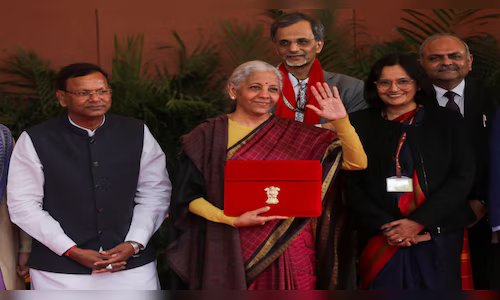
Finance Minister Nirmala Sitharaman on Thursday rejected Opposition claims that the middle class is being squeezed, saying rising personal income tax collections reflect expansion and formalisation of the economy — not suppression.
Replying to the debate on the Union Budget 2026-27 in the Rajya Sabha, Sitharaman said there is “no evidence” of middle-class distress and instead pointed to what she described as a historic widening of the tax base over the past decade.
The Opposition had argued that the middle class was being “sandwiched” between the rich and the poor, citing the fact that personal income tax collections have exceeded corporate tax revenues. Sitharaman said such a conclusion was misplaced.
“High personal income tax collection is not necessarily the middle class being crushed,” she said, adding that more people now have taxable incomes and more earnings are visible within the formal economy.
According to the Finance Minister, the number of taxpayers — including those filing returns or having tax deducted at source — rose from 5.26 crore in 2013–14 to 12.13 crore in 2024–25. Over the past 11 years, the taxpayer base has doubled, growing at a compound annual rate of 7.9 per cent.
“This is the largest structural expansion of the middle class in this country,” she said. “If the tax net itself is widening, it is not because of suppression. People are coming on board to pay.”
Sitharaman also highlighted changes in income tax slabs, noting that the income tax exemption limit has been raised to ₹12 lakh under the new regime and to ₹12.75 lakh for salaried individuals after accounting for the standard deduction. “If someone earning up to ₹12.76 lakh in the salaried class does not have to pay tax, where is the suppression?” she asked.
She said the new tax regime has simplified compliance and reduced due diligence requirements. In addition, GST rationalisation has lowered rates on several household items, helping ease monthly expenses. Inflation, she added, is at a historic low.
“Middle-class suppression cannot coexist with rising real incomes and record-low inflation,” Sitharaman said, asserting that the economy is witnessing upward mobility and broader participation.
Turning to broader economic issues, the Finance Minister said the country is going through a “rare phase” of macroeconomic balance, marked by steady GDP growth alongside low inflation. She dismissed suggestions that the economy is faltering, saying such criticism undermines the efforts of citizens contributing to growth.
On fiscal management, Sitharaman rejected charges of excessive borrowing and said the Centre’s funds are “not a free pool of cash” but the hard-earned money of citizens. She said the government would not “squander” public funds merely to meet artificial deadlines.
Responding to concerns about welfare spending, she said there has been no denial or stoppage of funds to states under central schemes. Comparing unspent allocations, she said ₹37,000 crore remained unused across 14 social sector schemes in the last decade, against ₹94,000 crore during the UPA years.
The minister also said that over ₹48 lakh crore has been transferred directly to beneficiaries’ accounts through Direct Benefit Transfer (DBT), resulting in savings of ₹4.31 lakh crore by plugging leakages.
Highlighting new initiatives, Sitharaman said the 2026–27 Budget proposes the setting up of an ‘Education to Employment and Enterprise’ Standing Committee aimed at preparing youth for opportunities in the services sector.
“The Budget is not forgetful of the past,” she said, referring to what she described as the fragile macroeconomic conditions and double-digit inflation seen earlier. “Today, inflation is under control — not by chance, but by strategy.”