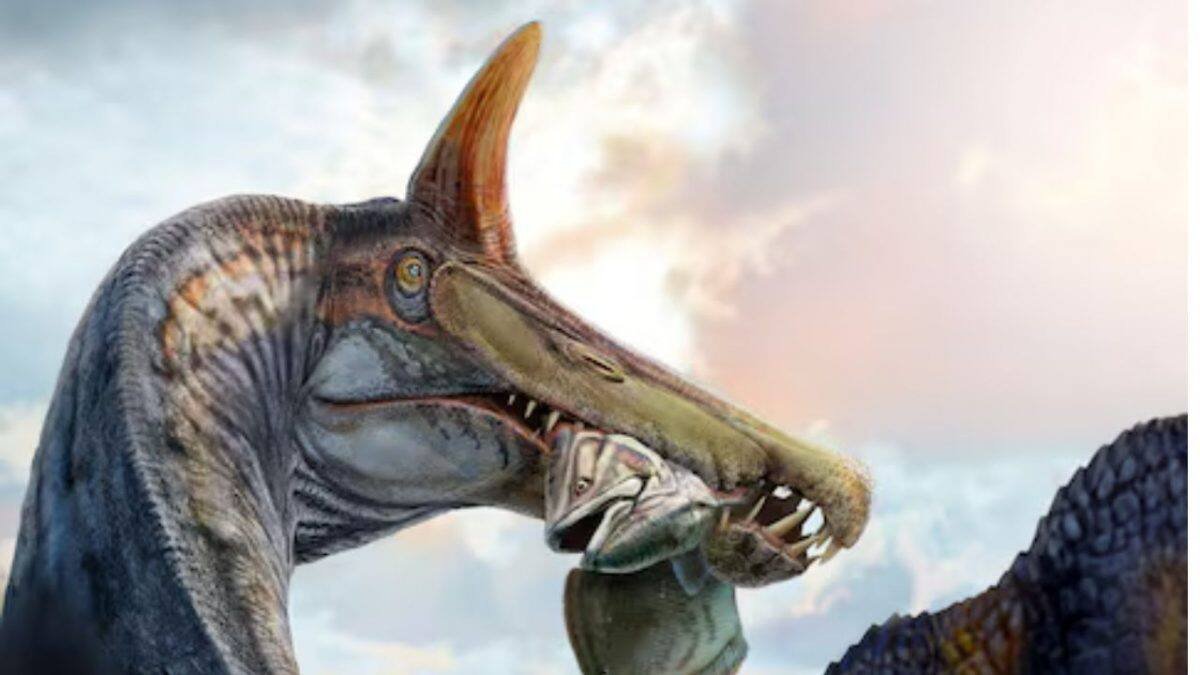
Deep in the remote desert of Niger, paleontologists have uncovered the remains of Spinosaurus mirabilis, a 12 metre long predator that dominated the river systems of the Cretaceous Period.
Deep within the sun scorched expanse of the Sahara, where the shifting sands of Niger now rule the landscape, a monumental discovery has rewritten the history of the Cretaceous Period. Paleontologists have unearthed the remains of a formidable new predator, a second species of the famous Spinosaurus that once patrolled the ancient waterways of Africa roughly 95 million years ago.
This discovery provides a vivid window into a lost world where massive, sail backed reptiles ruled the riverbanks, acting as apex predators in a lush, forested environment that has long since vanished.
A magnificent new species from the desert
The newly identified dinosaur has been named Spinosaurus mirabilis, a title that translates to “astonishing spine lizard.” This moniker is a direct nod to the creature’s most distinctive feature: a massive, blade like bony crest atop its skull. Standing approximately 20 inches tall, this crest resembles a curved scimitar and sets the animal apart from its famous relative, Spinosaurus aegyptiacus.
While the latter was first documented in 1915 using fossils from Egypt, S. mirabilis boasts a more elongated snout and longer hind limbs, suggesting a slightly different physical profile as it navigated the inland rivers of prehistoric Niger.
The lifestyle of a hell heron
Measuring a staggering 12 metres in length and weighing up to 7 tonnes, this carnivore was a true giant, rivaling the likes of Tyrannosaurus and Giganotosaurus in scale. However, its hunting methods were uniquely specialised. Researchers have likened the beast to a “hell heron” because of its tendency to wade into shallow waters to snare prey.
Its nostrils were positioned further back on the skull than those of most dinosaurs, allowing it to submerge its snout to track fish while continuing to breathe. This adaptation, combined with interlocking conical teeth, created a biological “fish trap” perfectly suited for seizing slippery coelacanths.
The purpose of the scimitar crest
Despite its intimidating appearance, the solid bone crest of S. mirabilis was likely not a weapon. Because the structure was relatively fragile and probably encased in a layer of keratin, scientists believe it served as a visual signal.
It may have been brightly coloured to attract mates or ward off rivals. Paul Sereno, a lead researcher from the University of Chicago, noted that the feature was likely central to the animal’s social life. He remarked, “It’s about love and life – attracting a mate, defending your hot feeding shallows. What else could be more important?”
Challenging the aquatic theory
For years, the scientific community has debated whether Spinosaurus was a fully aquatic pursuit predator that swam in the open ocean. However, the discovery of S. mirabilis hundreds of kilometres away from any ancient coastline suggests a different story.
Finding these fossils so far inland indicates that these dinosaurs were semi aquatic waders rather than deep water swimmers. Sereno described the find as “the coup de grâce for the aquatic hypothesis,” firmly placing the animal in the shallows of inland river systems.
A difficult journey to the Jenguebi site
Unearthing these fossils was no simple feat. The research team travelled in a convoy from Agadez, navigating treacherous sand dunes for three days to reach the remote site of Jenguebi. Their persistence resulted in the recovery of three skulls and various skeletal remains.
According to Daniel Vidal, the species shows “some of the most extreme piscivorous adaptations of any dinosaur,” proving it was a master of its watery domain. As Spinosaurus steps out of the shadow of other famous meat eaters, Sereno aptly summarised the excitement surrounding the find, calling it a “dino-happening.”
End of Article


